RAG Chunk Estimator
Rag Context Chunk Token Estimator helps estimate RAG context tokens, chunk capacity, overlap, and reserved output space for better prompt planning.
Result
No estimate yetLocal math: heuristic token estimate via LLMTokenCore; utilization assumes a 128k context window. How was this calculated? Chunks = ceil((tokens − overlap) / (size − overlap)).
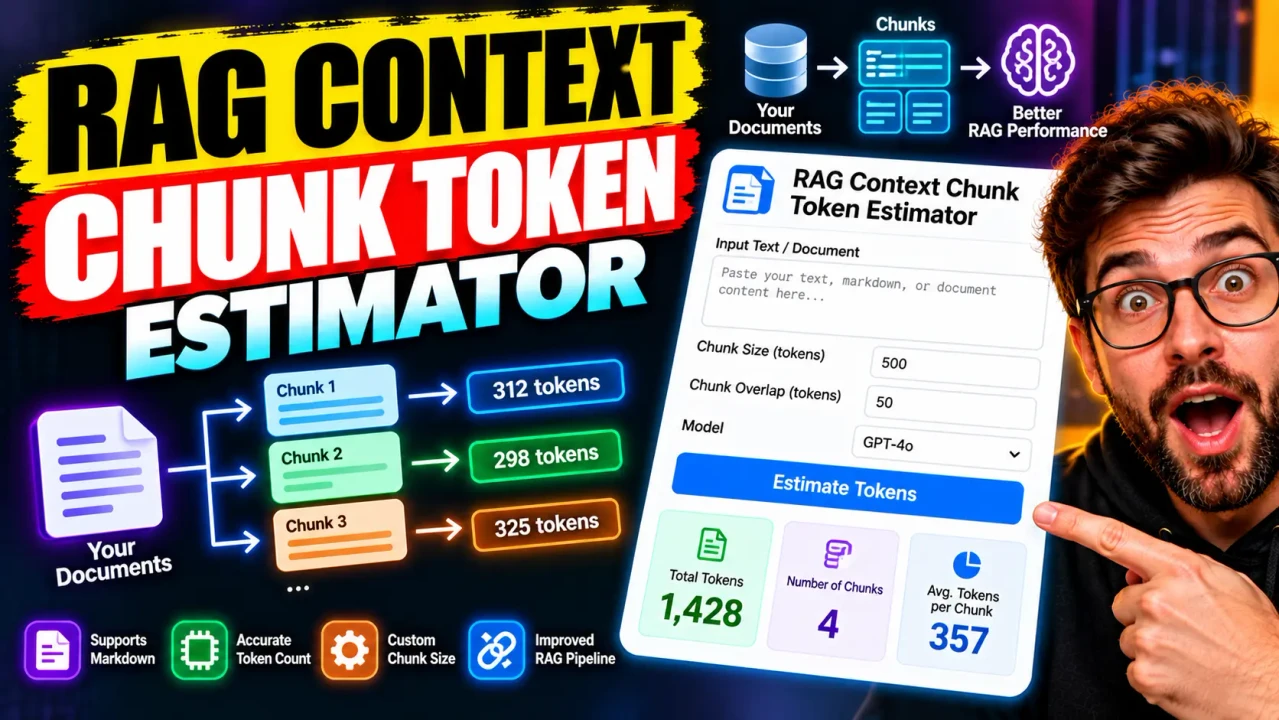
Rag Context Chunk Token Estimator
TL;DR Summary
The Rag Context Chunk Token Estimator is intended to help estimate how retrieved RAG context fits within an LLM token budget, using chunk and context-size assumptions; it should be treated as a planning estimate rather than an exact tokenizer result. The supplied tool materials do not document how entered data is processed or stored, so avoid entering sensitive information unless the page clearly explains its data handling.
Retrieval-augmented generation, or RAG, adds information retrieved from documents to an AI model's context before the model generates an answer. That makes token planning important. If retrieved chunks are too large, too numerous, or combined with a large prompt and output allowance, the total context can exceed the model's available context window.
The Rag Context Chunk Token Estimator is designed for this planning problem. It helps users reason about the relationship between chunk size, chunk count, overlap, available context, and tokens reserved for other parts of a request. The goal is not to replace a provider's tokenizer or an application's final token counter. Instead, it provides a practical way to estimate how much retrieved context can fit before a RAG request is assembled.
This can be useful for developers building RAG pipelines, AI application engineers, prompt engineers, technical teams testing retrieval settings, and anyone tuning document chunking for an LLM workflow. A common RAG pipeline retrieves several chunks, combines them with instructions and a user question, and sends that combined context to a model. The total token budget therefore depends on more than the size of one document chunk.
What the estimator is for
The main problem is simple: a RAG system needs enough retrieved information to answer a question, but the retrieved information must fit inside the model's available context. A chunking strategy that looks reasonable by itself can become too large when several chunks are retrieved at once.
For example, suppose a system uses a target chunk size of 500 tokens and retrieves 8 chunks. The raw chunk allowance is approximately:
500 × 8 = 4,000 tokens
If the chunks overlap, however, the effective amount of source text represented across those chunks can be different from a simple non-overlapping calculation. The application may also need room for a system prompt, user question, metadata, retrieved-document labels, conversation history, and the model's response.
This is why context planning should consider the complete request rather than only the chunk size.
Inputs and planning variables
The exact production fields for the Toolhox implementation are not exposed in the supplied material. The calculator-generation documentation requires the actual implementation to define its supported fields and formulas, while also warning against inventing inputs that are not required by the calculation. :contentReference[oaicite:0]{index=0}
For a standard RAG context chunk estimator, the relevant planning variables may include the model's available context budget, desired chunk size, number of retrieved chunks, chunk overlap, and tokens reserved for instructions, conversation content, or model output. These should only be presented as calculator inputs if they are actually implemented by the tool.
Users should also distinguish between estimated tokens and tokenized tokens. Character-count or rule-of-thumb estimates can differ from the exact count produced by a particular model tokenizer. Code, JSON, punctuation-heavy text, non-English text, and other content types can change token density. A current third-party token-estimation reference similarly notes that different providers can tokenize the same text differently. :contentReference[oaicite:1]{index=1}
How to Use
- Step 1: Enter the context-budget and chunking values requested by the calculator, using the units shown beside each field.
- Step 2: Enter the number of retrieved chunks or other retrieval values if the tool provides those fields.
- Step 3: Include any reserved tokens for prompts, conversation history, or model output when the calculator asks for them.
- Step 4: Review the estimated chunk capacity or remaining token budget shown in the results.
- Step 5: Adjust chunk size, overlap, retrieval count, or reserved output space and compare the resulting estimates.
Technical Explanation / Formula
The exact internal formula is not available in the supplied tool context, so the following describes the standard planning logic for a RAG context chunk estimator rather than claiming knowledge of hidden implementation details.
A basic context-budget calculation can be represented as:
Available RAG Tokens = Total Context Budget − Reserved Tokens
Where:
- Total Context Budget is the maximum token capacity available for the request.
- Reserved Tokens are tokens that need to remain available for instructions, conversation, the user request, generated output, or other request components.
- Available RAG Tokens are the tokens that can be allocated to retrieved context.
If the retrieved chunks are treated as having a target size of C tokens and the system retrieves N chunks, a basic retrieved-context estimate is:
Estimated Retrieved Tokens = C × N
For example, 6 chunks at 400 tokens each represent approximately:
400 × 6 = 2,400 estimated tokens
If the system has 8,000 tokens available for retrieved context, the basic calculation suggests that 2,400 tokens would fit within that allocation, leaving approximately:
8,000 − 2,400 = 5,600 tokens
That example does not mean every tokenizer will produce exactly 2,400 tokens. A chunk described as "400 tokens" may itself be an estimate, and additional formatting, metadata, separators, or prompt text can add tokens.
Understanding Chunk Overlap
Chunk overlap is commonly used so information near the boundary of one chunk is also present in the next chunk. This can help preserve context around document boundaries, but it can also increase the amount of repeated source material supplied to the model.
If a chunk has a target size of C tokens and overlap is O tokens, a simplified non-final chunk step is:
Chunk Step = C − O
For example, a 500-token chunk with 100 tokens of overlap has an approximate step size of:
500 − 100 = 400 tokens
This is useful when planning how documents are divided. It should not be mistaken for a complete token-counting formula for every chunking implementation because real systems can apply different boundary rules.
Preset Examples / Quick Reference
| Planning Scenario | Chunk Size | Chunks | Basic Estimated Context |
|---|---|---|---|
| Small retrieval set | 300 tokens | 4 | 1,200 tokens |
| Moderate retrieval set | 500 tokens | 6 | 3,000 tokens |
| Larger retrieval set | 800 tokens | 8 | 6,400 tokens |
These examples use simple multiplication only. They are illustrations of the planning method, not claims about the exact defaults or outputs of the Toolhox implementation.
Why Use This Rag Context Chunk Token Estimator & How Our Calculator Beats the Competition
The useful comparison is not between named competitors. It is between different ways of planning RAG context. Each method has a different level of flexibility and precision.
| Method | Ease of Use | Calculation Speed | Best For | Limitations |
|---|---|---|---|---|
| Toolhox Rag Context Chunk Token Estimator | Designed for calculator-based estimation | Immediate calculation when fields are provided | Planning RAG chunk and context budgets | Estimate depends on the inputs and does not replace exact provider tokenization unless explicitly supported |
| Manual Calculation | Requires arithmetic and careful tracking | Fast for simple cases | One-off checks | More room for arithmetic or bookkeeping mistakes as variables increase |
| Spreadsheet Calculation | Useful after a worksheet is prepared | Fast for repeated scenarios | Comparing many chunking configurations | Requires creating and maintaining the spreadsheet logic |
| Tokenizer or Model Tooling | Depends on the provider and implementation | Varies by tool | Exact or provider-specific token counting when supported | May require model-specific tooling and does not necessarily provide RAG planning logic |
Assumptions and Limitations
The biggest limitation is that an estimate is not necessarily an exact tokenizer count. Tokenization depends on the tokenizer and the actual text. Two pieces of text with the same character or word count can produce different token counts. RAG context also includes more than the retrieved document text. System instructions, user messages, metadata, separators, tool results, conversation history, and generated output can all consume context capacity.
The calculator should therefore be used as a planning aid. If an application has a strict context-window limit, users should leave enough headroom rather than designing a request that sits exactly at the theoretical maximum.
Chunk size is also not a universal quality setting. Smaller chunks may provide more focused retrieval units, while larger chunks can preserve more surrounding information. Overlap can preserve boundary context but also repeats material. Retrieval count affects how much evidence enters the final prompt. The best configuration depends on the documents, retrieval method, questions, model, tokenizer, and application design.
The supplied calculator requirements also emphasize that numeric inputs arrive as strings and must be explicitly parsed, while calculated outputs should use the platform's supported return structure. :contentReference[oaicite:2]{index=2} The research guidance likewise requires formulas, inputs, assumptions, edge cases, and limitations to be established before implementation rather than guessed. :contentReference[oaicite:3]{index=3}
Do not use the estimate alone to make production capacity decisions when an exact provider tokenizer, API limit, or application-specific context format is available. For production RAG systems, validate representative real prompts and retrieved chunks with the tokenizer and model configuration that will actually be used.