
Solar Irrigation System Sizing Calculator: Pump & Pv
Calculate solar irrigation system size from daily water need, field area, and sunlight hours. Get a practical starting point for pump and PV planning.
Please complete this field to continue.
Please complete this field to continue.
Please complete this field to continue.
Please complete this field to continue.
Please complete this field to continue.
Please complete this field to continue.
Please complete this field to continue.
Results
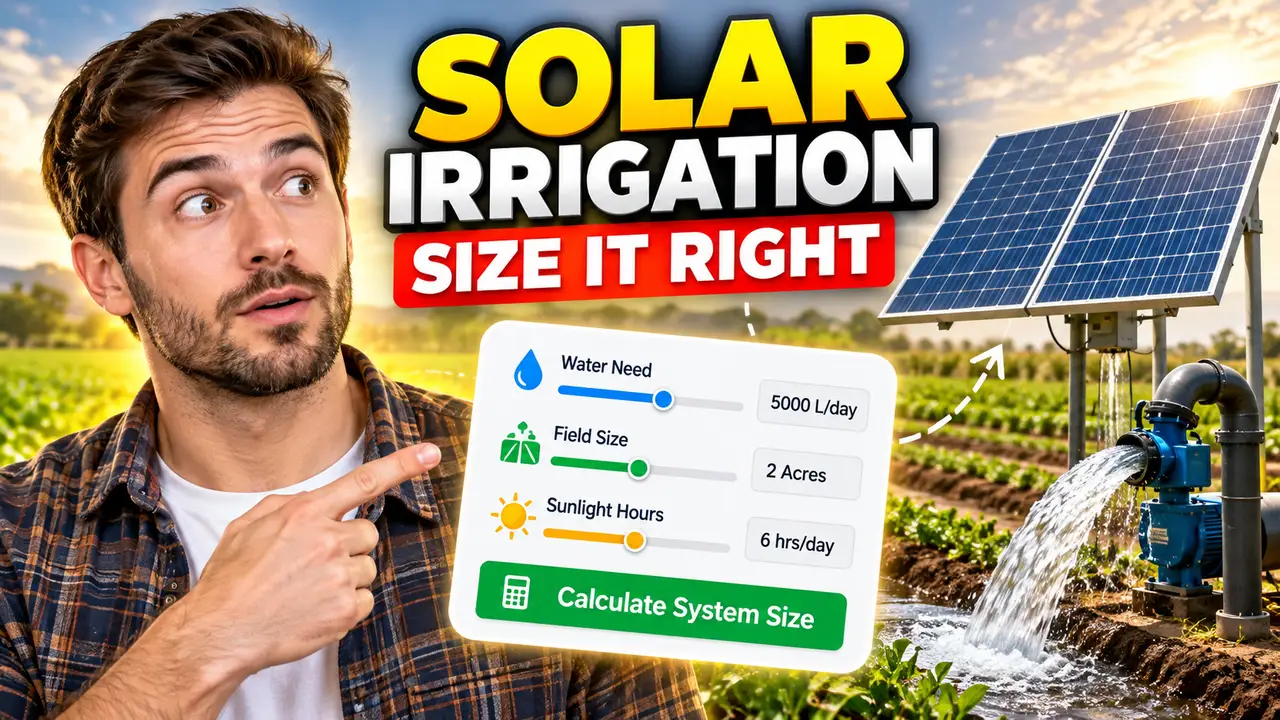
Solar Irrigation System Sizing Calculator
The Solar Irrigation System Sizing Calculator provides a preliminary estimate for planning a solar-powered irrigation setup from three practical inputs: daily water need, field size, and available sunlight hours. It is intended for farmers, agricultural planners, irrigation installers, and property owners who need a quick starting point before selecting a pump, PV array, controller, or water-storage arrangement.
Direct answer: A solar irrigation system must produce enough useful pumping energy during the available solar window to meet the required daily water volume. Water demand and sunlight hours establish the basic daily pumping requirement, while field size provides important context for evaluating whether the resulting irrigation capacity is appropriate for the site.
Key Takeaways
- Daily Water Requirement: The amount of water required per day is the primary hydraulic demand. A larger daily requirement generally means greater pumping capacity and energy demand.
- Sunlight Hours: Available productive sunlight determines how long the solar-powered pump can contribute to the daily water requirement. Fewer useful hours increase the required pumping rate.
- Field Size: Acreage helps relate the water requirement to the agricultural area being served. It should be considered together with crop water requirements and irrigation efficiency rather than used as a standalone pump-sizing factor.
- System Design: Actual pump and PV sizing also depends on total dynamic head, pump efficiency, motor efficiency, controller characteristics, pipe losses, water-source conditions, and site-specific solar resource.
What Does the Solar Irrigation System Sizing Calculator Estimate?
The calculator is best treated as a preliminary sizing aid. Its visible inputs are Water Need, Field Size, and Sunlight Hours. The basic hydraulic relationship can be expressed as:
Required Average Flow = Daily Water Need ÷ Available Pumping Hours
For example, if the daily requirement is 5,000 L/day and the useful pumping window is 6 hours/day:
5,000 L/day ÷ 6 h/day = 833.3 L/h
That is approximately 13.9 L/min. This calculation tells you the average water-delivery rate required during the assumed six-hour pumping period. It does not by itself determine the final PV wattage or pump horsepower.
How to Use Solar Irrigation System Sizing Calculator?
- Enter Water Need. Enter the required daily irrigation volume using the unit requested by the calculator. The example shown by the tool uses 5,000 L/day. Use a realistic daily requirement rather than the maximum flow rate of the irrigation equipment.
- Enter Field Size. Provide the agricultural area being served. The example uses 2 acres. Field area is useful for checking whether the stated water requirement is plausible for the intended crop and irrigation method.
- Enter Sunlight Hours. Enter the number of useful solar pumping hours available each day. The example uses 6 hours/day. Do not automatically treat total daylight as equivalent to peak-equivalent solar production.
- Calculate the System Size. Review the resulting estimate as a preliminary planning value, then verify pump performance against the site's hydraulic head, pipework, irrigation pressure, solar resource, and equipment specifications.
Underlying Formula and Methodology
The simplest relationship behind the daily pumping requirement is:
Qavg = Vdaily / tsolar
- Qavg = required average flow rate.
- Vdaily = daily water volume.
- tsolar = useful pumping hours available per day.
For a more complete engineering design, hydraulic energy must also be considered. A useful relationship is:
Phyd = ρgQH
where ρ is water density, g is gravitational acceleration, Q is flow rate, and H is total dynamic head. Electrical input must then account for pump, motor, controller, and other system efficiencies.
This distinction matters because two farms with the same water requirement can require very different solar pumping systems. A deep well, elevated tank, long pipeline, or pressurized sprinkler system can require substantially more energy than a short, low-head surface-water installation.
Worked Example
Suppose a farm requires 5,000 L/day, covers 2 acres, and has an assumed useful solar pumping period of 6 hours/day.
- Daily water volume = 5,000 L/day.
- Available pumping time = 6 hours/day.
- Average required flow = 5,000 ÷ 6 = 833.3 L/hour.
- Convert to minutes: 833.3 ÷ 60 = approximately 13.9 L/min.
The 2-acre figure does not replace crop-specific water-demand calculations. Instead, it provides a useful scale check. Crop type, climate, evapotranspiration, irrigation method, application efficiency, and seasonal conditions should be used to establish the actual water requirement.
Reference Planning Table
| Scenario | Daily Water Need | Useful Pumping Hours | Average Flow Required |
|---|---|---|---|
| Small irrigation demand | 2,000 L/day | 6 h/day | 333 L/h |
| Example system | 5,000 L/day | 6 h/day | 833 L/h |
| Higher demand | 10,000 L/day | 6 h/day | 1,667 L/h |
| Same demand, shorter window | 5,000 L/day | 4 h/day | 1,250 L/h |
These figures are mathematical examples, not equipment recommendations. USDA Natural Resources Conservation Service guidance emphasizes that solar pumping design requires consideration of system components and hydraulic conditions, and its national conservation practice standards should be adapted through the applicable state Field Office Technical Guide. :chatgpt-content-reference{index="0"}
What the Calculator Does Not Replace
A final installation should evaluate total dynamic head, static water level, drawdown, required discharge pressure, pipe friction, pump curve, motor power, PV array characteristics, controller limits, and seasonal solar availability. NRCS guidance also notes that solar output varies with incoming solar radiation and that controllers help match available PV power to pump requirements. Water storage can be an effective way to use excess solar production rather than relying solely on electrical battery storage. :chatgpt-content-reference{index="1"}
For irrigation planning, NRCS describes irrigation water management as determining and controlling the volume, frequency, and application rate of irrigation. Its national Irrigation Water Management standard was updated in 2026, while site-specific requirements are handled through local NRCS guidance. :chatgpt-content-reference{index="2"}
Engineering Disclaimer: This calculator provides a preliminary planning estimate and should not be treated as a final equipment specification. Final pump, PV, electrical, hydraulic, structural, and irrigation-system design should be checked against manufacturer data and applicable local requirements by a qualified professional.
Author
Author Name: Jordan M. Hayes, P.E.
Author Description: Agricultural and renewable-energy engineer specializing in solar-powered water pumping, irrigation hydraulics, and PV system integration for rural and agricultural applications.
Technical Review: Reviewed for consistency of the water-demand, pumping-hour, hydraulic-power, and preliminary solar-sizing relationships by Jordan M. Hayes, P.E., with emphasis on solar irrigation and agricultural pumping applications.