Solar Battery Storage Sizing Calculator For Home
Solar Battery Storage Sizing Calculator For Home estimates battery capacity from daily use, backup days, depth of discharge, and efficiency for early planning. — 159 characters.
Please complete this field to continue.
Please complete this field to continue.
Please complete this field to continue.
Please complete this field to continue.
Please complete this field to continue.
Results
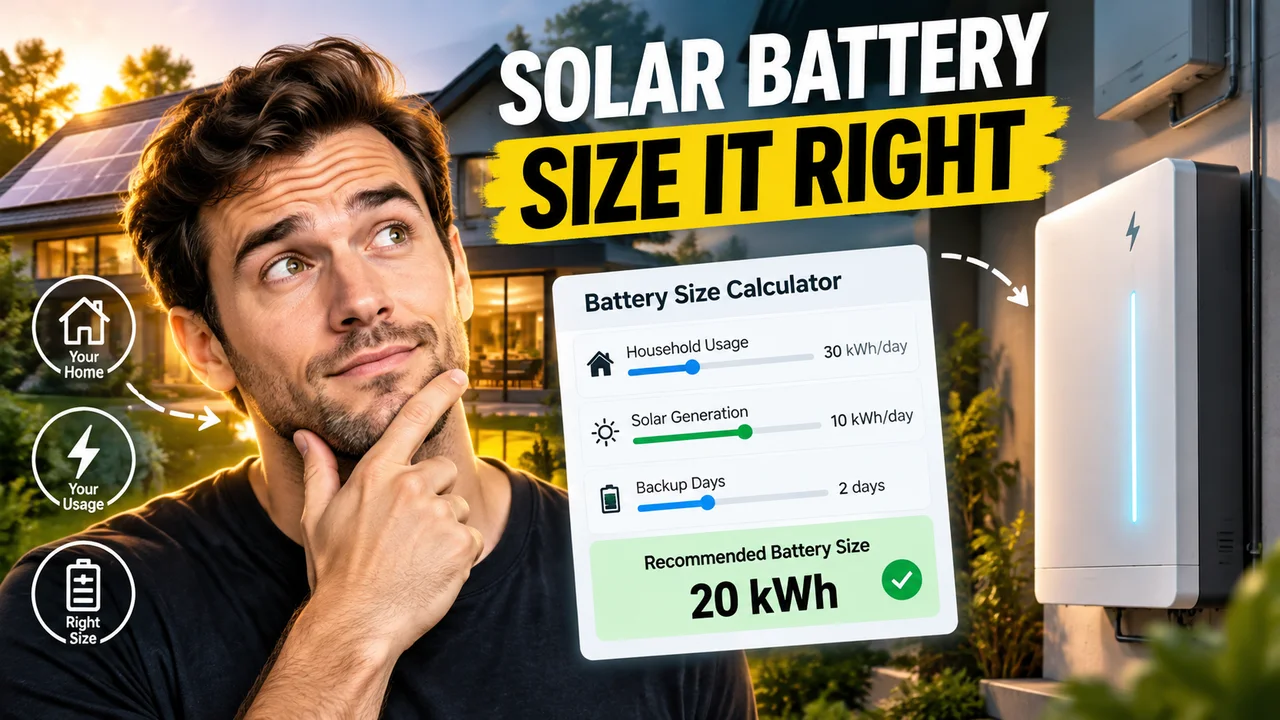
Solar Battery Storage Sizing Calculator For Home
TL;DR Summary
The Solar Battery Storage Sizing Calculator For Home estimates the battery energy capacity needed to support a selected portion of household electricity use for a chosen number of backup days. Use the result as an early planning estimate; privacy behavior is not specified by the supplied tool information, so avoid entering sensitive information unless the page clearly explains how entered data is handled.
About This Tool
The Solar Battery Storage Sizing Calculator For Home helps homeowners estimate how much battery storage may be needed for a solar-plus-storage or home backup system. Instead of starting with a battery size and guessing what it can support, you start with the amount of electricity your home uses and the level of backup you want.
The calculator focuses on energy capacity, measured in kilowatt-hours (kWh). Energy capacity tells you how much electricity a battery can store. It is different from power capacity, which is measured in kilowatts (kW) and describes how much power the system can deliver at a given time. The U.S. Department of Energy notes that storage systems have both energy and power characteristics, and both matter when designing a real system.
This tool is useful for homeowners comparing possible battery sizes, planning backup power, estimating storage needs before requesting solar quotes, or checking whether a proposed battery capacity is in the general range suggested by their energy needs. It can also help explain why two homes with different electricity use may need very different battery capacities.
What You Enter
The calculator uses five main inputs:
- Average daily home energy use: Enter your typical electricity consumption in kWh per day. A recent utility bill or energy-monitoring system can help you estimate this value.
- Backup load percentage: Enter the share of your normal daily energy use that you want supported by the battery. For example, 50% means the calculation plans around half of your normal daily energy consumption.
- Backup duration: Enter the number of days of energy you want the battery to cover. One day means the calculation targets one day of the selected backup load.
- Depth of discharge: Enter the percentage of the battery's rated energy that the system is designed to use. Use the value supplied for the specific battery you are considering.
- Round-trip efficiency: Enter the battery system's round-trip efficiency. If the manufacturer's specification is available, use that figure rather than relying on a generic assumption.
What the Calculator Produces
The main result is the recommended battery capacity in kWh. This is an estimated nameplate energy capacity after allowing for the selected depth of discharge and round-trip efficiency.
The calculator also reports the estimated usable battery energy needed, the daily backup energy, and the total backup energy required before battery efficiency and depth-of-discharge adjustments.
These results are planning values. They are not a product recommendation and do not identify a particular battery model. Actual systems also depend on battery power ratings, inverter limits, system controls, temperature, wiring and conversion losses, battery degradation, operating conditions, and the loads connected during an outage.
How to Use
- Step 1: Enter your average daily household electricity use in kWh. Use a representative period rather than a single unusual day whenever possible.
- Step 2: Enter the percentage of your daily electricity use that you want to support during an outage. Use a lower percentage if only selected or critical loads will be backed up.
- Step 3: Enter the number of backup days you want the battery to cover.
- Step 4: Enter the battery's depth-of-discharge specification. Check the manufacturer's documentation for the specific battery.
- Step 5: Enter the battery's round-trip efficiency. If the manufacturer's published value is available, use it.
- Step 6: Review the recommended battery capacity in kWh and the supporting results.
- Step 7: Compare the estimated energy capacity with the usable capacity and power specifications of actual battery systems before making a purchase or installation decision.
Technical Explanation and Formula
The calculator uses a standard energy-sizing approach for an early-stage estimate. The exact formula is:
Daily Backup Energy = Daily Home Energy Use × Backup Load Percentage
Backup Energy Required = Daily Backup Energy × Backup Duration
Usable Battery Energy Needed = Backup Energy Required ÷ Round-Trip Efficiency
Recommended Battery Capacity = Usable Battery Energy Needed ÷ Depth of Discharge
Daily home energy use is measured in kWh/day. Backup load percentage and depth of discharge are percentages. Backup duration is measured in days. Round-trip efficiency is also a percentage. The resulting battery capacity is measured in kWh.
For example, suppose a home uses 30 kWh per day, the homeowner wants to support 50% of that usage during an outage, and the desired backup period is one day. The daily backup requirement is:
30 kWh × 50% = 15 kWh
If the selected battery has 85% round-trip efficiency, the battery energy needed after accounting for efficiency is:
15 ÷ 0.85 = 17.65 kWh
If the battery is designed for an 80% depth of discharge, the estimated nameplate capacity is:
17.65 ÷ 0.80 = 22.06 kWh
So the calculator would return approximately 22.06 kWh of estimated battery nameplate capacity for this example. This is a mathematical planning example, not a recommendation to purchase a particular battery.
NREL describes round-trip efficiency as the ratio of useful energy recovered from storage to energy put into storage, while depth of discharge describes how much of a battery's total energy capacity is discharged. :contentReference[oaicite:3]{index=3} DOE also notes that storage is not 100% efficient and that storage capacity and power capacity are separate system characteristics. :contentReference[oaicite:4]{index=4}
Why Battery Capacity Is Only Part of Solar Storage Sizing
A larger kWh number does not automatically mean a battery can operate every appliance in a home. The battery and inverter must also be able to deliver the required power in kW. A refrigerator, pump, air conditioner, well pump, electric range, or other high-power load may have starting or continuous power requirements that are not captured by an energy-only calculation.
Solar production also changes over time. DOE notes that solar production can be affected by season, time of day, clouds, dust, haze, rain, snow, and shading. :contentReference[oaicite:5]{index=5} A battery that looks adequate from an average daily energy calculation may need a different design if the goal is to survive several cloudy days without grid power.
Preset Examples and Quick Reference
| Input | Example Value | Unit |
|---|---|---|
| Daily home energy use | 30 | kWh/day |
| Backup load | 50 | % |
| Backup duration | 1 | day |
| Depth of discharge | 80 | % |
| Round-trip efficiency | 85 | % |
| Estimated battery capacity | 22.06 | kWh |
These example values demonstrate the calculation only. Battery manufacturers can specify different usable capacities, operating limits, efficiencies, and recommended depth-of-discharge values.
Why Use This Solar Battery Storage Sizing Calculator For Home & How Our Calculator Beats the Competition
The practical value of this calculator is that it puts the main energy-sizing assumptions in front of the user. It is designed for an early calculation rather than a full engineering model. That makes it useful when you want to understand the relationship between household energy use, backup duration, battery efficiency, and usable capacity before moving to a detailed system design.
| Method | Ease of Use | Calculation Speed | Best For | Limitations |
|---|---|---|---|---|
| Toolhox Calculator | Enter five sizing inputs | Immediate calculation | Early home battery capacity estimates | Does not model a complete electrical system or specific battery product |
| Manual Calculation | Requires applying each formula yourself | Depends on the user | Checking the underlying math | More opportunity for input or arithmetic mistakes |
| Spreadsheet Calculation | Flexible after setup | Depends on spreadsheet design | Custom scenarios and repeated comparisons | Requires building and maintaining the model |
| Professional Engineering Software | Usually requires more inputs and technical knowledge | Depends on the model | Detailed system design and performance analysis | More complex than an early-stage energy-capacity estimate |
Assumptions and Limitations
This calculator estimates battery energy capacity from average energy consumption and user-selected backup assumptions. It does not perform a complete solar PV system design. It does not calculate panel count, solar production, inverter sizing, battery charge rate, battery discharge power, conductor sizing, voltage, temperature effects, degradation over time, utility interconnection requirements, or local permitting requirements.
The result also assumes that the selected backup percentage reasonably represents the energy demand that the battery will actually serve. Real outage loads may vary substantially from average daily consumption. Large loads can create short periods of high power demand even when total daily energy use is moderate.
For an actual installation, use the specifications supplied by the battery and inverter manufacturers and have the final system evaluated by an appropriately qualified solar or electrical professional. This is especially important for whole-home backup, off-grid systems, high-voltage battery systems, critical medical equipment, large motors, or systems subject to local electrical and utility requirements.
Battery storage is also not the same as guaranteed outage duration. DOE explains that storage can provide backup power during an electrical disruption, but storage systems have different energy and power capabilities. :contentReference[oaicite:6]{index=6} The calculator therefore provides an energy-capacity estimate rather than a guarantee that a home will remain powered for a particular outage.