
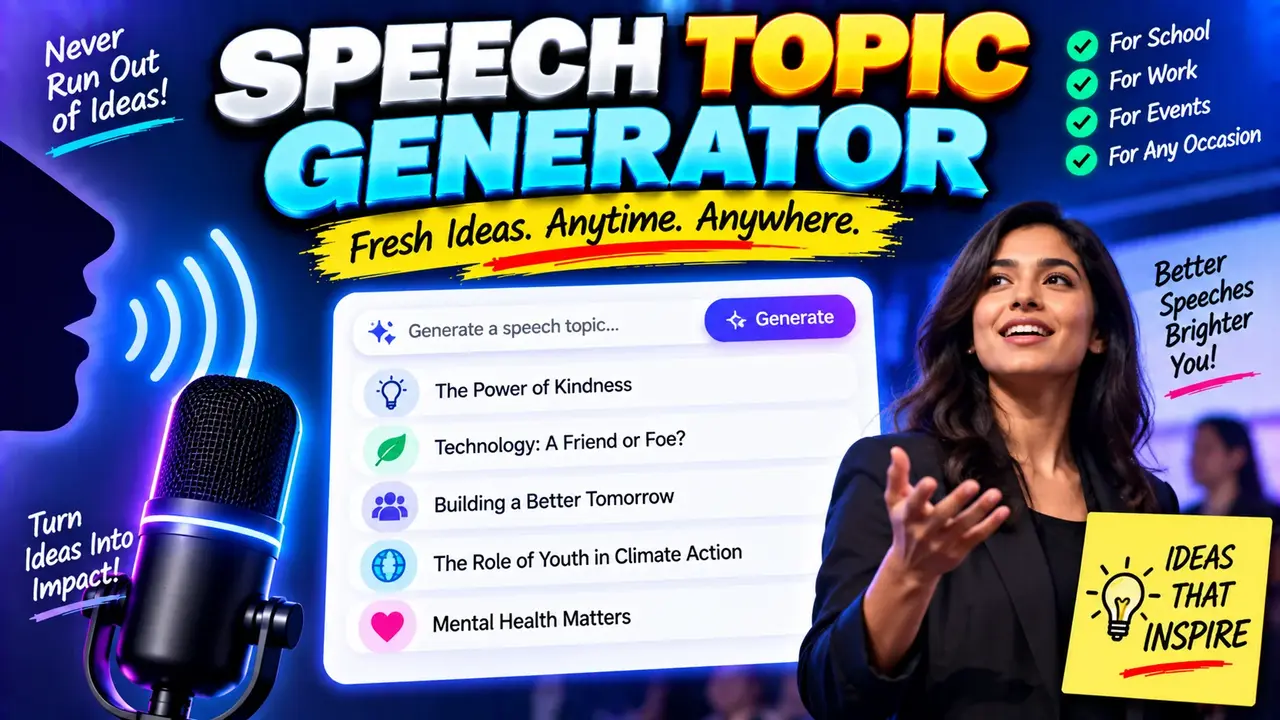
Free Speech Topic Generator | Unlimited Ideas
Quick answer: Free Speech Topic Generator | Unlimited Ideas is a speech-topic idea generator designed to help students, educators, public speakers, and presenters explore potential speech subjects. It supports brainstorming for informative, persuasive, and other speech assignments by helping users identify topics that fit their interests, audience, and speaking goals. The exact input fields, generation method, and output controls depend on the implemented tool interface.
Choosing a speech topic is often the first challenge in preparing a presentation. A subject may be interesting but too broad, difficult to research, unsuitable for the audience, or hard to explain within the available time. The Free Speech Topic Generator | Unlimited Ideas is intended to help users move from an open-ended request for ideas toward a more focused subject they can develop into a speech.
Speech topic generation is useful for classroom assignments, debate preparation, public speaking practice, presentations, workshops, and educational activities. Instead of repeatedly brainstorming from scratch, users can use generated suggestions as starting points, compare possible directions, and select an idea that matches their purpose.
What Makes a Good Speech Topic?
A useful speech topic is specific enough to discuss within the allotted time, relevant to the intended audience, and appropriate for the speaker's purpose. A strong topic also gives the speaker a clear direction for research, examples, supporting evidence, and a conclusion.
- Relevance: The subject connects with the audience's interests, needs, or experiences.
- Scope: The topic can be explained within the available speaking time.
- Purpose: The topic supports an informative, persuasive, demonstrative, or entertaining presentation.
- Research potential: Credible sources and examples can support the main points.
- Originality: The speaker can approach the subject from a focused or distinctive perspective.
How to Use Free Speech Topic Generator | Unlimited Ideas?
- Open the generator: Access the tool and review the available input controls.
- Define your direction: If the interface provides relevant options, select a subject area, speech purpose, audience, or difficulty level.
- Generate ideas: Use the available generation control to obtain speech-topic suggestions.
- Review the results: Compare the ideas and select a topic that fits the assignment and audience.
- Refine the topic: Turn the selected idea into a focused title, research question, or central claim.
The exact steps depend on the controls exposed by the live implementation. Options such as category filters, audience selectors, downloadable results, or automatic outline generation should only be described as available if they are present in the actual tool.
Speech Topic Examples: From Broad Subjects to Focused Ideas
The following examples illustrate how a general subject can become a more manageable speech topic. They are sample ideas for demonstrating topic selection, not claimed outputs from a live generation run.
| Broad Subject | Focused Speech Topic | Possible Purpose |
|---|---|---|
| Technology | How artificial intelligence is changing the way students learn | Informative |
| Environment | Practical ways schools can reduce single-use plastic waste | Persuasive |
| Education | Should financial literacy be a compulsory school subject? | Persuasive |
| Health and lifestyle | How consistent sleep routines can support student learning | Informative |
| Communication | Why active listening matters in resolving everyday disagreements | Informative |
| Community | How neighborhood volunteering can strengthen local communities | Persuasive |
| Science | What the search for life beyond Earth can teach us about science | Informative |
| Media | How to evaluate online claims before sharing them | Persuasive |
Speech Purpose Reference Table
Choosing the purpose before finalizing a topic makes it easier to decide what evidence, structure, and speaking approach to use.
| Speech Type | Primary Objective | Useful Topic Pattern | What the Speaker Needs |
|---|---|---|---|
| Informative | Explain a subject clearly | How does X work? What causes Y? | Accurate explanations, definitions, and supporting examples |
| Persuasive | Influence beliefs or actions | Should X change? Why should people consider Y? | A defensible claim, credible evidence, and responses to counterarguments |
| Demonstrative | Show how to do something | How to complete X step by step | A practical process, materials where applicable, and clear sequencing |
| Entertaining | Engage or amuse an audience | Unexpected facts about X; humorous lessons from Y | Audience awareness, timing, and a coherent narrative |
| Inspirational | Encourage reflection or action | Lessons from overcoming X; habits that support Y | Relevant examples, a meaningful message, and an appropriate tone |
How to Turn a Generated Idea into a Speech
A generated topic is a starting point rather than a finished speech. After choosing an idea, narrow it to a central question or claim and identify the main points needed to explain or defend it.
- Set the scope: Replace broad subjects such as “technology” with a specific issue, audience, or application.
- Choose a central message: Write one sentence that explains what the audience should understand, consider, or do.
- Identify supporting points: Select two to four main points that directly support the message and fit the speaking time.
- Verify the evidence: Consult reliable sources for factual claims, statistics, quotations, and examples.
- Adapt to the audience: Use familiar language, explain necessary terms, and select examples appropriate for the listeners.
Topic Selection Examples by Speaking Time
| Approximate Speaking Time | Topic Scope | Example |
|---|---|---|
| 1–3 minutes | One main idea or a short explanation | Three ways to make a presentation opening more engaging |
| 4–7 minutes | A focused issue with a few supporting points | Why schools should teach basic media literacy |
| 8–12 minutes | A broader question with evidence and contrasting viewpoints | The opportunities and limitations of AI-assisted learning |
These time ranges are practical planning examples, not fixed rules. The appropriate scope depends on the speaker's pace, assignment requirements, audience knowledge, and the amount of evidence needed.
Limitations and Responsible Use
- Suggestions are not verified facts: A generated topic does not establish that a related claim is accurate.
- Audience fit requires judgment: Review the suitability of sensitive, controversial, or age-specific topics before using them.
- Research is still necessary: Confirm factual claims, dates, statistics, quotations, and source credibility independently.
- Topic originality varies: Popular subjects may be suggested frequently. A narrower question or distinctive perspective can make a speech more individual.
- Tool-specific controls are implementation-dependent: No particular generation algorithm, category list, export function, privacy behavior, or output limit is assumed here without verification.
For factual and educational speeches, useful starting points include the Library of Congress for historical and primary-source materials and the Centers for Disease Control and Prevention for relevant public-health information. Choose sources appropriate to the topic, and distinguish established evidence from opinion.
Frequently Asked Questions
What should I do if a suggested topic is too broad?
Turn the subject into a specific question, narrow the audience or setting, and identify one main point. For example, change “social media” to “How can students recognize misleading health claims on social media?”
Should I choose an informative or persuasive topic?
Choose an informative topic when the main goal is to explain or clarify something. Choose a persuasive topic when you need to defend a position, address counterarguments, or encourage a change in belief or behavior.
Can a generated topic be used for a school assignment?
Yes, as a starting idea, provided it matches the assignment instructions. Check any requirements concerning subject matter, research, originality, citations, presentation length, and permitted assistance.
How can I make a common speech topic more original?
Focus on a less-discussed audience, a specific local example, a recent development, a comparison, or a question that invites deeper analysis. Originality can come from the angle and evidence, not just the subject.
Does generating a topic automatically create a complete speech?
Not necessarily. Topic suggestions and full speech writing are different tasks. Unless the live interface explicitly supports speech drafting, users should treat a suggested topic as the beginning of the planning process.
Author Information
Author Name: Jordan Mitchell
Author Description: Educational Content Specialist focused on public speaking, communication, and instructional content design.
Technical Review: The guidance covers topic narrowing, speech-purpose selection, example development, and evidence checking. The live generator's implementation-specific capabilities have not been independently verified.
