Hvac Maintenance Agreement Price Calculator
Calculate Hvac Maintenance Agreement Price Calculator For Contractors costs, margin, annual price, and monthly pricing from labor, materials, visits, and overhead.
Please complete this field to continue.
Please complete this field to continue.
Please complete this field to continue.
Please complete this field to continue.
Please complete this field to continue.
Please complete this field to continue.
Please complete this field to continue.
Results
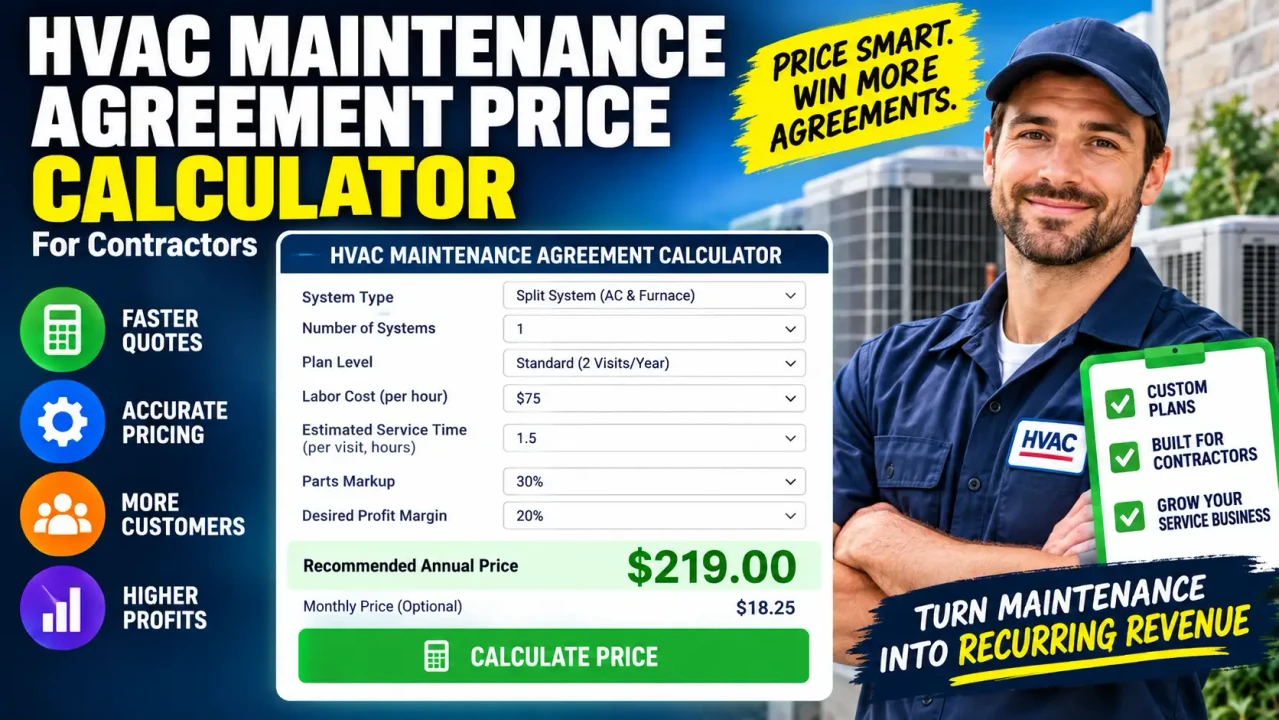
Hvac Maintenance Agreement Price Calculator For Contractors
TL;DR Summary
The Hvac Maintenance Agreement Price Calculator For Contractors estimates the cost and suggested selling price of a 12-month HVAC maintenance agreement using units, planned visits, labor, materials, overhead, and a target gross margin. Use the result as a pricing estimate rather than a guaranteed market price; the supplied tool information does not establish how calculator data is stored or processed.
About This Tool
The Hvac Maintenance Agreement Price Calculator For Contractors is designed for HVAC business owners, service managers, estimators, and contractors who need a practical way to estimate what a preventive maintenance agreement should cost. Instead of starting with a customer-facing price and working backward, the calculator starts with the expected work and cost of delivering the agreement.
That approach matters because a maintenance agreement is more than a single service visit. A contract may cover several HVAC units and multiple preventive maintenance visits during a 12-month period. Each visit can require technician time, materials, consumables, travel-related resources, and a share of the business's operating overhead. Current HVAC pricing guidance also identifies labor costs, material costs, overhead, and target gross margin as important parts of service pricing. :contentReference[oaicite:1]{index=1}
The calculator is intended for contractors who want to build a repeatable pricing estimate from their own business costs. It does not attempt to determine what every customer or market will accept. Local competition, equipment condition, travel distance, building type, contract scope, emergency response terms, included repairs, filter requirements, and other commercial terms can change the final price.
What You Enter
The calculator uses seven main inputs. First, enter the number of HVAC units covered by the agreement. Next, enter the number of maintenance visits planned for each unit during the year. This establishes the total planned visit count.
You then enter estimated labor hours per unit per visit and your labor cost per hour. The labor input should reflect the cost you want to recover for the technician time used to deliver the agreement. Contractors may use a fully burdened labor cost when appropriate, rather than looking only at a technician's base wage.
The next input is materials cost per unit per visit. This can represent expected filters, cleaning materials, belts, lubricants, or other consumables that are part of the maintenance scope. Only include materials that you actually expect the agreement price to cover.
You also enter an overhead allocation per unit per visit. This allows the estimate to account for a portion of costs that are not direct maintenance materials or technician labor. Finally, enter the target gross margin percentage you want the agreement price to achieve.
What the Calculator Produces
The calculator returns the total estimated cost of the planned maintenance work, a suggested annual agreement price, a suggested monthly equivalent, estimated gross profit, and the planned number of maintenance visits.
The annual price is not a quoted industry rate. It is a calculated selling-price target based on the costs and margin you enter. This distinction is important. Two HVAC companies can provide a similar maintenance service but have very different labor costs, overhead structures, service areas, equipment mixes, and business goals.
How to Use
- Step 1: Enter the number of HVAC units that will be covered by the 12-month maintenance agreement.
- Step 2: Enter the planned maintenance visits per unit during the year.
- Step 3: Estimate the technician labor hours required for one unit during one maintenance visit.
- Step 4: Enter your labor cost per technician hour, material cost per unit visit, and overhead allocation per unit visit.
- Step 5: Enter the gross margin percentage you want the agreement price to produce.
- Step 6: Review the total estimated cost and suggested annual agreement price.
- Step 7: Review the monthly equivalent and adjust the inputs if your actual contract scope or business costs differ.
Technical Explanation and Formula
The calculator uses a standard cost-plus gross-margin pricing method. Current HVAC pricing guidance describes a similar structure in which the cost of labor, materials, and overhead is used to establish a price that achieves a target gross margin. :contentReference[oaicite:2]{index=2} Current service-agreement guidance also describes estimating labor and material costs and applying a target margin when pricing an agreement. :contentReference[oaicite:3]{index=3}
The first calculation is the total number of planned maintenance visits:
Total Visits = HVAC Units × Visits per Unit per Year
Labor cost per visit is:
Labor Cost per Visit = Labor Hours per Visit × Labor Cost per Hour
Total labor cost is:
Total Labor Cost = Total Visits × Labor Cost per Visit
Total materials cost is:
Total Materials Cost = Total Visits × Materials Cost per Visit
Total overhead allocation is:
Total Overhead = Total Visits × Overhead Allocation per Visit
The estimated agreement cost is:
Total Estimated Cost = Total Labor Cost + Total Materials Cost + Total Overhead
The suggested annual agreement price uses the target gross margin:
Suggested Annual Price = Total Estimated Cost ÷ (1 − Target Gross Margin)
For example, if the estimated cost is $4,000 and the target gross margin is 30%, the suggested price is $4,000 ÷ 0.70, or about $5,714.29. The difference of about $1,714.29 represents the gross profit at that selling price before any costs not included in the calculator.
The monthly equivalent is simply:
Monthly Price = Suggested Annual Price ÷ 12
All monetary results are shown in U.S. dollars. The calculator does not apply a state-specific tax, permit charge, market adjustment, emergency-service charge, financing charge, or customer discount because those values are not established by the supplied calculator specification.
Preset Examples / Quick Reference
| Input | Example Value |
|---|---|
| HVAC units | 4 |
| Visits per unit per year | 2 |
| Labor hours per unit per visit | 1.5 hours |
| Labor cost per hour | $75 |
| Materials per unit per visit | $25 |
| Overhead per unit per visit | $20 |
| Target gross margin | 30% |
With these example inputs, there are 8 planned visits. Each visit has $112.50 of labor, $25 of materials, and $20 of overhead, for an estimated cost of $1,260 for the year. At a 30% target gross margin, the suggested annual agreement price is $1,800, or $150 per month. This example is only a demonstration of the formula and is not a recommended HVAC market price.
What This Calculator Does Not Price Automatically
The calculator does not automatically inspect equipment, identify maintenance tasks, estimate filter quantities, determine repair probabilities, or pull current local labor rates. It also does not create a legal service agreement or determine which services should be included in your contract.
For a commercial agreement, the scope can become more detailed. Current HVAC service-agreement documentation commonly addresses equipment, maintenance frequency, labor and material pricing, emergency terms, payment terms, warranties, and termination conditions. :contentReference[oaicite:4]{index=4} Those contract terms should be reviewed separately when preparing an actual customer agreement.
Why Use This Hvac Maintenance Agreement Price Calculator For Contractors & How Our Calculator Beats the Competition
The practical benefit of this calculator is that it makes the pricing assumptions visible. You can change the unit count, service frequency, labor cost, material cost, overhead allocation, or target margin and immediately see how those changes affect the agreement price. That is different from choosing a price first and trying to determine later whether the contract will cover its expected costs.
| Method | Ease of Use | Calculation Speed | Best For | Limitations |
|---|---|---|---|---|
| Toolhox Calculator | Enter the defined pricing inputs | Immediate calculation | Quick maintenance agreement price estimates | Depends on the accuracy of contractor-entered cost and scope assumptions |
| Manual Calculation | Requires more arithmetic | Depends on the person doing the calculation | One-off estimates or checking formulas | Manual arithmetic can become harder as contract scope grows |
| Spreadsheet Calculation | Requires a prepared spreadsheet | Fast after setup | Businesses managing detailed pricing models | Requires the spreadsheet structure and formulas to be maintained |
| Professional Engineering or Service Software | Depends on the software and setup | Can support larger workflows | Detailed estimating, service management, and engineering workflows | May include features beyond a simple agreement-price estimate |
Assumptions and Limitations
- The calculator assumes a 12-month maintenance agreement.
- The number of visits is entered as an annual frequency for each covered HVAC unit.
- Labor hours are entered as an estimate for one unit during one visit.
- Materials and overhead are entered as per-unit, per-visit amounts.
- The target margin is applied using a gross-margin pricing formula, not a simple markup formula.
- The result does not include costs that you leave out of the inputs.
- The result does not automatically account for travel, emergency response, after-hours work, included repairs, discounts, taxes, permits, financing, or unusual equipment requirements.
- The calculator does not determine whether your target margin is appropriate for your business or market.
- Actual agreement pricing should be reviewed against your service scope, historical job costs, local market conditions, and contract terms before a customer quote is issued.
For complex commercial agreements, contractors may need a more detailed cost model that separates equipment, locations, visit types, labor categories, materials, and billing terms. Current service-agreement systems also distinguish agreement pricing from additional or unplanned work, which this calculator does not model. :contentReference[oaicite:5]{index=5}