Hvac Return Air Grille Size Calculator
Use Hvac Return Air Grille Size Calculator to estimate required grille area from airflow, face velocity, and free area for residential HVAC sizing and planning.
Please complete this field to continue.
Please complete this field to continue.
Please complete this field to continue.
Results
Hvac Return Air Grille Size Calculator
TL;DR Summary
The Hvac Return Air Grille Size Calculator estimates the gross grille area needed for a return-air opening from airflow, target face velocity, and grille free-area percentage. It is a sizing estimate rather than a complete HVAC design, and no specific privacy behavior is established by the supplied tool information, so avoid entering sensitive information.
What This Tool Does
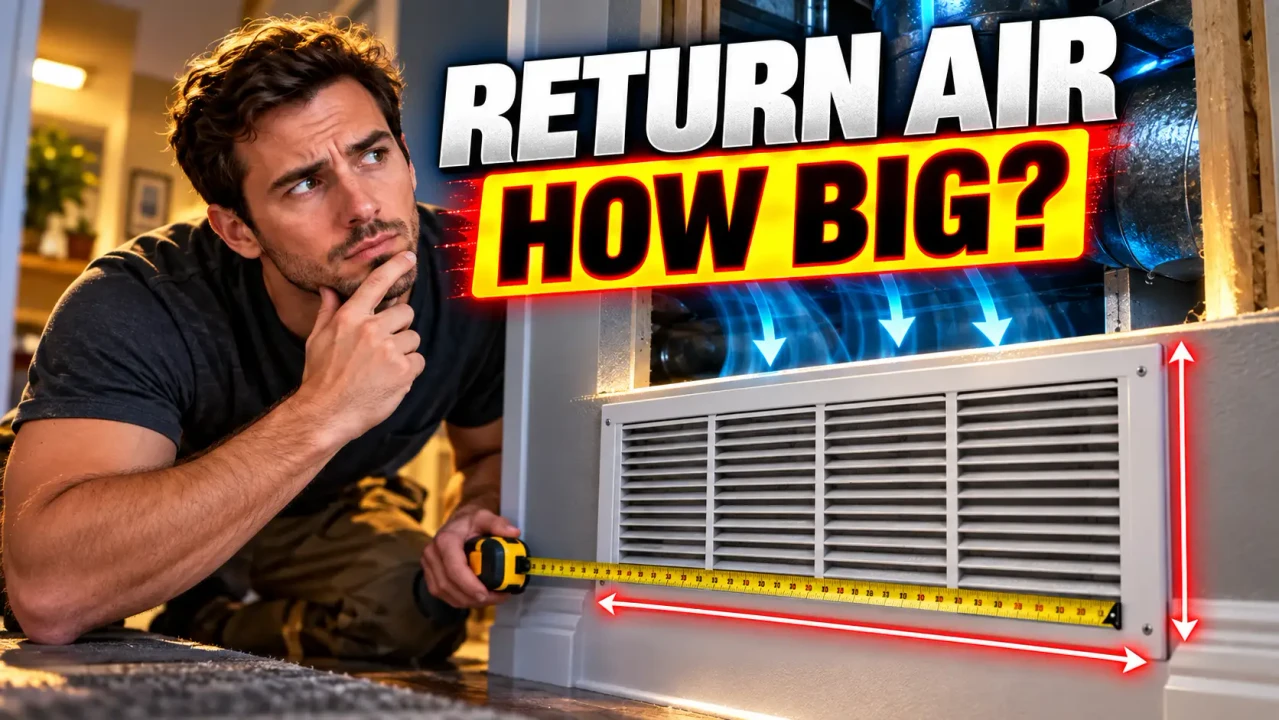
The Hvac Return Air Grille Size Calculator helps estimate the size of a return air grille for an HVAC system. It uses the amount of air that needs to pass through the grille, the target face velocity, and the percentage of the grille that is open to airflow. The result gives you a required gross grille area and a square-equivalent dimension that can be used as a starting point when selecting a grille.
Return air is the air that travels from the conditioned space back toward the HVAC equipment. The return grille is the visible opening that allows this air to enter the return path. If the opening is too small for the required airflow, air must move through the available opening at a higher velocity. That can affect noise, pressure, and the overall performance of the return-air path.
This calculator is intended for homeowners, HVAC technicians, installers, contractors, maintenance workers, students, and others who need a first-pass return grille size estimate. It can also help when comparing different grille options or checking how a change in target velocity affects the required opening.
What You Need to Enter
The calculator uses three inputs.
- Return Airflow: Enter the required airflow in cubic feet per minute, or CFM. This should represent the airflow that the return grille needs to handle.
- Target Face Velocity: Enter the desired air velocity through the grille face in feet per minute, or FPM. A lower target generally requires a larger opening.
- Grille Free Area: Enter the percentage of the grille's gross face that is actually open to airflow. When a manufacturer's free-area value is available, use that value instead of relying on a general estimate.
The free-area input matters because a grille's outside dimensions are not the same as its open airflow area. Louvers, bars, frames, and other grille components can block part of the face. A grille with a lower free-area percentage needs more gross face area to move the same amount of air at the same target velocity.
How to Use
- Step 1: Enter the return airflow in CFM. Use the airflow that the return opening is expected to carry.
- Step 2: Enter the target face velocity in FPM. Choose a value appropriate for the intended application and noise requirements.
- Step 3: Enter the grille's free-area percentage. Check the manufacturer's product data when a specific grille has already been selected.
- Step 4: Review the required gross grille area and required free area shown by the calculator.
- Step 5: Use the square-equivalent dimension as a sizing reference, then select an available grille whose actual gross area meets or exceeds the calculated requirement.
- Step 6: Before installation, check the selected grille, filter, return duct, equipment requirements, and applicable design requirements as a complete return-air system.
Technical Explanation and Formula
The calculator uses the standard airflow relationship between volumetric flow, air velocity, and effective free area. The core relationship is:
Required Free Area (ft²) = CFM ÷ Face Velocity (FPM)
Because grille dimensions are commonly specified in square inches, the free-area result can be converted with:
Required Free Area (in²) = CFM × 144 ÷ Face Velocity
The calculator then accounts for the fact that only part of the grille face is open. The gross grille area is:
Required Gross Grille Area (in²) = CFM × 144 ÷ (Face Velocity × Free Area Fraction)
For example, if the free-area percentage is 70%, the free-area fraction is 0.70.
The variables mean:
- CFM: Required airflow in cubic feet per minute.
- Face Velocity: Target air speed through the grille's effective opening, measured in feet per minute.
- Free Area Fraction: The open portion of the grille expressed as a decimal. For example, 70% becomes 0.70.
- 144: The conversion factor from square feet to square inches.
The square-equivalent dimension is calculated by taking the square root of the required gross grille area. This is a convenient reference, not a claim that the final grille must be square. A rectangular grille can be used if its gross face area is large enough and the product is suitable for the intended airflow.
Worked Example
Suppose a return grille must handle 1,200 CFM. The target face velocity is 400 FPM, and the selected grille has 70% free area.
First, calculate the required free area:
1,200 ÷ 400 = 3.0 ft²
Convert that to square inches:
3.0 × 144 = 432 in²
Now account for the 70% free-area ratio:
1,200 × 144 ÷ (400 × 0.70) = 617.1 in²
The square-equivalent size is:
√617.1 = 24.8 inches
So the calculator indicates about 617 square inches of gross grille area, with a square-equivalent dimension of about 24.8 × 24.8 inches. In practice, the installer would select an available grille configuration that provides at least the required area and then verify the manufacturer's performance data.
Quick Reference
| Input or Result | Unit | Meaning |
|---|---|---|
| Return Airflow | CFM | Air volume that must pass through the return grille |
| Target Face Velocity | FPM | Desired air speed through the effective grille opening |
| Free Area | % | Percentage of the gross grille face that is open to airflow |
| Required Free Area | sq in | Open area needed to carry the specified CFM at the target velocity |
| Required Gross Grille Area | sq in | Total grille face area needed after accounting for the free-area ratio |
| Square-Equivalent Size | in × in | Square reference dimension based on the calculated gross area |
Why Face Velocity Matters
Face velocity is one of the main factors controlling the required grille area. If airflow stays the same and the target velocity is reduced, the required free area increases. If the target velocity is increased, the calculated area becomes smaller.
This does not mean that the smallest possible grille is always the right choice. Grille selection also depends on sound, pressure drop, grille construction, location, filter loading where applicable, return duct size, and the performance data for the specific product.
ASHRAE guidance for small forced-air systems emphasizes selecting return grilles from manufacturer performance data and considering the actual quantity of air and velocity for the selected grille. The same principle applies when using this calculator: treat the result as a sizing aid, then verify the actual product.
Why Free Area Matters
Two grilles with identical outside dimensions can have different effective airflow areas. The difference comes from the grille pattern, frame, louvers, bars, and other construction details. That is why the calculator asks for free-area percentage rather than assuming that the entire face is open.
For a specific product, the manufacturer's published free-area value is the better input. If that information is not available, the result should be treated as an estimate rather than a product-specific selection.
Why Use This Hvac Return Air Grille Size Calculator & How Our Calculator Beats the Competition
The practical advantage of this calculator is that it puts the main variables into one repeatable calculation. It does not replace engineering software or manufacturer selection data, but it can make a first-pass calculation easier to understand and check.
| Method | Ease of Use | Calculation Speed | Best For | Limitations |
|---|---|---|---|---|
| Toolhox Calculator | Enter three sizing values | Immediate calculated result | First-pass return grille area estimates | Does not replace complete HVAC design or product testing |
| Manual Calculation | Requires the formula and arithmetic | Depends on the user | Checking individual calculations | More opportunity for arithmetic or unit errors |
| Spreadsheet Calculation | Requires a prepared spreadsheet | Fast after setup | Repeated calculations and project worksheets | Requires maintaining formulas and inputs |
| Professional Engineering Software | Usually requires more setup | Depends on the software and model | Detailed HVAC system design | More complex than a single grille-area calculation |
Assumptions and Limitations
This calculator is a screening and planning tool. It calculates grille area from airflow, target face velocity, and free area. It does not perform a complete duct design, room-by-room load calculation, static-pressure analysis, acoustic analysis, or manufacturer-specific grille selection.
The calculated result also depends directly on the values entered. An incorrect CFM value, an unsuitable target velocity, or an inaccurate free-area percentage can produce an unsuitable grille size.
For filter grilles, the filter itself can affect airflow resistance and effective performance. The calculator does not model a particular filter's pressure drop. Likewise, it does not determine whether the return duct, wall cavity, transfer path, door undercut, or air handler can support the selected grille.
ASHRAE guidance notes that return grille selection should be based on manufacturer performance information and the actual airflow and velocity requirements. For a real installation, especially where noise, pressure drop, equipment limits, code requirements, or comfort are important, the selected grille and complete return-air path should be reviewed by an appropriately qualified HVAC professional.
Applicable building and mechanical requirements can also vary by location. This calculator does not identify or certify compliance with a particular state, city, county, or project-specific code requirement.
Use the Hvac Return Air Grille Size Calculator as a practical starting point for estimating gross grille area. For final equipment selection and installation, use the actual grille manufacturer's data and the requirements applicable to the project.