Voltage Unbalance Calculator Hvac Tool Online
Use the Voltage Unbalance Calculator Hvac Tool to calculate three-phase voltage unbalance from three phase-to-phase readings and review key results.
Please complete this field to continue.
Please complete this field to continue.
Please complete this field to continue.
Results
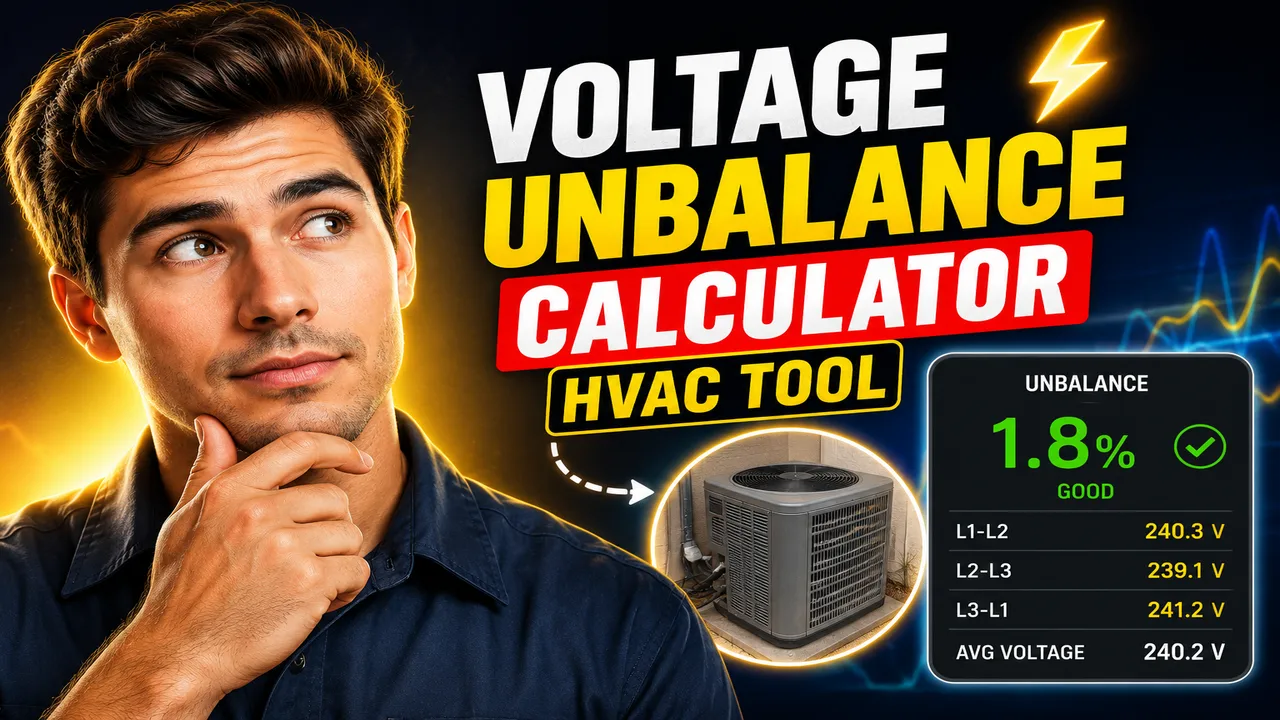
Voltage Unbalance Calculator Hvac Tool
TL;DR Summary
The Voltage Unbalance Calculator Hvac Tool calculates three-phase voltage unbalance from three phase-to-phase voltage readings and shows the average voltage, maximum deviation, and percentage unbalance. Use the result as a troubleshooting and screening aid rather than as a substitute for equipment-specific electrical requirements or professional engineering review. The supplied tool information does not establish a specific data-storage or server-processing policy, so avoid entering sensitive information unless the page explains how submitted data is handled.
Voltage balance matters when working with three-phase HVAC equipment. Motors, compressors, drives, and other three-phase loads are designed to operate with phase voltages that are equal or very close to equal. Even a relatively small voltage difference can produce a larger current imbalance in a motor. That can contribute to additional heating, mechanical stress, vibration, reduced performance, or equipment problems.
The Voltage Unbalance Calculator Hvac Tool provides a simple way to turn three measured phase-to-phase voltages into one percentage value. It is intended for HVAC technicians, electricians, maintenance personnel, facilities teams, engineers, and other users who need to check voltage balance during troubleshooting or electrical inspection.
What the Voltage Unbalance Calculator Does
The tool requires three phase-to-phase voltage measurements:
- L1-L2 voltage: the measured voltage between L1 and L2.
- L2-L3 voltage: the measured voltage between L2 and L3.
- L1-L3 voltage: the measured voltage between L1 and L3.
All three readings should use the same voltage unit and measurement conditions. For a typical U.S. HVAC electrical system, these measurements may be taken with an appropriate electrical test instrument at the relevant equipment supply or motor terminals. Follow the instrument manufacturer's safety instructions and the applicable electrical safety procedures for the system being tested.
The calculator then produces three main results:
- Average Voltage: the arithmetic average of the three measurements.
- Maximum Deviation: the largest absolute difference between one measured voltage and the average voltage.
- Voltage Unbalance: the maximum deviation expressed as a percentage of the average voltage.
The result is a measurement of voltage magnitude imbalance. It does not diagnose the cause of the imbalance. An unusual reading can have several possible causes, including load distribution problems, loose electrical connections, worn contacts, or issues elsewhere in the electrical distribution system. Further testing is needed to determine the actual cause.
Who Can Use It?
This tool is useful for HVAC service and maintenance work where three-phase voltage measurements need to be checked quickly. A technician can enter readings taken during a service call and see whether the three measurements are closely grouped. Maintenance teams can also use the calculation when documenting electrical checks around motors, compressors, air-conditioning equipment, pumps, and related three-phase loads.
It can also be useful for learning the voltage-unbalance calculation. Instead of performing the average, deviation, and percentage steps manually, the calculator performs those mathematical steps from the three measurements.
How to Use
- Step 1: Measure the L1-L2 voltage of the three-phase HVAC electrical system using an appropriate electrical test instrument and enter the reading in volts.
- Step 2: Measure the L2-L3 voltage under the same relevant operating conditions and enter the reading in volts.
- Step 3: Measure the L1-L3 voltage and enter the reading in volts.
- Step 4: Review the calculated average voltage and maximum deviation.
- Step 5: Review the final voltage-unbalance percentage and compare it with the equipment manufacturer's requirements and applicable electrical guidance.
Technical Explanation and Formula
The standard voltage-unbalance calculation used for this tool is:
Average Voltage = (V1 + V2 + V3) / 3
Next, calculate the absolute deviation of each reading from the average:
D1 = |V1 - Average Voltage|
D2 = |V2 - Average Voltage|
D3 = |V3 - Average Voltage|
The maximum deviation is:
Maximum Deviation = max(D1, D2, D3)
Finally:
Voltage Unbalance (%) = (Maximum Deviation / Average Voltage) × 100
Here, V1, V2, and V3 are the three phase-to-phase voltage measurements, expressed in volts. The average voltage is also expressed in volts. Maximum deviation is expressed in volts. The final voltage-unbalance result is expressed as a percentage.
This maximum-deviation-from-average method is documented by Fluke for three-phase voltage measurements. Its HVAC guidance gives an example using 474 V, 481 V, and 476 V. The average is 477 V, the maximum deviation is 4 V, and the resulting percentage is about 0.84% when the deviation is calculated against the average. The same source also provides an HVAC example using 474 V, 481 V, and 476 V and describes the general 1% ideal and 2% generally acceptable reference levels. :contentReference[oaicite:3]{index=3}
Worked Example
Suppose the three measured voltages are:
| Measurement | Voltage |
|---|---|
| L1-L2 | 474 V |
| L2-L3 | 481 V |
| L1-L3 | 476 V |
First calculate the average:
(474 + 481 + 476) / 3 = 477 V
The deviations from the average are 3 V, 4 V, and 1 V. Therefore, the maximum deviation is 4 V.
The voltage unbalance is:
(4 / 477) × 100 = 0.84%
This is a mathematical result, not a diagnosis of the equipment. The appropriate action depends on the equipment manufacturer's specifications, system conditions, measurement location, and applicable electrical requirements.
Understanding the Percentage
A perfectly equal set of three voltage readings has zero voltage unbalance. As the readings move farther apart, the calculated percentage increases.
Fluke's HVAC electrical-testing guidance states that voltage imbalance ideally should not exceed 1% and that 2% is generally acceptable with most HVAC equipment. These are useful reference points, not universal pass/fail limits for every HVAC system. Manufacturer requirements and the specific application should take priority. :contentReference[oaicite:4]{index=4}
| Calculated Result | General Reference |
|---|---|
| 0% | Three readings are equal |
| Up to 1% | Generally within the ideal reference range described by Fluke |
| Over 1% to 2% | Review equipment requirements and operating conditions |
| Over 2% | Investigate further and check the applicable equipment requirements |
Why Voltage Unbalance Matters in HVAC
Three-phase motors depend on balanced electrical conditions. Voltage imbalance can produce current imbalance that is much larger than the original voltage imbalance. Fluke notes that voltage unbalance at motor terminals can produce substantially higher current unbalance, with possible effects such as increased losses, vibration, mechanical stress, and motor heating. :contentReference[oaicite:5]{index=5}
For that reason, an unusual voltage-unbalance result should not simply be ignored. It can be a useful indication that additional troubleshooting is needed. Potential causes can include unequal loading, loose connections, worn contacts, or other electrical distribution issues. The calculation itself cannot identify which condition is responsible. :contentReference[oaicite:6]{index=6}
Why Use This Voltage Unbalance Calculator Hvac Tool & How Our Calculator Beats the Competition
The practical advantage of a dedicated calculator is that it follows the same basic mathematical sequence each time: average the three readings, determine the largest deviation from that average, and calculate the percentage. It does not replace a meter, electrical tester, manufacturer's service information, or professional engineering software.
| Method | Ease of Use | Calculation Speed | Best For | Limitations |
|---|---|---|---|---|
| Toolhox Calculator | Enter three voltage readings | Immediate mathematical result | Quick voltage-unbalance calculations | Does not diagnose electrical faults or replace field measurements |
| Manual Calculation | Requires several arithmetic steps | Depends on the person calculating | Learning or checking the formula | More opportunity for arithmetic mistakes |
| Spreadsheet | Requires a prepared worksheet or formulas | Fast after setup | Repeated calculations and record keeping | Formula setup and maintenance are required |
| Professional Engineering Software | Varies by software | Varies by workflow | Broader electrical analysis and engineering work | May provide capabilities beyond what is needed for a simple unbalance calculation |
Assumptions and Limitations
This calculator assumes that the three entered values are valid phase-to-phase voltage measurements from the same three-phase system and are expressed in volts. The calculation uses the magnitude of each voltage reading and does not analyze waveform distortion, phase angle, harmonics, transient events, frequency, current unbalance, or motor condition.
The result is a mathematical estimate based on the measurements entered. It is not a complete electrical-system assessment. A calculated percentage does not establish that an HVAC motor, compressor, drive, or other equipment is safe to operate.
Users should not rely on the result alone when troubleshooting equipment, especially where there are signs of overheating, unusual noise, vibration, repeated protective-device trips, damaged components, or other electrical faults. Check the equipment manufacturer's specifications and applicable electrical requirements. Where the condition is uncertain or the work involves energized electrical equipment, use qualified personnel and appropriate safety procedures.
The calculator also does not determine the cause of voltage imbalance. A high result can indicate that further investigation is warranted, but additional measurements and inspection are needed to identify the underlying problem. Fluke identifies issues such as unequal loading, loose connections, and worn contacts among possible causes of voltage unbalance. :contentReference[oaicite:7]{index=7}
Finally, the 1% and 2% reference points should not be treated as universal equipment limits. HVAC equipment can have specific electrical requirements. Always give the manufacturer's published requirements priority when they differ from general troubleshooting guidance.