Hvac Thermostat Compatibility Checker Tool Online
Use the Hvac Thermostat Compatibility Checker Tool to compare HVAC wiring, system type, stages, and C-wire needs with supported thermostat features for setup.
Please complete this field to continue.
Please complete this field to continue.
Please complete this field to continue.
Please complete this field to continue.
Please complete this field to continue.
Please complete this field to continue.
Please complete this field to continue.
Please complete this field to continue.
Please complete this field to continue.
Please complete this field to continue.
Please complete this field to continue.
Please complete this field to continue.
Please complete this field to continue.
Please complete this field to continue.
Results
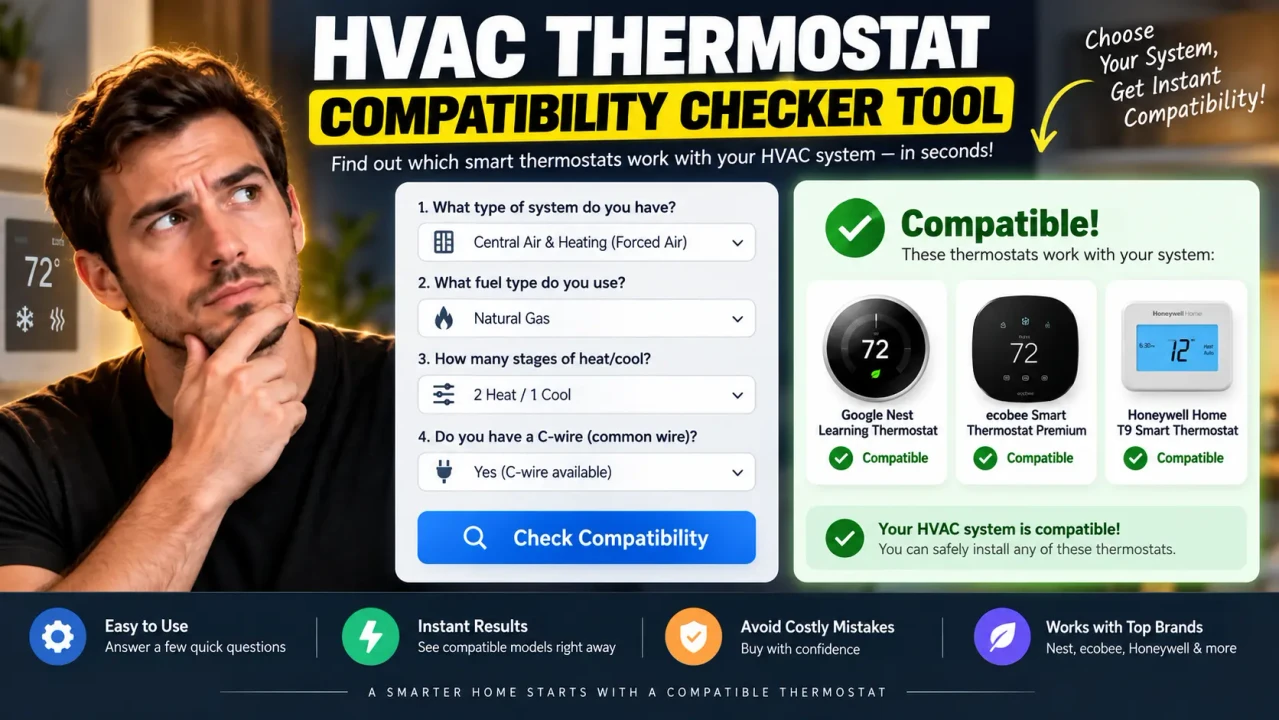
Hvac Thermostat Compatibility Checker Tool
TL;DR Summary
The Hvac Thermostat Compatibility Checker Tool compares your HVAC system type, control voltage, heating and cooling stages, C-wire situation, and heat-pump requirements with the capabilities you enter for a replacement thermostat. It is a compatibility screening tool, not a substitute for the thermostat manufacturer's wiring guide or a qualified HVAC professional, and no specific privacy behavior beyond the information shown on the tool page is assumed.
What This Tool Does
Choosing a replacement thermostat is not always as simple as matching the number of wires on the wall. The HVAC equipment, wire functions, heating and cooling stages, power method, and thermostat features all affect compatibility. Heat pump systems can add another layer because they may use an O/B reversing-valve connection and auxiliary heat controls.
The Hvac Thermostat Compatibility Checker Tool gives you a structured way to compare those requirements before you start an installation. You enter information about the existing HVAC system and the capabilities or requirements of the thermostat you are considering. The tool then checks for common compatibility conflicts and reports whether the information entered shows a potential match or an issue that needs further review.
This tool is intended for homeowners, renters, HVAC customers, technicians performing an initial check, and anyone researching a thermostat replacement. It can also be useful when comparing a conventional furnace-and-air-conditioner setup with a thermostat that supports multiple stages or when checking a heat pump installation.
What You Need to Enter
Start by identifying the type of HVAC system. The available choices cover conventional heating and cooling, heat-only systems, cool-only systems, and heat pumps. The system type matters because a heat pump uses different control functions from many conventional systems.
You also enter the HVAC control voltage. The checker is designed around typical 24 VAC thermostat systems. A millivolt or otherwise different system should not be treated as automatically compatible with a conventional 24 VAC thermostat simply because the wire labels look familiar.
Next, enter the number of heating and cooling stages. A single-stage system and a multi-stage system do not place the same demands on a thermostat. The checker compares your equipment's stage count with the maximum heating and cooling stages supported by the thermostat.
The C wire is another important input. The common wire, normally labeled C, can provide 24 VAC common power to a thermostat. Some modern thermostats require a C wire, while some products provide another power method or an approved adapter. Manufacturer documentation should always be checked for the exact thermostat being installed. Resideo documentation, for example, identifies C as the 24 VAC common connection on supported systems and documents C-wire adapter options for certain products. Resideo's compatibility guidance also specifically directs users to check thermostat compatibility with existing wiring. :contentReference[oaicite:0]{index=0}
For a heat pump, the checker asks about the O/B reversing-valve connection and auxiliary heat. These are important because a heat-pump thermostat needs to provide the control functions required by the equipment. Manufacturer wiring documents show O/B as the changeover-valve connection and Aux/E as a control for auxiliary or emergency heat on applicable heat-pump configurations. Some equipment may use B instead of O for the reversing valve, so the exact equipment documentation remains important. :contentReference[oaicite:1]{index=1}
How to Use
- Step 1: Identify your HVAC system type and control voltage from the existing thermostat, equipment documentation, or a qualified HVAC professional.
- Step 2: Enter the number of heating and cooling stages supported by your HVAC equipment.
- Step 3: Check whether a C wire is present and, for a heat pump, identify the O/B and auxiliary-heat connections.
- Step 4: Enter the replacement thermostat's supported system type, maximum stages, C-wire requirement, and heat-pump features using its product specifications or installation guide.
- Step 5: Review the compatibility result and read the explanation for any identified conflict.
- Step 6: Before wiring the thermostat, compare the result with the exact manufacturer's installation instructions for your HVAC equipment and thermostat model.
How the Compatibility Check Works
This is a rule-based compatibility check rather than a single mathematical formula. The tool compares the requirements of the HVAC system with the capabilities entered for the thermostat.
The main checks can be summarized as:
Stage compatibility:
Thermostat heating stages supported ≥ HVAC heating stages
Thermostat cooling stages supported ≥ HVAC cooling stages
If the equipment requires more stages than the thermostat supports, the thermostat cannot be assumed to control every available stage.
System-type compatibility:
A conventional system requires a thermostat identified as supporting conventional equipment. A heat pump requires a thermostat identified as supporting heat pumps. A thermostat that supports both categories can satisfy either system-type requirement, subject to its other limitations.
C-wire compatibility:
If the thermostat requires a C wire, the check looks for either an identified C wire or a compatible C-wire adapter or alternative explicitly entered as supported by the thermostat. The presence of a wire alone does not prove that it is correctly connected or available for the intended function.
Heat-pump compatibility:
For a heat pump, the check considers the reversing-valve requirement and auxiliary heat. If the entered equipment uses an O/B reversing-valve connection, the thermostat must support that function. If auxiliary heat is present, the thermostat must also be identified as supporting auxiliary heat. Manufacturer documentation shows that heat-pump wiring can include O/B, C, Y, G, R, and auxiliary/emergency heat connections depending on the system. :contentReference[oaicite:2]{index=2}
Understanding Common Thermostat Wires
| Terminal | Common Function | Why It Matters |
|---|---|---|
| R / Rc | 24 VAC power connections | Provides thermostat control power on applicable systems. |
| C | 24 VAC common | Often used to provide continuous power to modern thermostats. |
| Y / Y2 | Compressor stages | Controls cooling or heat-pump compressor stages. |
| W / W2 | Heating stages | Commonly used for conventional heating stages. |
| G | Fan relay | Controls the indoor fan on applicable systems. |
| O/B | Heat-pump changeover valve | Used by compatible heat-pump thermostats to control the reversing valve. |
| AUX/E | Auxiliary or emergency heat | Used on applicable heat-pump systems for backup heating functions. |
Terminal names are not universal instructions. Manufacturer documentation may use alternate labels, and some equipment has special wiring arrangements. Resideo documentation, for example, lists alternate wire labels and notes that some heat pumps use B rather than O for the reversing valve. :contentReference[oaicite:3]{index=3}
Worked Example
Suppose an existing home has a 24 VAC conventional system with one heating stage, one cooling stage, and a C wire. The replacement thermostat supports conventional systems, up to two heating stages and two cooling stages, and requires a C wire.
The stage checks pass because the thermostat supports at least as many stages as the HVAC equipment. The C-wire check also passes because a C wire is present. If the thermostat otherwise supports the system's required controls, the checker can report that no obvious compatibility conflict was entered.
Now consider a two-stage heat pump with auxiliary heat. If the replacement thermostat is listed only for conventional equipment, the system-type check identifies a conflict. Likewise, a thermostat that does not support the required O/B reversing-valve control or auxiliary heat should not be treated as compatible merely because the physical thermostat wire count appears sufficient.
Why Use This Hvac Thermostat Compatibility Checker Tool & How Our Hvac Thermostat Compatibility Checker Tool Beats the Competition
The practical benefit of a compatibility checker is that it organizes several related requirements in one place. It does not replace the detailed specifications for a particular thermostat or HVAC system. Instead, it provides an initial screening before you commit to wiring or purchasing a replacement.
| Method | Ease of Use | Calculation Speed | Best For | Limitations |
|---|---|---|---|---|
| Toolhox Hvac Thermostat Compatibility Checker Tool | Guided inputs | Immediate rule-based result | Initial compatibility screening | Depends on the information entered and does not replace model-specific documentation |
| Manual Calculation or Wiring Review | Requires HVAC knowledge | Depends on the person reviewing it | Detailed system-specific review | Easy to overlook a requirement or terminal function |
| Spreadsheet | Requires setup | Depends on spreadsheet design | Custom comparisons and record keeping | Rules must be created and maintained manually |
| Professional Engineering or HVAC Software | Usually more specialized | Depends on the software | Detailed system design and professional analysis | May require more system information and technical knowledge |
Assumptions and Limitations
The result is an initial compatibility assessment based on the values entered. It does not confirm the electrical condition of the wiring, the actual configuration of the HVAC equipment, or the complete feature set of a particular thermostat model.
The checker is built around common thermostat compatibility factors such as 24 VAC control systems, conventional versus heat-pump operation, heating and cooling stages, C-wire requirements, reversing-valve control, and auxiliary heat. Manufacturer documentation shows that actual wiring can vary by equipment and thermostat model. :contentReference[oaicite:4]{index=4}
Do not rely on this result alone when installing a thermostat. Check the exact thermostat installation guide and HVAC equipment documentation. Carrier specifically warns that advanced systems such as heat pumps, dual-fuel equipment, variable-speed equipment, and zoned systems can require specialized wiring and configuration. It also recommends professional help when compatibility or wiring is uncertain. :contentReference[oaicite:5]{index=5}
Never assume that wire color proves terminal function. Turn off HVAC power before handling thermostat wiring and follow the manufacturer's safety and installation instructions. If the wiring does not match the documentation, if the system uses unusual equipment, or if you cannot identify the existing controls, have a qualified HVAC professional review the installation.