Hvac Refrigerant Line Set Length Pressure Drop Calculator
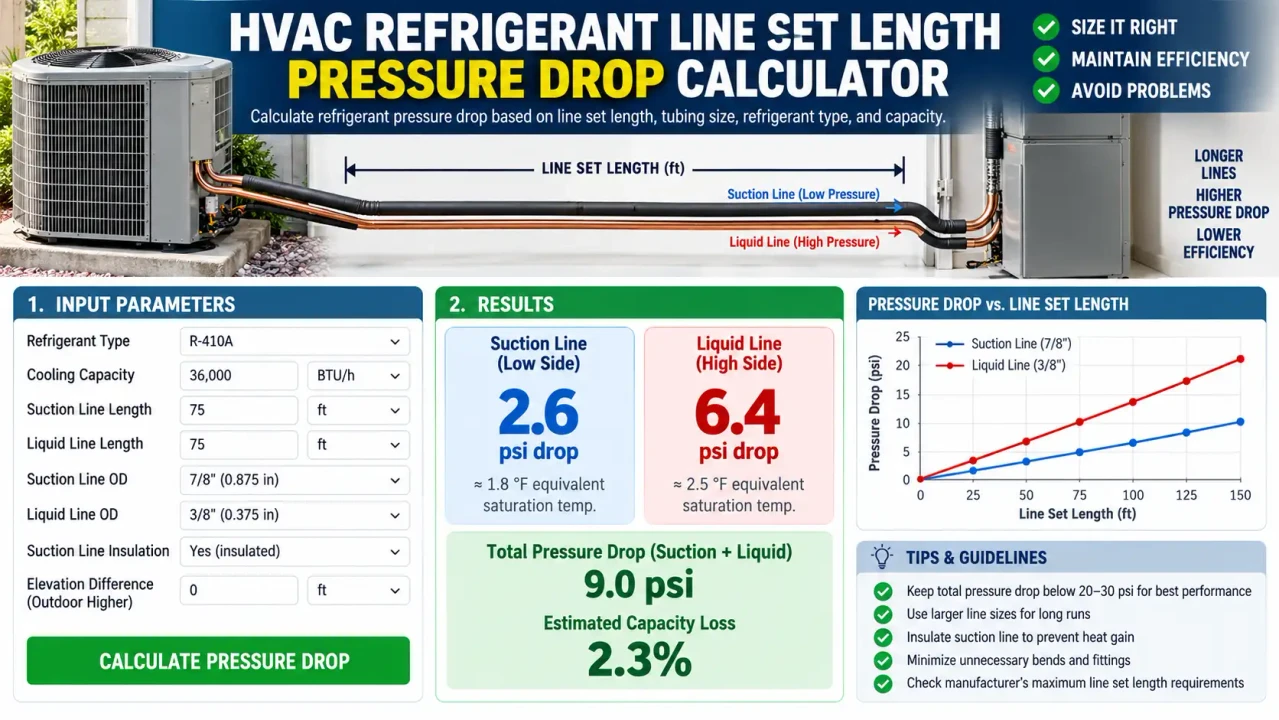
Hvac Refrigerant Line Set Length Pressure Drop Calculator estimates HVAC refrigerant line pressure drop from equivalent length and psi per 100 ft.
Please complete this field to continue.
Please complete this field to continue.
Please complete this field to continue.
Results
Hvac Refrigerant Line Set Length Pressure Drop Calculator
TL;DR Summary
The Hvac Refrigerant Line Set Length Pressure Drop Calculator estimates refrigerant piping pressure drop from straight line length, fittings and accessories equivalent length, and pressure drop per 100 feet. It is a planning estimate, not a complete refrigerant piping design, and the supplied tool information does not establish a specific privacy or data-storage policy.
About This Tool
The Hvac Refrigerant Line Set Length Pressure Drop Calculator helps estimate pressure loss through an HVAC refrigerant line set. Refrigerant piping creates resistance to flow, and that resistance can increase as the piping route becomes longer or includes fittings and accessories.
The calculator uses an equivalent-length method. You enter the straight line length, add any equivalent length assigned to fittings and accessories, and provide the applicable pressure drop per 100 feet. The calculator then estimates the total pressure drop for the combined equivalent length.
This tool can be useful for HVAC technicians, installers, contractors, service personnel, designers, and students who need a quick calculation for a refrigerant piping run. It can also help during preliminary planning when comparing different piping routes or checking the arithmetic behind a known pressure-drop value.
Inputs
The calculator requires three calculation inputs. The first is the straight refrigerant line length. The length input uses the calculator's length unit system, with feet as the reference unit for the pressure-drop calculation.
The second input is the equivalent length for fittings and accessories. This represents additional straight-pipe length used to account for the resistance of components in the refrigerant piping route. If no additional equivalent length is being used, enter zero.
The third input is pressure drop per 100 feet. This value should come from the applicable refrigerant piping table, equipment manufacturer's documentation, or another suitable engineering reference. It should match the refrigerant, pipe size, operating condition, and flow requirements being evaluated.
Outputs
The calculator returns two main results. The first is total equivalent line length in feet. This is the straight piping length plus the fittings and accessories equivalent length.
The second result is estimated pressure drop in psi. The result is calculated by scaling the supplied pressure-drop-per-100-foot value to the total equivalent line length.
How to Use
- Step 1: Determine the straight refrigerant line length for the piping route.
- Step 2: Determine the equivalent length for fittings and accessories from the applicable engineering or manufacturer data.
- Step 3: Enter the pressure drop per 100 feet for the actual refrigerant piping application.
- Step 4: Review the calculated total equivalent line length.
- Step 5: Review the estimated pressure drop in psi and compare it with the applicable system requirements.
Technical Explanation and Formula
The calculator uses the following equivalent-length relationship:
Total Equivalent Length = Straight Line Length + Fittings and Accessories Equivalent Length
The estimated pressure drop is then:
Estimated Pressure Drop = Total Equivalent Length × Pressure Drop per 100 ft ÷ 100
In this formula:
- Straight Line Length is the actual refrigerant piping length, expressed in feet.
- Fittings and Accessories Equivalent Length is the additional equivalent straight-pipe length, expressed in feet.
- Total Equivalent Length is the combined piping length used by the calculation, expressed in feet.
- Pressure Drop per 100 ft is the applicable pressure loss supplied by the user, expressed in psi per 100 feet.
- Estimated Pressure Drop is the calculated pressure loss, expressed in psi.
For example, if a refrigerant piping route has 75 feet of straight length and 25 feet of fitting equivalent length, the total equivalent length is 100 feet. If the applicable pressure-drop value is 3.5 psi per 100 feet, the estimated pressure drop is 3.5 psi.
This example demonstrates the arithmetic only. The 3.5 psi value is an illustrative input and is not a universal recommendation for a particular refrigerant, pipe diameter, or HVAC system.
Why Equivalent Length Matters
A refrigerant piping route can contain elbows, valves, tees, filters, and other components. These components can contribute resistance to refrigerant flow. Equivalent length provides a way to represent that additional resistance as an added length of straight pipe.
Refrigerant piping references can use pressure-drop tables expressed as pressure loss per 100 feet. When such a value is available, the calculator can scale it to the total equivalent piping length.
The pressure-drop input is therefore important. The calculator does not independently determine a universal pressure-drop rate for every refrigerant system. The value must be appropriate for the actual application.
Quick Reference Examples
| Straight Length | Fitting Equivalent Length | Total Equivalent Length | Pressure Drop per 100 ft | Estimated Pressure Drop |
|---|---|---|---|---|
| 50 ft | 0 ft | 50 ft | 2.0 psi | 1.000 psi |
| 75 ft | 25 ft | 100 ft | 3.5 psi | 3.500 psi |
| 120 ft | 30 ft | 150 ft | 4.0 psi | 6.000 psi |
These are mathematical examples for understanding the calculation. They should not be treated as recommended pressure-drop limits or equipment-selection values.
Important HVAC Design Factors
Line length is only one part of refrigerant piping design. The actual pressure drop can depend on the refrigerant, pipe diameter, mass flow, operating temperatures, system capacity, fittings, valves, elevation changes, and equipment requirements.
Because of these factors, this calculator does not select a pipe size or determine whether a pressure drop is acceptable for a particular system. Instead, it applies a pressure-drop-per-100-foot value that the user supplies from an appropriate source.
Elevation can also be important. A system with significant vertical piping may require additional analysis beyond a simple equivalent-length calculation. The applicable equipment documentation and refrigerant piping design data should be reviewed before using the result for an actual installation.
Assumptions and Limitations
The calculation assumes that the supplied pressure-drop-per-100-foot value is appropriate for the refrigerant piping application being evaluated. It also assumes that the fittings and accessories can be represented by the equivalent length entered by the user.
The calculator does not independently calculate refrigerant properties, mass flow, pipe friction from first principles, fitting coefficients, refrigerant charge, pipe-size selection, elevation pressure effects, or equipment capacity.
The result should therefore be treated as an estimate based on the supplied inputs. It should not be used as the sole basis for selecting refrigerant piping or approving an installation.
For long line sets, significant elevation changes, complex piping arrangements, critical capacity requirements, or equipment with specific piping restrictions, use the applicable manufacturer's engineering information and installation instructions and obtain professional engineering review when appropriate.
Why Use This Hvac Refrigerant Line Set Length Pressure Drop Calculator & How Our Calculator Beats the Competition
The calculator provides a focused way to apply an existing pressure-drop-per-100-foot value to an equivalent refrigerant piping length. It can reduce repetitive arithmetic while keeping the inputs and calculation method visible.
| Method | Ease of Use | Calculation Speed | Best For | Limitations |
|---|---|---|---|---|
| Toolhox Calculator | Enter the required values | Immediate calculation | Quick equivalent-length pressure-drop estimates | Does not replace system-specific piping data or detailed design |
| Manual Calculation | Requires arithmetic | Depends on the user | Checking a known formula manually | Manual arithmetic is required for each calculation |
| Spreadsheet | Requires spreadsheet setup | Depends on the spreadsheet | Projects with repeated calculations or stored scenarios | Requires formulas and inputs to be configured correctly |
| Professional Engineering Software | May require more setup | Depends on the software and model | Detailed HVAC and refrigerant piping analysis | Requires more system-specific information and modeling |
The practical advantage of this calculator is its focused scope. It does not attempt to replace detailed engineering software or manufacturer piping tables. It provides the arithmetic for a defined equivalent-length pressure-drop calculation.
When Not to Rely on the Result Alone
Do not use the calculated value by itself to determine whether a refrigerant piping installation is acceptable. A final piping design may require information that is outside the calculator's scope.
Always check the applicable equipment manufacturer's requirements, refrigerant piping tables, allowable line lengths, elevation limits, pipe-size requirements, and operating conditions. If those requirements conflict with a simple pressure-drop estimate, the applicable system-specific engineering information should control.