Kg To Liters Calculator For Density Of Milk
Calculate Kg To Liters Calculator For Density Of Milk to convert milk weight in kilograms to liters using density and get a practical volume :contentReference[oaicite:8]{index=8}
Please complete this field to continue.
Please complete this field to continue.
Results
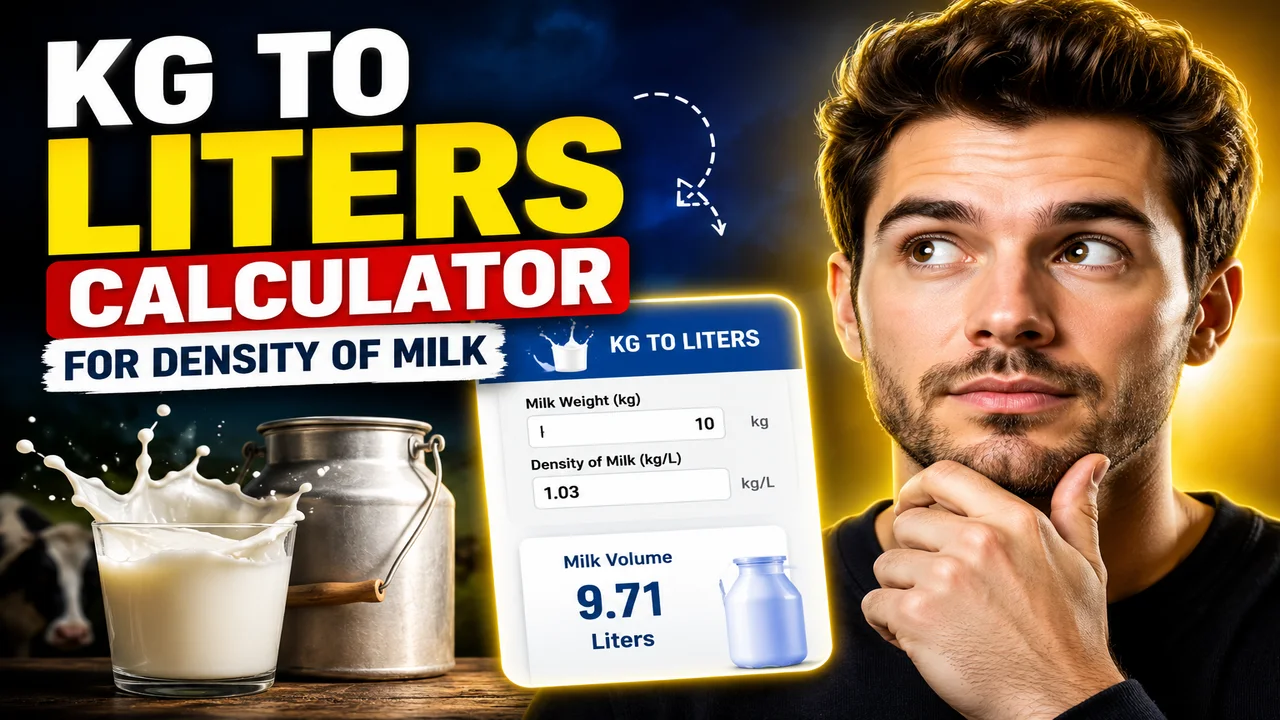
Kg To Liters Calculator For Density Of Milk
TL;DR Summary
The Kg To Liters Calculator For Density Of Milk converts a known milk weight in kilograms into an estimated volume in liters using milk density. It is a practical conversion tool, but the result can vary because milk density changes with composition, temperature, and other conditions; the supplied tool information does not establish a specific privacy or data-storage policy.
What This Calculator Does
The Kg To Liters Calculator For Density Of Milk helps convert the mass of liquid milk from kilograms (kg) to liters (L). Unlike a simple kilogram-to-liter conversion for water, milk needs a density value because a kilogram measures mass while a liter measures volume.
This distinction matters because milk is slightly denser than water. Published dairy references commonly place normal milk density in the range of about 1.028 to 1.033 kg/L. A commonly used reference value is approximately 1.03 kg/L. The exact density can vary with milk composition, including fat and solids content, as well as temperature and handling conditions.
The calculator is useful when you know how much milk you have by weight but need an approximate volume. It can help with everyday quantity checks, dairy handling, recipe planning, storage estimates, production calculations, and other situations where milk is measured in kilograms but the required result is liters.
What You Need to Enter
The calculator uses two numerical inputs:
- Milk Weight: Enter the amount of milk in kilograms.
- Milk Density: Enter the density in kilograms per liter (kg/L). A reference value of 1.03 kg/L can be used for a general estimate.
The density field is important because there is no single density value that applies to every milk sample. Dairy references report a normal range rather than one universal number. For example, the FAO Small-Scale Dairy Farming Manual gives a normal milk density of approximately 1.028–1.033 kg/L at 15°C or 20°C and notes that density depends on protein and fat content. :contentReference[oaicite:2]{index=2}
What the Calculator Produces
The main result is the estimated milk volume in liters. The calculator also shows the milk weight and the density value used in the calculation so you can check the inputs behind the result.
For example, if you enter 10 kg of milk and use a density of 1.03 kg/L, the estimated volume is about 9.71 liters.
How to Use
- Step 1: Enter the milk weight in kilograms, such as 10 kg.
- Step 2: Enter the milk density in kg/L. Use 1.03 kg/L for a general liquid cow's milk estimate when you do not have a measured density.
- Step 3: Review the calculated volume in liters.
- Step 4: Check the density used if you need a result based on a particular milk sample or measured density.
Technical Explanation and Formula
The standard mass-density relationship is:
Volume = Mass ÷ Density
For this calculator:
- Volume: estimated milk volume in liters (L).
- Mass: milk weight in kilograms (kg).
- Density: milk density in kilograms per liter (kg/L).
The calculation is therefore:
Liters = kilograms ÷ (kilograms per liter)
For example:
10 kg ÷ 1.03 kg/L = 9.7087 L
Rounded to two decimal places, the result is 9.71 L.
This follows the basic definition of density as mass divided by volume. Rearranging that relationship gives volume equal to mass divided by density. The FAO/INFOODS Density Database also lists milk density and specific-gravity values in the general range used for liquid milk, while other dairy references identify approximately 1.03 kg/L as a practical reference value. :contentReference[oaicite:3]{index=3}
Why Milk Density Matters
Milk is not exactly the same density as water. Its composition includes water, fat, proteins, lactose, minerals, and other solids. Changes in composition can change density. The FAO notes that milk density depends on factors such as protein and fat content. :contentReference[oaicite:4]{index=4}
Temperature can matter as well. Dairy measurement references commonly specify a temperature when reporting density or specific gravity. This means a calculation based on a general reference density should be treated as an estimate rather than a laboratory measurement.
Reference Density for Liquid Cow's Milk
| Reference | Density Information | Use in This Calculator |
|---|---|---|
| General reference | About 1.03 kg/L | Practical estimate |
| FAO dairy reference | About 1.028–1.033 kg/L at 15°C or 20°C | Shows normal variation |
| USDA FAS reference | Approximately 1.03 kg per liter of cow's milk | Supports the general reference value |
The values above are reference information, not a guarantee that a particular milk sample has exactly that density. The FAO specifically notes that local testing can be useful when an accurate conversion value is needed. :contentReference[oaicite:5]{index=5}
Preset Examples and Quick Reference
| Milk Weight | Density | Estimated Volume |
|---|---|---|
| 1 kg | 1.03 kg/L | 0.97 L |
| 5 kg | 1.03 kg/L | 4.85 L |
| 10 kg | 1.03 kg/L | 9.71 L |
| 20 kg | 1.03 kg/L | 19.42 L |
| 50 kg | 1.03 kg/L | 48.54 L |
| 100 kg | 1.03 kg/L | 97.09 L |
These examples use the same 1.03 kg/L reference density. They are mathematical examples rather than measurements of a particular milk product.
Why Use This Kg To Liters Calculator For Density Of Milk & How Our Calculator Beats the Competition
The main practical benefit of this tool is that it puts the mass-to-volume calculation into a simple input-and-result format. You do not need to rearrange the density equation manually. You can also enter a different density when you have a more appropriate value for the milk being measured.
| Method | Ease of Use | Calculation Speed | Best For | Limitations |
|---|---|---|---|---|
| Toolhox Calculator | Simple numeric inputs | Immediate calculation after input | Quick kg-to-liter milk estimates | Depends on the density entered |
| Manual Calculation | Requires the formula | Depends on the user | Checking or learning the calculation | More opportunity for arithmetic or unit errors |
| Spreadsheet | Requires setup | Can calculate repeated entries | Custom records and repeated calculations | Requires a spreadsheet and formula setup |
| Professional Measurement Equipment | Requires equipment and procedure | Depends on the measurement process | Obtaining an actual sample density | Not simply a conversion calculator |
This calculator is designed for the conversion step. It does not measure milk density itself. If you need a highly specific volume for purchasing, billing, laboratory work, quality control, or another process where the actual density matters, use a measured density from the relevant sample rather than relying only on a general reference value.
Assumptions and Limitations
The main assumption is that the selected density is representative of the milk being converted. A value of 1.03 kg/L is a practical general reference for liquid cow's milk, but actual density can vary.
The calculation does not independently identify milk type, fat percentage, protein level, temperature, adulteration, or other composition factors. It also does not measure density. Those factors can affect the relationship between milk mass and volume.
The result should therefore be treated as an estimate when a reference density is used. The FAO reports normal milk density around 1.028–1.033 kg/L and explains that density varies with milk composition. :contentReference[oaicite:6]{index=6} Another FAO source states that milk density normally varies around 1.028–1.034 kg/L and recommends local testing when a correct conversion value is needed for a particular area or application. :contentReference[oaicite:7]{index=7}
For ordinary quantity conversions, the calculator can provide a useful estimate. For commercial measurement, laboratory testing, dairy quality control, or any situation where a small density difference could materially affect the result, use an appropriate measured density and follow the applicable measurement procedure.
Privacy and Input Safety
The supplied calculator information does not establish a specific privacy, storage, or server-processing policy. Avoid entering sensitive or confidential information unless the page clearly explains how that information is handled. This calculator only requires numerical conversion inputs for its stated calculation.