Storm Water Storage Tank Sizing Tool
Estimate stormwater tank storage with Storm Water Storage Tank Sizing Tool using catchment area, rainfall depth, and runoff coefficient for planning.
Please complete this field to continue.
Please complete this field to continue.
Please complete this field to continue.
Please complete this field to continue.
Please complete this field to continue.
Results
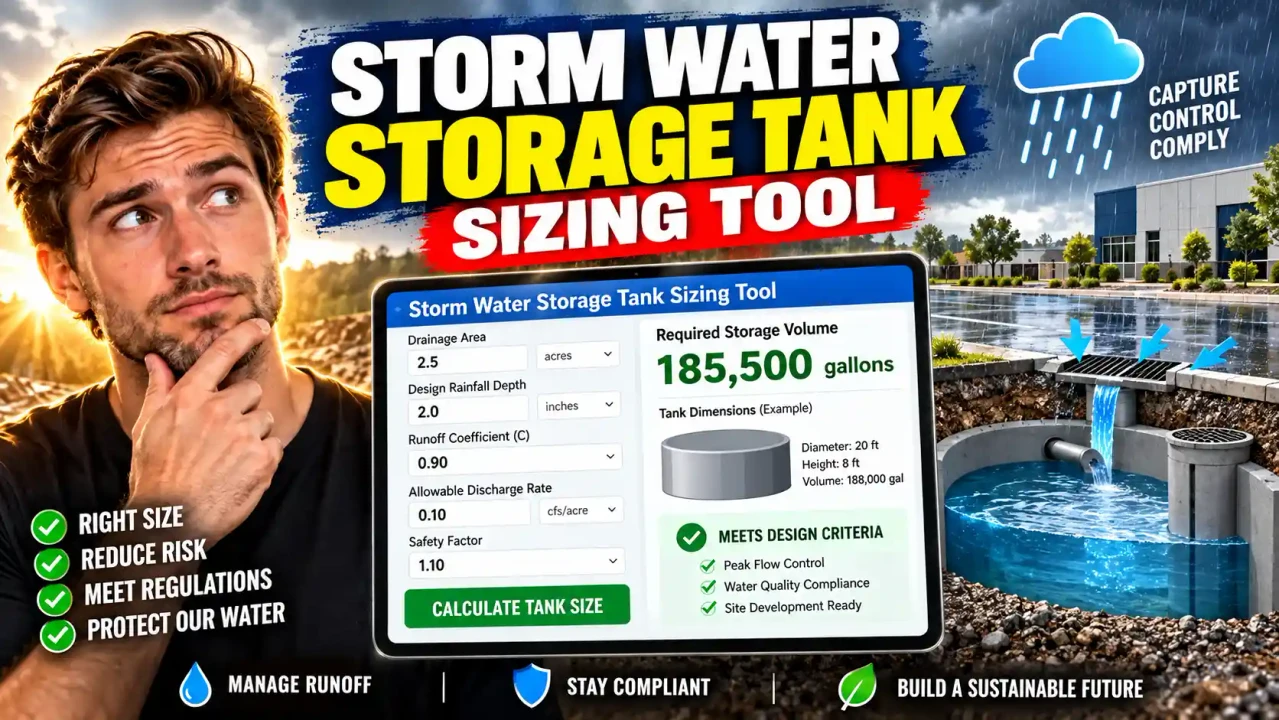
Storm Water Storage Tank Sizing Tool
TL;DR Summary
The Storm Water Storage Tank Sizing Tool estimates the stormwater storage volume needed from a catchment area, design rainfall depth, and runoff coefficient. It is a preliminary planning estimate, not a site-specific engineering design, and the supplied tool information does not establish how entered data is stored or transmitted, so avoid entering sensitive information unless the site's privacy terms are clear.
What This Tool Does
The Storm Water Storage Tank Sizing Tool helps estimate how much stormwater storage may be needed when rainfall from a defined catchment area is collected in a tank or cistern. The basic idea is simple: a larger collection area, a deeper design rainfall event, or a higher runoff coefficient produces more runoff and therefore requires more potential storage.
This type of estimate can be useful during early planning for homes, buildings, commercial sites, small developments, rainwater harvesting systems, and other projects where stormwater may be collected for storage. It can also provide a quick volume check before a more detailed hydrologic or hydraulic analysis is performed.
The calculator uses three main physical inputs. First, enter the catchment area, which is the surface that drains toward the storage system. The tool accepts square feet or acres. Second, enter the design rainfall depth and select inches or millimeters. Third, enter the runoff coefficient. The runoff coefficient represents the fraction of rainfall that is expected to become runoff. A coefficient of 1 means all of the rainfall is treated as runoff, while a coefficient of 0 means none of it is treated as runoff.
What You Need to Enter
- Catchment area: The roof, paved surface, or other drainage area contributing water to the tank.
- Area unit: Square feet or acres.
- Design rainfall depth: The rainfall depth selected for the design event.
- Rainfall unit: Inches or millimeters.
- Runoff coefficient: A value from 0 to 1 representing the fraction of rainfall expected to become runoff.
The tool returns the estimated required storage volume in gallons and cubic feet. It also reports the estimated runoff depth after applying the runoff coefficient. These results describe the runoff volume represented by the inputs. They do not select a particular commercial tank, tank shape, manufacturer, installation method, or regulatory design standard.
How to Use
- Step 1: Enter the catchment area that drains into the proposed stormwater tank, and choose square feet or acres.
- Step 2: Enter the rainfall depth for the storm event you want to evaluate, then choose inches or millimeters.
- Step 3: Enter a runoff coefficient between 0 and 1 that represents the expected runoff behavior of the collection surface.
- Step 4: Review the calculated storage volume in gallons and cubic feet.
- Step 5: Compare the calculated volume with available tank sizes and then check the result against the requirements that apply to the actual project location.
Technical Explanation and Formula
For preliminary sizing, the tool uses a simplified volumetric runoff relationship:
Runoff Volume = Rainfall Volume × Runoff Coefficient
In U.S. customary units, the calculation can be written as:
V = A × P × C
- V = estimated runoff volume in cubic feet
- A = catchment area in square feet
- P = rainfall depth in feet
- C = dimensionless runoff coefficient from 0 to 1
When rainfall is entered in inches, the calculator converts it to feet by dividing the rainfall depth by 12. It then converts the resulting cubic-foot volume to gallons using the standard relationship of approximately 7.48052 gallons per cubic foot.
If the catchment area is entered in acres, the calculator converts acres to square feet before performing the volume calculation. One acre equals 43,560 square feet. If rainfall is entered in millimeters, the calculator converts millimeters to inches before calculating the storage volume.
The runoff coefficient is important because not every drop of rainfall becomes collected runoff. Roofs and other highly impervious surfaces generally produce more runoff than surfaces where substantial infiltration can occur. EPA documentation describes the volumetric runoff coefficient as an empirical way to estimate total runoff volume from rainfall volume. EPA also notes that runoff coefficients represent effects such as infiltration, imperviousness, and other rainfall losses. :contentReference[oaicite:3]{index=3}
Choosing the Design Rainfall
The calculator does not automatically select a rainfall depth because the appropriate design storm depends on the project, location, duration, frequency, and applicable requirements. For U.S. projects, NOAA's National Weather Service Hydrometeorological Design Studies Center provides precipitation-frequency estimates through its precipitation-frequency data resources. NOAA describes Atlas 14 as the current precipitation-frequency resource, with different volumes covering different regions. :contentReference[oaicite:4]{index=4}
As of September 2026, NOAA is also developing Atlas 15. The current NOAA material identifies Atlas 14 as the existing precipitation-frequency resource while Atlas 15 is under development. Users should therefore use the precipitation-frequency information and design criteria required for the specific project and jurisdiction rather than assuming one rainfall depth applies across the United States. :contentReference[oaicite:5]{index=5}
Worked Example
Suppose a roof has a catchment area of 2,000 square feet. Assume the selected design rainfall is 2 inches and the runoff coefficient is 0.90.
First convert rainfall to feet:
2 ÷ 12 = 0.1667 feet
Then calculate runoff volume:
2,000 × 0.1667 × 0.90 ≈ 300 cubic feet
Convert the result to gallons:
300 × 7.48052 ≈ 2,244 gallons
For this example, the simplified calculation represents approximately 300 cubic feet, or about 2,244 gallons, of runoff. A physical tank selected for the project would need to account for the actual storage objective, available tank sizes, freeboard, overflow, outlet behavior, pretreatment, drawdown, and applicable design requirements.
Preset Examples and Quick Reference
| Input | Example | Meaning |
|---|---|---|
| Catchment area | 2,000 ft² | Surface draining toward the tank |
| Rainfall depth | 2 inches | Selected design rainfall depth |
| Runoff coefficient | 0.90 | 90% of rainfall is treated as runoff |
| Estimated runoff | ≈300 ft³ | Preliminary storage volume represented by the inputs |
| Estimated runoff | ≈2,244 gal | Same volume expressed in gallons |
Why the Result Is a Preliminary Estimate
A simple volume calculation is not the same as a complete stormwater model. EPA's National Stormwater Calculator and SWMM support more detailed analysis involving rainfall, runoff processes, storage, drainage, infiltration, routing, and other site conditions. EPA describes SWMM as a dynamic rainfall-runoff model that can evaluate storage and drainage systems, including detention facilities. :contentReference[oaicite:6]{index=6}
A real tank may also have an outlet that releases water between storms. If the tank has already been partly filled when a storm begins, the available storage will be smaller than its total physical capacity. Conversely, if water is regularly used for irrigation or another permitted purpose, the tank may have more available storage before the next rainfall event. EPA material on rainwater harvesting notes that tank sizing can depend on local precipitation, catchment area, water demand, and storage objectives. :contentReference[oaicite:7]{index=7}
Why Use This Storm Water Storage Tank Sizing Tool & How Our Calculator Beats the Competition
| Method | Ease of Use | Calculation Speed | Best For | Limitations |
|---|---|---|---|---|
| Toolhox Calculator | Enter a small set of inputs | Immediate calculation | Preliminary storage-volume estimates | Does not perform a full site-specific hydrologic or hydraulic model |
| Manual Calculation | Requires the formula and unit conversions | Depends on the user | Checking a simple runoff-volume calculation | More opportunity for unit or arithmetic errors |
| Spreadsheet Calculation | Requires spreadsheet setup | Fast after setup | Repeated calculations and project worksheets | Requires the user to build and maintain the formulas |
| Professional Engineering Software | Requires more setup and technical inputs | Depends on the model | Detailed stormwater and drainage analysis | More data and modeling decisions are required |
The practical advantage of this tool is its narrow purpose. It turns catchment area, rainfall depth, and runoff coefficient into a preliminary storage-volume estimate without requiring a complete hydrologic model. That makes it useful for an early planning check. It should not be treated as a replacement for detailed engineering software or project-specific stormwater design.
Assumptions and Limitations
- The calculation assumes the selected rainfall depth represents the design event being evaluated.
- The runoff coefficient is supplied by the user and has a major effect on the result.
- The simplified calculation treats the runoff coefficient as a volume fraction.
- Depression storage is not separately modeled.
- Infiltration is not calculated separately.
- Tank drawdown between storms is not modeled.
- Existing water in the tank is not modeled.
- Overflow structures and outlet controls are not modeled.
- Freeboard, sediment storage, pretreatment, structural design, and tank geometry are not selected by this calculator.
- The tool does not determine the rainfall frequency, duration, or return period required by a local authority.
- State, county, municipal, watershed, and project-specific stormwater requirements may use different methods or design criteria.
For a regulated development, flood-control project, detention system, or other project requiring formal approval, the calculated volume should be reviewed against the applicable state and local stormwater manual and project requirements. NOAA advises users to consult the governing regulatory agency when selecting the appropriate precipitation-frequency resource. :contentReference[oaicite:8]{index=8}
In short, the Storm Water Storage Tank Sizing Tool is best viewed as a preliminary planning calculator. It provides a transparent estimate based on the information entered. A final tank or stormwater system should be selected only after considering the actual site, drainage network, rainfall data, storage objective, overflow path, outlet configuration, and applicable engineering and regulatory requirements.