Solar Panel Shading Loss Calculator Tool Online
Calculate Solar Panel Shading Loss Calculator Tool estimates energy lost from a shading percentage and shows remaining PV output from a baseline energy value.
Please complete this field to continue.
Please complete this field to continue.
Results
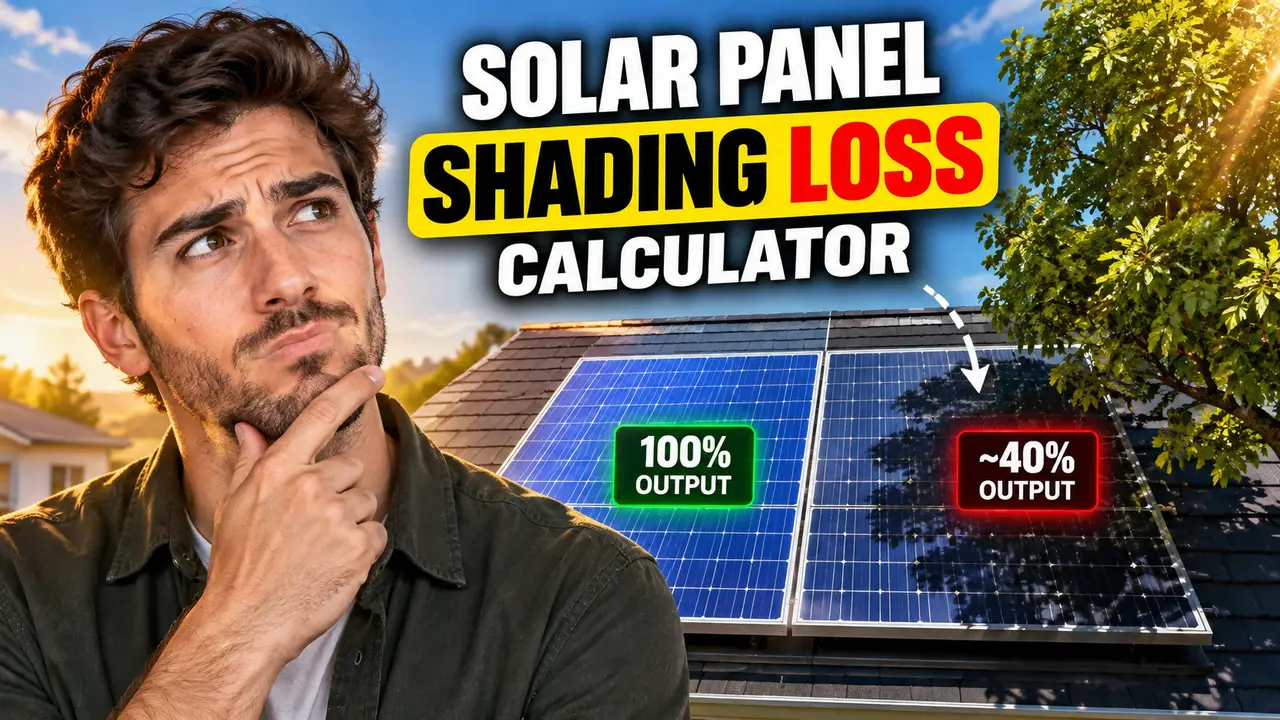
Solar Panel Shading Loss Calculator Tool
TL;DR Summary
The Solar Panel Shading Loss Calculator Tool estimates how much photovoltaic energy is lost when a solar system has a known shading-loss percentage, then shows the remaining energy output. It is a simplified estimate based on the values you enter, and privacy behavior is not specified by the supplied tool information, so avoid entering sensitive information unless the page explains how submitted data is handled.
What the Solar Panel Shading Loss Calculator Tool Does
The Solar Panel Shading Loss Calculator Tool helps you estimate the effect of shading on a solar photovoltaic (PV) system. Shading can come from trees, nearby buildings, roof structures, poles, mountains, or other objects that block sunlight from reaching the solar array. Even when a solar panel remains exposed to some sunlight, shading can reduce the energy that the system produces.
This calculator is designed for a simple calculation when you already have a baseline PV energy value and a shading-loss percentage. Instead of trying to model the sun's position, local weather, panel layout, or electrical behavior, it applies the supplied shading percentage directly to the baseline energy figure. This makes the result easy to understand and useful for an initial estimate.
The main input is Baseline PV Energy, entered in kilowatt-hours (kWh). This is the amount of energy the system would produce before applying the specified shading loss. You then enter Shading Loss (%), which represents the estimated percentage of that baseline energy lost because of shading.
The calculator produces three main results. Energy Lost to Shading shows the amount of PV energy attributed to the entered shading percentage. Remaining PV Energy shows the baseline energy after the shading loss is removed. Effective Output shows the percentage of the baseline energy that remains after the shading loss.
For example, if the baseline energy is 1,000 kWh and the estimated shading loss is 3%, the estimated energy loss is 30 kWh. The remaining energy is 970 kWh, and the effective output is 97% of the baseline value. The calculation does not require you to enter a panel count, panel wattage, roof area, latitude, tilt, azimuth, or weather data.
Who Can Use It?
The calculator can be useful for homeowners, solar customers, installers, property planners, students, and anyone who needs a straightforward way to translate a known shading-loss percentage into an energy estimate. It can also help when comparing an unshaded baseline with a scenario where shading is expected to reduce production.
It is particularly useful during an early planning discussion. For example, if a solar estimate gives you an expected annual energy production figure and a separate shading assessment gives you an estimated loss percentage, you can use those two values to estimate the energy impact of shading.
The tool should not be treated as a full solar design or shading-analysis program. A real PV system can respond to shading in ways that depend on module layout, string configuration, bypass diodes, module-level power electronics, inverter behavior, the timing of shadows, solar position, and the difference between direct and diffuse sunlight. The simple percentage approach does not model those factors individually.
How to Use
- Step 1: Enter the baseline PV energy in kWh. Use the energy value before the shading loss is applied.
- Step 2: Enter the estimated shading loss as a percentage from 0% to 100%.
- Step 3: Review the estimated energy lost to shading, remaining PV energy, and effective output percentage.
- Step 4: Compare the remaining energy with your baseline value to understand the estimated production impact.
Technical Explanation and Formula
The calculator uses a simple percentage-loss calculation. The standard model treats the entered shading loss as a reduction applied to the baseline PV energy.
Energy Lost to Shading = Baseline PV Energy × (Shading Loss ÷ 100)
Remaining PV Energy = Baseline PV Energy − Energy Lost to Shading
Effective Output = 100 − Shading Loss
Here, Baseline PV Energy is the starting energy value in kWh. Shading Loss is the estimated loss percentage. Energy Lost to Shading and Remaining PV Energy are expressed in kWh. Effective Output is expressed as a percentage.
This percentage-loss approach is consistent with the way PVWatts represents user-specified system losses as percentages of PV energy. NREL's PVWatts documentation identifies shading as one of the loss categories and explains that system losses are applied as reductions rather than simply added together. NREL also notes that shading from nearby trees or structures may require external shading software or an on-site survey for a more appropriate estimate. :contentReference[oaicite:0]{index=0}
Because this Toolhox calculator has only two user inputs, it does not reproduce the detailed shading models available in more advanced PV performance software. NREL's research on partial shading shows that shading can have non-linear effects on PV array performance, depending on system design and module-level behavior. :contentReference[oaicite:1]{index=1}
Worked Example
| Input or Result | Example Value |
|---|---|
| Baseline PV Energy | 1,000 kWh |
| Shading Loss | 3% |
| Energy Lost to Shading | 30 kWh |
| Remaining PV Energy | 970 kWh |
| Effective Output | 97% |
The example is calculated as follows: 1,000 × 0.03 = 30 kWh of estimated shading loss. Subtracting 30 kWh from 1,000 kWh leaves 970 kWh. The remaining percentage is 100% − 3% = 97%.
Understanding Shading Loss
A shading-loss percentage is not the same thing as the percentage of a solar panel's physical surface that is covered by shade. A panel can experience electrical effects that are different from a simple shaded-area calculation. The time of day, season, shadow direction, array wiring, module technology, and power electronics can all affect actual production.
For that reason, the shading-loss input should represent an estimated energy loss percentage, not simply the percentage of panel area that appears shaded. If a solar professional or a detailed modeling program has provided a shading-loss estimate, that value is more appropriate for this calculator than a visual guess about shaded panel area.
NREL's PVWatts documentation gives shading as a user-specified loss category and explains that its default shading assumption represents horizon blocking from relatively distant features. It recommends increasing the loss appropriately when nearby trees or structures create shading and using external shading software or an on-site survey when needed. :contentReference[oaicite:2]{index=2}
Why Use This Solar Panel Shading Loss Calculator Tool & How Our Calculator Beats the Competition
The practical difference between calculation methods is mainly the amount of detail they require. This Toolhox calculator focuses on a known baseline energy value and a known shading-loss percentage. Other approaches may require more inputs or more detailed modeling.
| Method | Ease of Use | Calculation Detail | Best For | Limitations |
|---|---|---|---|---|
| Toolhox Calculator | Simple | Percentage-loss estimate | Quick shading-loss estimates from known values | Does not model site-specific solar geometry or electrical behavior |
| Manual Calculation | Requires arithmetic | Depends on the formula used | Checking a known percentage calculation | More opportunity for input or arithmetic mistakes |
| Spreadsheet Calculation | Flexible | Can range from simple to detailed | Repeated scenarios and custom models | Requires setup and maintenance of formulas |
| Professional PV Modeling Software | More complex | Can model site and system characteristics in greater detail | Detailed solar design and energy-yield analysis | Requires more inputs, modeling choices, and technical knowledge |
Assumptions and Limitations
The main assumption is that the entered shading-loss percentage can be applied directly to the baseline PV energy. The calculator does not determine the shading percentage from a photograph, roof plan, panel dimensions, tree height, obstruction distance, sun-path diagram, latitude, tilt, azimuth, or hourly irradiance data.
The calculator also does not model the detailed electrical effects of partial shading. A shadow over part of a module or array can sometimes cause losses that are not proportional to the shaded physical area. System design choices such as module-level power electronics and string configuration can also change the impact.
Results should therefore be treated as estimates. For a new solar installation, a major design decision, financing analysis, or performance guarantee, use a site-specific assessment and appropriate PV modeling. NREL and the U.S. Department of Energy describe shading as an important factor in PV energy yield and identify more detailed modeling resources for analyzing environmental and system effects. :contentReference[oaicite:3]{index=3}
Use the calculator when you have a reasonable baseline energy value and a shading-loss percentage that you want to translate into estimated energy loss. If you only know that part of a panel is shaded, that information alone should not be treated as an exact shading-loss percentage.