Solar Panel Series Vs Parallel Calculator Online
Use the Solar Panel Series Vs Parallel Calculator to compare panel voltage, current, and power for series and parallel connections before planning an :contentReference[oaicite:9]{index=9}:contentReference[oaicite:10]{index=10}:contentReference[oaicite:11]{index=11}
Please complete this field to continue.
Please complete this field to continue.
Please complete this field to continue.
Please complete this field to continue.
Please complete this field to continue.
Results
Solar Panel Series Vs Parallel Calculator
TL;DR Summary
The Solar Panel Series Vs Parallel Calculator compares the voltage, current, and approximate rated power of identical solar panels wired in series versus parallel. It is a basic electrical planning tool, not a complete solar-system design check, and its privacy behavior is not specified by the supplied tool information.
About the Solar Panel Series Vs Parallel Calculator
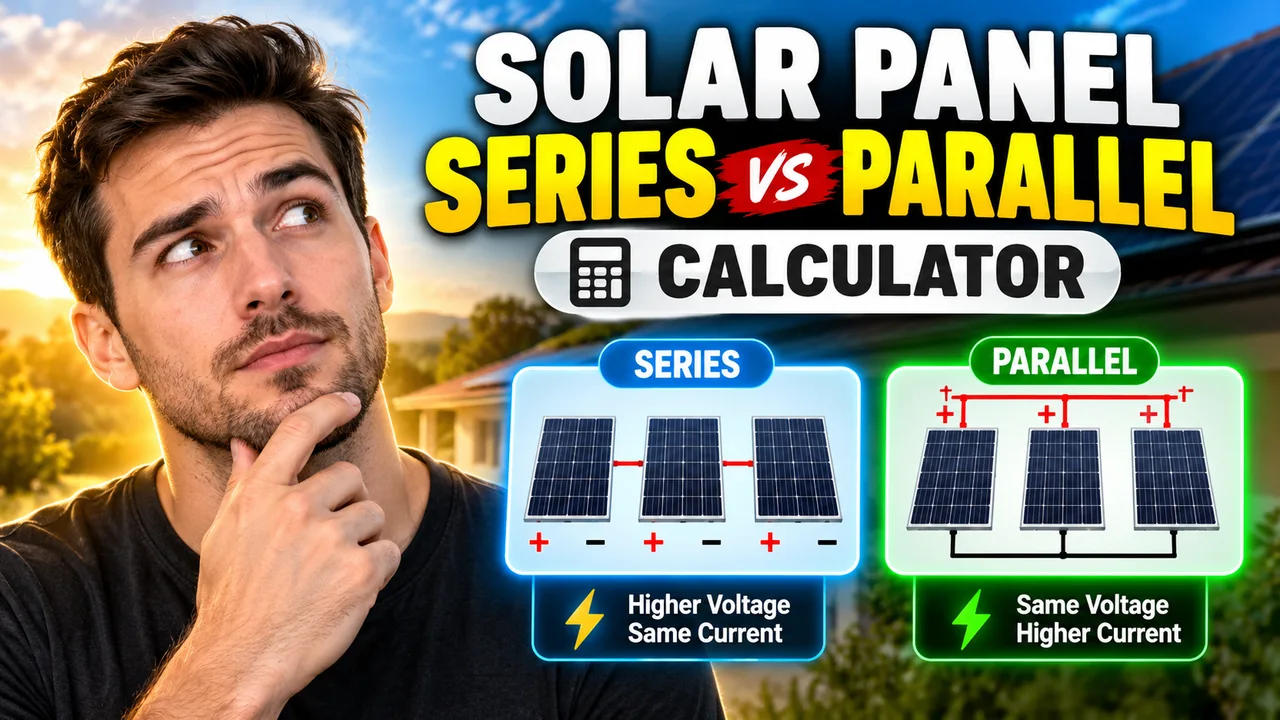
The Solar Panel Series Vs Parallel Calculator helps you understand how the electrical ratings of solar panels change when multiple panels are connected together. The main difference is simple: a series connection increases voltage while keeping current at approximately the same panel rating, while a parallel connection keeps voltage approximately the same while increasing current.
This distinction matters when planning a photovoltaic (PV) array. An inverter, charge controller, battery system, wiring system, or other connected equipment may have specific voltage and current limits. Understanding the expected array voltage and current is therefore an important early step before selecting a wiring arrangement.
The calculator is designed for homeowners, solar learners, DIY users, technicians, students, and anyone who wants to compare basic series and parallel configurations. It uses the electrical ratings you enter for one panel and applies the standard series and parallel relationships to the selected number of panels.
What You Enter
The calculator asks for five basic values:
- Number of solar panels: The number of identical panels being compared.
- Vmp: Voltage at maximum power, measured in volts (V).
- Imp: Current at maximum power, measured in amps (A).
- Voc: Open-circuit voltage, measured in volts (V).
- Isc: Short-circuit current, measured in amps (A).
These values are normally found on a panel's electrical specification label or datasheet. For the basic calculation to be meaningful, the panels should have compatible electrical ratings. The calculator does not identify a panel model or retrieve manufacturer specifications automatically.
What the Calculator Produces
The results show the expected electrical ratings for both connection types. For the series configuration, the calculator reports Vmp, Imp, Voc, Isc, and calculated power. For the parallel configuration, it reports the same five values.
Power is shown in watts (W). Voltage is shown in volts (V), and current is shown in amps (A). The power calculation uses the maximum-power voltage and maximum-power current entered for one panel.
Series Connections Explained
When identical PV panels are connected in series, their voltages add while the current remains approximately equal to the current of one panel. The U.S. Department of Energy describes this basic relationship by showing that two 12-volt, 3-amp modules connected in series produce 24 volts at 3 amps. :contentReference[oaicite:1]{index=1}
For example, suppose you have three identical panels with a Vmp of 40 V and an Imp of 10 A. A simple series calculation gives 120 V at 10 A at maximum power. The corresponding rated power is 1,200 W.
Series wiring can therefore be useful when a system needs a higher DC operating voltage. However, the resulting voltage must be checked against the permitted operating range and maximum DC voltage of the connected equipment. Open-circuit voltage is especially important when checking maximum voltage because the series Voc also increases with the number of panels.
Parallel Connections Explained
When identical PV panels are connected in parallel, the voltage remains approximately equal to the voltage of one panel while the currents add. The Department of Energy gives the example that two 12-volt, 3-amp modules in parallel produce 12 volts at 6 amps. :contentReference[oaicite:2]{index=2}
Using the same three 40 V, 10 A panels, a simple parallel calculation gives 40 V at 30 A at maximum power. The calculated rated power is again 1,200 W.
This illustrates an important point: under the calculator's simple idealized assumptions, series and parallel wiring produce the same calculated power from the same number of identical panels. What changes is the voltage-current combination.
How to Use the Solar Panel Series Vs Parallel Calculator
- Step 1: Enter the number of identical solar panels you want to compare.
- Step 2: Enter the panel's Vmp and Imp ratings from its electrical specification.
- Step 3: Enter the panel's Voc and Isc ratings from the same specification.
- Step 4: Review the Series results to see how voltage and current change when the panels are connected in series.
- Step 5: Review the Parallel results to see how voltage and current change when the panels are connected in parallel.
- Step 6: Compare the resulting voltage and current with the limits and operating range of the inverter, charge controller, battery equipment, wiring, and other components before building an actual system.
Technical Explanation and Formula
The formulas used here are the standard idealized electrical relationships for identical PV modules connected in series or parallel. They describe the arithmetic relationship between module ratings; they do not model every operating condition of a real PV array.
Series Formula
For N identical panels:
Series Vmp = N × Panel Vmp
Series Imp = Panel Imp
Series Voc = N × Panel Voc
Series Isc = Panel Isc
Series Power = Series Vmp × Series Imp
Here, Vmp is voltage at maximum power in volts, Imp is current at maximum power in amps, Voc is open-circuit voltage in volts, Isc is short-circuit current in amps, and N is the number of panels.
Parallel Formula
For N identical panels:
Parallel Vmp = Panel Vmp
Parallel Imp = N × Panel Imp
Parallel Voc = Panel Voc
Parallel Isc = N × Panel Isc
Parallel Power = Parallel Vmp × Parallel Imp
Electrical power is calculated as voltage multiplied by current. The U.S. Department of Energy describes electrical power as the product of current and voltage. :contentReference[oaicite:3]{index=3}
Worked Example
Assume four identical panels, each rated at 40 V Vmp, 10 A Imp, 48 V Voc, and 10.5 A Isc.
| Value | Series | Parallel |
|---|---|---|
| Vmp | 160 V | 40 V |
| Imp | 10 A | 40 A |
| Voc | 192 V | 48 V |
| Isc | 10.5 A | 42 A |
| Calculated power | 1,600 W | 1,600 W |
The example shows why connection choice is not simply about choosing the configuration with more power. With identical panels and the same number of modules, the idealized calculated power is the same. The important difference is whether that power is delivered at a higher voltage and lower current, or a lower voltage and higher current.
Why Use This Solar Panel Series Vs Parallel Calculator & How Our Calculator Beats the Competition
The practical value of this calculator is that it puts the basic series-versus-parallel arithmetic in one place. It can be used as an initial comparison before checking equipment specifications and detailed installation requirements.
| Method | Ease of Use | Calculation Speed | Best For | Limitations |
|---|---|---|---|---|
| Toolhox Calculator | Enter panel ratings and panel count | Immediate calculator result | Basic series-versus-parallel comparison | Does not perform complete PV system design or equipment matching |
| Manual Calculation | Requires applying the formulas yourself | Depends on the user | Learning and checking individual calculations | More opportunity for arithmetic or transcription errors |
| Spreadsheet | Requires creating or maintaining formulas | Fast after setup | Custom calculations and repeated scenarios | Formula setup and input management are required |
| Professional Engineering Software | Typically requires more setup | Depends on the software and model | Detailed system design and engineering analysis | More complex than a basic series/parallel comparison |
Assumptions and Limitations
This Solar Panel Series Vs Parallel Calculator uses a simplified electrical model. It assumes the panels are identical and that their stated electrical ratings can be combined using standard series and parallel relationships. It does not simulate the full current-voltage behavior of a PV array under changing sunlight, temperature, shading, mismatch, wiring losses, or other operating conditions.
Real PV module output changes with environmental conditions. The Department of Energy notes that temperature affects PV electrical behavior, including a much larger effect on voltage than on current. :contentReference[oaicite:4]{index=4} A detailed PV model can therefore produce different operating values from a simple multiplication of nameplate ratings. NREL's photovoltaic modeling work also treats PV arrays as combinations of series and parallel-connected modules and uses more detailed electrical relationships for actual PV behavior. :contentReference[oaicite:5]{index=5}
The calculator also does not determine whether a particular inverter, charge controller, battery, combiner, fuse, conductor, or disconnect is correctly sized. It does not calculate wire voltage drop, temperature-adjusted maximum voltage, maximum power point tracking range, overcurrent protection, shading losses, or code compliance.
Before installing a system, compare calculated values with the manufacturer's equipment specifications and applicable electrical requirements. The Department of Energy notes that PV systems include modules, power-conditioning equipment, and other system components, while qualified installers need to account for applicable building, fire, and electrical codes. :contentReference[oaicite:6]{index=6}
Do not use the result by itself as an engineering approval or installation instruction. For a real solar installation, a qualified solar professional should review the complete design, especially where maximum DC voltage, current, conductor sizing, protection, equipment compatibility, or local requirements are involved.