Solar Panel Mounting Rail Length Calculator Online
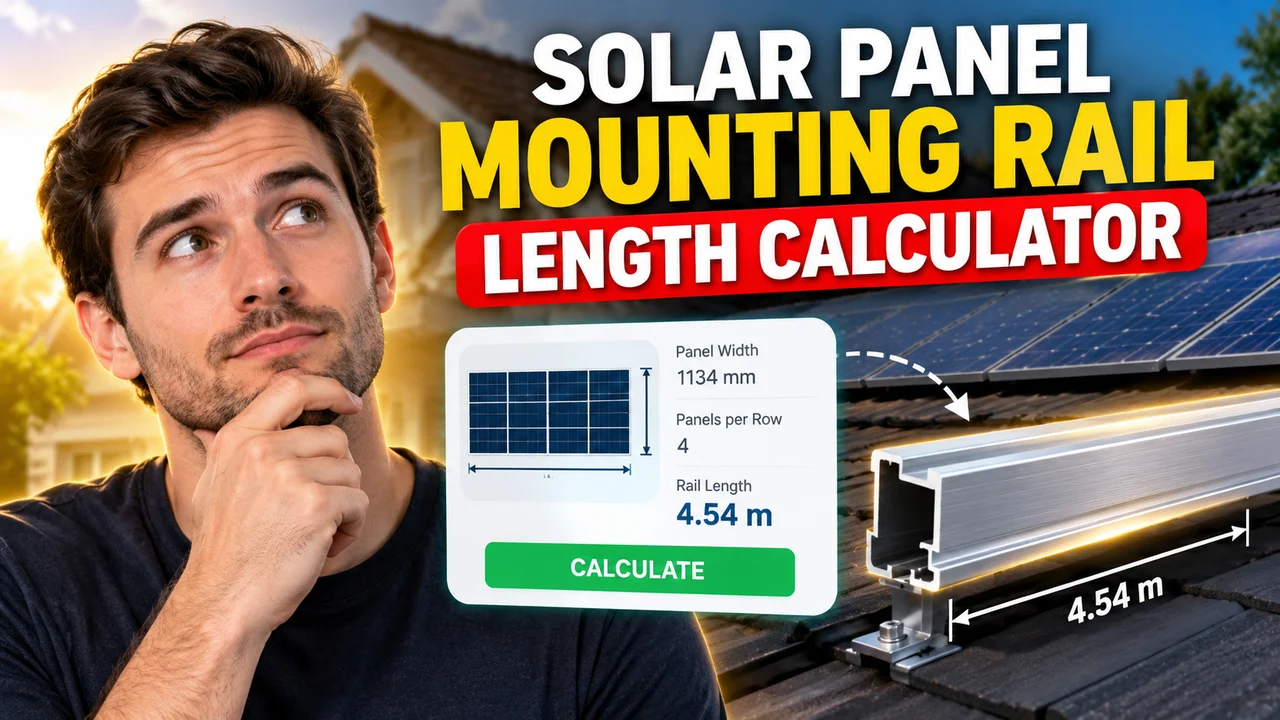
Solar Panel Mounting Rail Length Calculator estimates rail length from panel width, panel count, module gaps, and end overhang for solar array planning needs.
Please complete this field to continue.
Please complete this field to continue.
Please complete this field to continue.
Please complete this field to continue.
Results
Solar Panel Mounting Rail Length Calculator
TL;DR Summary
The Solar Panel Mounting Rail Length Calculator estimates the rail length needed for a row of solar panels using panel width, panel count, the gap between panels, and rail overhang at each end. Use the result for layout and material planning, then verify the final rail size, clamp requirements, rail spans, and structural design against the specific racking and module manufacturer's installation instructions; privacy behavior for this page is not specified, so avoid entering sensitive information.
About This Tool
The Solar Panel Mounting Rail Length Calculator helps solar installers, designers, DIY solar users, and project planners estimate how long a mounting rail should be for one row or run of photovoltaic modules. Instead of adding each panel dimension by hand, you can enter the panel width, number of panels, gap between adjacent panels, and the rail overhang required at each end. The calculator then combines those dimensions into an estimated total rail length.
The main problem this tool solves is simple: the physical width of a solar panel row is not always the same as the rail length. Small gaps between modules take up space, and the rail normally extends beyond the outside panels to provide room for the end-clamping arrangement. Leaving those items out can produce a rail-length estimate that is too short. Adding them explicitly gives you a clearer starting point for planning.
The calculator is designed around measurements commonly expressed in inches in U.S. solar mounting work. The default reference values are 0.25 inch between panels and 1.5 inches of rail overhang at each end. These values are consistent with documented Standard Series guidance from Unirac and rail-length guidance published by IronRidge. However, mounting systems differ. The defaults should therefore be treated as reference values, not as a universal requirement for every racking system. Manufacturer instructions should control the final design.
What You Enter
Panel Width: Enter the dimension of the module that runs along the rail. This is often the panel width when modules are arranged in portrait orientation, but the correct dimension depends on how your particular array is laid out.
Number of Panels: Enter the number of modules in the rail run. The calculator treats the panels as a single row for purposes of this length calculation.
Gap Between Panels: Enter the clear space between adjacent modules. The default reference value is 0.25 inch. The gap is counted only between panels, so a row of five panels has four panel-to-panel gaps.
Rail Overhang Per End: Enter the amount of rail extending beyond each outside panel. The default reference value is 1.5 inches per end. Both ends are included in the result.
How to Use
- Step 1: Measure the panel dimension that will run along the mounting rail and enter it as Panel Width.
- Step 2: Enter the number of panels that will share the rail run.
- Step 3: Check the required module-to-module spacing in the racking manufacturer's installation instructions and enter that value as Gap Between Panels.
- Step 4: Enter the required rail extension beyond each outside panel as Rail Overhang Per End.
- Step 5: Review the calculated rail length in inches and feet.
- Step 6: Compare the estimate with the actual rail profile, available rail lengths, splice requirements, clamp system, support locations, and the project-specific installation instructions before cutting or ordering material.
Technical Explanation and Formula
The standard calculation used for this tool is:
Rail Length = (Panel Width × Number of Panels) + (Panel Gap × (Number of Panels − 1)) + (End Overhang × 2)
Each variable represents a physical dimension:
- Panel Width: the panel dimension measured along the rail, in inches.
- Number of Panels: the number of modules in the rail run.
- Panel Gap: the spacing between neighboring modules, in inches.
- End Overhang: the rail extension beyond each outside panel, in inches.
- Rail Length: the calculated total rail length, in inches.
The gap is multiplied by one less than the number of panels because gaps occur between panels, not outside them. For example, five panels create four internal gaps. The end overhang is multiplied by two because the calculation includes both ends of the rail.
For the default reference values, suppose five panels are each 40 inches wide, the panel gap is 0.25 inch, and the rail overhang is 1.5 inches at each end.
Rail Length = (40 × 5) + (0.25 × 4) + (1.5 × 2)
Rail Length = 200 + 1 + 3 = 204 inches
That is 17.00 feet. This worked example matches the type of rail-length calculation documented in IronRidge's rail assembly guidance. Unirac's Standard Series installation guide also describes the installation area as total module width plus 1/4 inch for each module gap and approximately 3 inches for the two end clamps. :contentReference[oaicite:3]{index=3}
Units and Conversions
The calculator uses inches as its reference unit for the standard U.S. setup. The displayed feet result is calculated by dividing the final inch value by 12:
Rail Length in Feet = Rail Length in Inches ÷ 12
The calculator does not round intermediate values before completing the calculation. The displayed results are rounded to two decimal places. Keeping the intermediate calculation unrounded helps preserve the entered dimensions when fractional measurements are used.
Preset Examples and Quick Reference
| Input | Example Value |
|---|---|
| Panel Width | 40 in |
| Number of Panels | 5 |
| Panel Gap | 0.25 in |
| End Overhang Per End | 1.5 in |
| Calculated Rail Length | 204 in / 17 ft |
Another useful way to check the formula is to consider a single panel. With one panel, there are no internal module gaps. The result becomes the panel width plus two end-overhang allowances. This is an important boundary check because it confirms that the calculator does not add a nonexistent mid-clamp gap.
Why Rail Length Is Not the Same as Complete Structural Design
A rail-length calculation addresses one part of solar array planning. It does not determine whether a rail profile can safely support the modules under the project's wind, snow, seismic, or other structural loads. It also does not determine the correct attachment spacing, cantilever, rail span, clamp position, roof attachment, module orientation, grounding method, or fire-code layout.
Module manufacturers can also specify particular clamp locations and minimum overlap requirements. For example, Canadian Solar's 2026 installation manual states that clamp positions are important to installation reliability and provides module-specific clamping ranges and overlap requirements. Those requirements cannot be inferred from panel width alone. :contentReference[oaicite:4]{index=4}
Why Use This Solar Panel Mounting Rail Length Calculator & How Our Calculator Beats the Competition
| Method | Ease of Use | Calculation Speed | Best For | Limitations |
|---|---|---|---|---|
| Toolhox Calculator | Enter four dimensions | Immediate calculation | Quick rail-length estimates | Does not replace system-specific structural or installation design |
| Manual Calculation | Requires arithmetic | Depends on the user | Checking a simple row by hand | More opportunity for arithmetic or gap-counting mistakes |
| Spreadsheet | Requires setup | Fast after setup | Repeated project calculations | Formulas must be created and maintained correctly |
| Professional Engineering Software | Usually more involved | Depends on the software and model | Detailed structural and system design | More information and project inputs are typically required |
The practical value of this calculator is its narrow focus. If you already know the module dimensions and the spacing required by your mounting system, the tool gives you a direct rail-length estimate without requiring a full engineering model. A manual calculation remains useful as a check, while spreadsheets and engineering software may be more suitable when the project requires many rows, detailed material schedules, structural analysis, or system-specific design checks.
Assumptions and Limitations
- The calculation assumes one continuous rail run supporting the stated number of panels.
- The entered panel dimension is assumed to be the dimension that runs along the rail.
- The calculator counts one gap between each pair of adjacent panels.
- The end-overhang value is applied equally to both ends of the rail.
- The default 0.25-inch panel gap and 1.5-inch end allowance are reference values associated with documented standard mounting arrangements, not universal requirements.
- The result does not select a rail product or stock length.
- The result does not calculate rail span, cantilever, attachment spacing, structural capacity, wind loading, snow loading, seismic design, roof capacity, or code compliance.
- The result does not determine the correct clamp position for a particular solar module.
- The result does not account for every manufacturer's coupler, splice, thermal-expansion, end-cap, or attachment requirement.
- Different racking systems can use different module gaps and end-clamp allowances. The manufacturer's instructions should therefore be checked before material is cut or ordered.
Use the Solar Panel Mounting Rail Length Calculator as a planning and estimating aid rather than as a complete engineering design. For a permanent installation, verify the calculated layout against the exact module installation manual, racking-system documentation, project loads, attachment plan, and applicable local requirements. When structural capacity or code compliance is involved, professional review may be appropriate.