
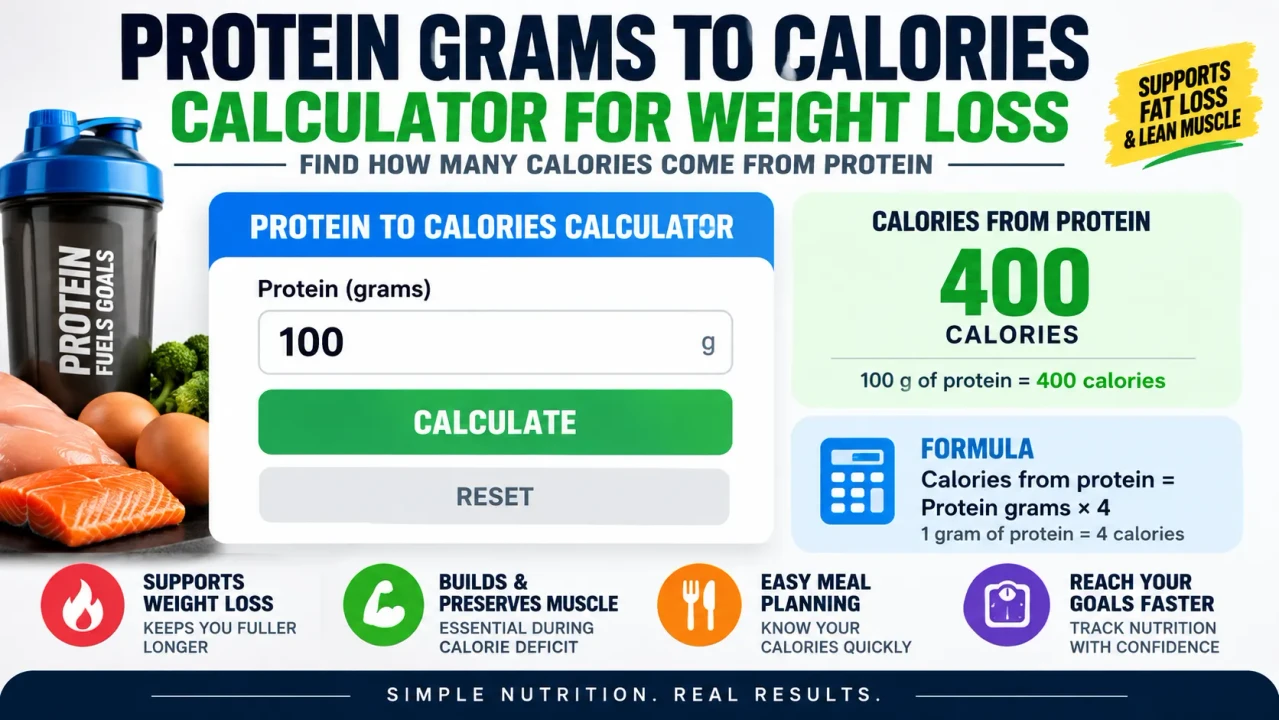
Protein Grams To Calories Calculator
Quick answer: The Protein Grams To Calories Calculator is a nutrition calculator that converts grams of protein into estimated calories using the standard energy value of 4 kilocalories per gram of protein. Enter the amount of protein in grams to calculate its calorie contribution, which is useful for meal planning, nutrition tracking, and weight management.
Protein provides energy while supporting muscle maintenance, tissue repair, and other essential body functions. If a food contains 25 grams of protein, that protein contributes approximately 100 calories. The Protein Grams To Calories Calculator makes this relationship easy to understand without requiring manual multiplication.
This calculator is particularly useful for people tracking macronutrients, estimating meal energy, comparing nutrition labels, or planning a diet for weight loss or muscle development. It calculates calories contributed by protein alone, not the total calories in a food or meal.
Key Takeaways
- Primary Function: Converts protein grams into estimated kilocalories.
- Input: Amount of protein in grams.
- Output: Estimated calories from protein.
- Calculation: Protein grams × 4 kcal per gram.
- Best Suited For: Macro tracking, meal planning, and calorie budgeting.
How to Use Protein Grams To Calories Calculator?
- Enter protein grams: Input the amount of protein listed on a nutrition label or recorded in your meal tracker.
- Calculate calories: Multiply the protein quantity by 4 to determine the approximate energy supplied by protein.
- Review the result: Use the calculated calories when evaluating your meal's macronutrient composition.
What Should You Enter?
Enter the quantity of protein in grams, not the weight of the entire food. For example, 100 grams of cooked chicken does not necessarily contain 100 grams of protein. Use the protein amount provided by a reliable nutrition label or food database.
Use a non-negative numerical value. If the protein amount is unknown, estimate it from a suitable food composition reference before calculating calories.
What Does the Output Mean?
The output represents the estimated energy attributable to protein. It does not include energy from carbohydrates, fat, alcohol, or other dietary components. For complete meal calorie estimates, calculate or obtain the energy contributions of the other macronutrients as well.
Protein Grams to Calories Formula
The calculator uses the standard general nutrition conversion factor of 4 kilocalories per gram of protein.
Formula:
Calories from Protein = Protein (g) × 4 kcal/g
Where:
- Protein (g): The quantity of protein measured in grams.
- 4 kcal/g: The conventional energy factor used to estimate calories from protein.
- Calories from Protein: The estimated energy contribution expressed in kilocalories (kcal), commonly called calories on food labels.
Worked Example: 30 Grams of Protein
Input: 30 grams of protein
Calculation: 30 × 4 = 120 kcal
Result: Approximately 120 calories from protein.
If a meal contains 30 grams of protein, 40 grams of carbohydrates, and 10 grams of fat, the estimated macronutrient energy is:
- Protein: 30 × 4 = 120 kcal
- Carbohydrates: 40 × 4 = 160 kcal
- Fat: 10 × 9 = 90 kcal
- Total estimated macronutrient energy: 370 kcal
This example illustrates why protein calories are only one part of a food's total energy. Actual nutrition-label values can differ because of rounding, food composition, and applicable labeling conventions.
Protein Grams to Calories Reference Table
Use this reference table to quickly estimate the calories supplied by common protein quantities.
| Protein (grams) | Calculation | Calories (kcal) |
|---|---|---|
| 1 g | 1 × 4 | 4 |
| 5 g | 5 × 4 | 20 |
| 10 g | 10 × 4 | 40 |
| 15 g | 15 × 4 | 60 |
| 20 g | 20 × 4 | 80 |
| 25 g | 25 × 4 | 100 |
| 30 g | 30 × 4 | 120 |
| 40 g | 40 × 4 | 160 |
| 50 g | 50 × 4 | 200 |
| 75 g | 75 × 4 | 300 |
| 100 g | 100 × 4 | 400 |
| 150 g | 150 × 4 | 600 |
| 200 g | 200 × 4 | 800 |
How Protein Calories Relate to Weight Loss
Protein can be an important part of a weight-management plan because it supports muscle maintenance and contributes to dietary satiety. However, converting protein grams into calories does not determine whether someone will lose weight.
Weight change depends on overall energy intake, energy expenditure, individual circumstances, and consistency over time. This calculator helps identify the energy contribution of protein so users can evaluate it alongside carbohydrates, fats, activity levels, and total daily intake.
For example, a meal containing 35 grams of protein supplies approximately 140 calories from protein. The meal may contain substantially more calories when fats, carbohydrates, sauces, and other ingredients are included.
Protein Calories Compared With Other Macronutrients
| Macronutrient | General Energy Factor | Calculation |
|---|---|---|
| Protein | 4 kcal/g | Protein grams × 4 |
| Carbohydrates | 4 kcal/g | Carbohydrate grams × 4 |
| Fat | 9 kcal/g | Fat grams × 9 |
These are general Atwater factors commonly used for nutrition estimates. Specific foods and labeling systems may use different factors or adjustments. For a general reference, consult the U.S. Food and Drug Administration's Nutrition Facts Label guidance.
Edge Cases and Calculation Limitations
Zero Grams of Protein
Zero grams of protein produces zero estimated calories from protein. This does not mean the food itself contains zero calories, since it may contain fat, carbohydrates, or other energy-contributing ingredients.
Decimal Protein Values
Decimal quantities work with the same formula. For example, 12.5 grams of protein contributes approximately 50 kcal. Retaining decimal precision can help when adding several ingredients together.
Negative or Invalid Inputs
Negative protein quantities do not represent a meaningful food intake and should not be used for nutrition calculations. Text, empty values, or malformed numbers must be corrected before calculation. The exact input validation and display behavior depends on the calculator implementation.
Rounding Differences
The mathematical result can be fractional when the input contains decimals. Food labels may round displayed grams and calories, so independently calculating energy from rounded macronutrient values may not reproduce the listed calorie total exactly.
Protein Grams Are Not Food Weight
A 150-gram serving of food is not necessarily 150 grams of protein. Use the actual protein quantity for the serving size being evaluated, accounting for whether the nutrition information refers to raw, cooked, drained, or prepared food.
Accuracy, Methodology, and Disclaimer
The formula provides a standard estimate of energy from protein, rather than a laboratory measurement of the metabolizable energy of a particular meal. Protein sources differ in composition and digestibility, and nutrition-label calculations can involve additional conventions.
Technical Disclaimer: This calculator is intended for general nutrition education and meal-planning estimates. It does not prescribe a protein target, establish an individual calorie requirement, or replace personalized advice from a qualified dietitian or healthcare professional. People with medical conditions requiring dietary protein restrictions should follow individualized clinical guidance.
Frequently Asked Questions
How many calories are in one gram of protein?
One gram of protein provides approximately 4 kilocalories under the standard general nutrition conversion factor.
How many calories are in 100 grams of protein?
One hundred grams of protein contributes approximately 400 kcal, calculated as 100 × 4.
Does the calculator show total food calories?
No. It calculates calories attributable to protein only. Total food calories can also include carbohydrates, fats, and other energy-contributing components.
Can I use decimal values?
Yes, the formula works mathematically with decimal protein quantities. For example, 12.5 grams multiplied by 4 equals 50 kcal.
How does this calculation help with weight loss?
It helps you estimate protein's contribution to daily energy intake. Weight loss depends on overall energy balance and other individual factors, not protein calories alone.
Why can calculated calories differ from a nutrition label?
Nutrition labels may round protein grams and calorie values or apply food-specific energy factors. Therefore, calculating calories from displayed macronutrients may not exactly match the listed total.
Author Information
Author Name: Daniel Brooks
Author Description: Nutrition Data and Wellness Content Specialist focused on nutrition calculations, macronutrient tracking, and practical food-label interpretation.
Technical Review: The formula and reference calculations are presented using the conventional 4 kcal/g protein factor. This review covers the mathematical methodology and stated limitations, not independent testing of the calculator's implementation.
