Gram To Dram Calculator For Perfume
Convert perfume grams to U.S. fluid drams using perfume density. Calculate the intermediate volume in milliliters and review the conversion basis.
Please complete this field to continue.
Please complete this field to continue.
Results
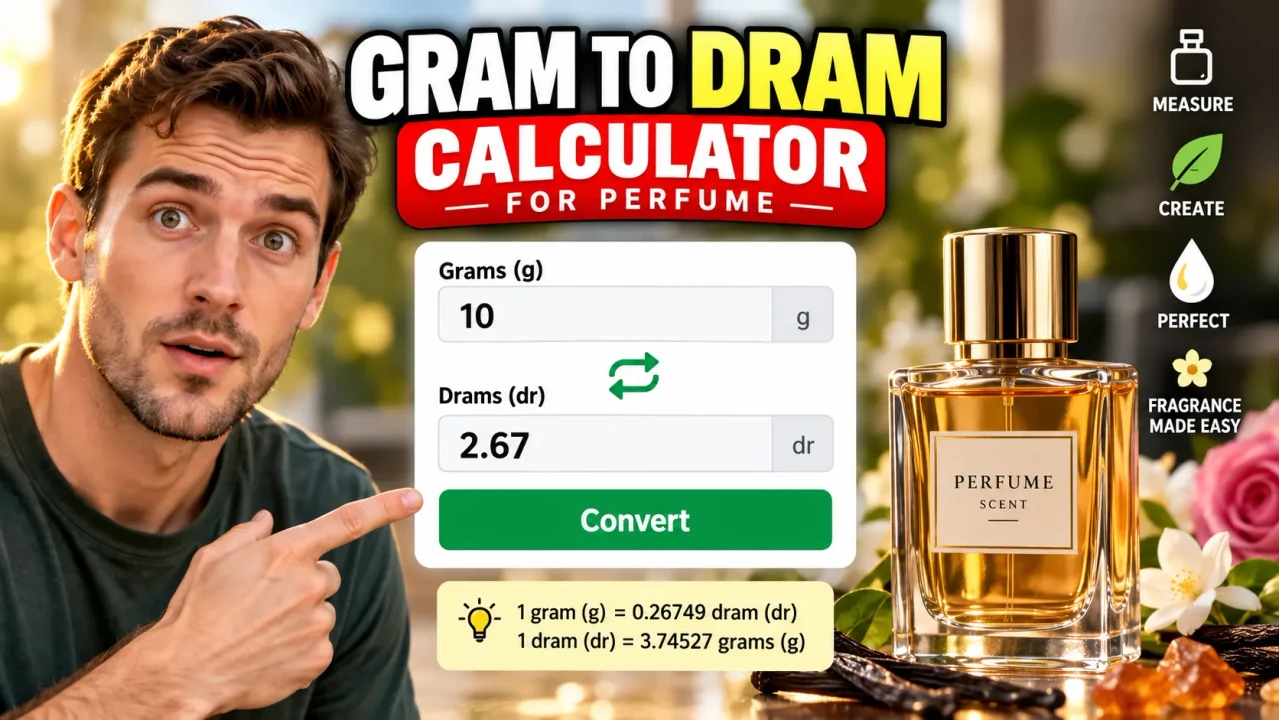
Gram To Dram Calculator For Perfume
TL;DR Summary
Gram To Dram Calculator For Perfume converts a perfume weight in grams into an estimated volume in U.S. fluid drams by first using the perfume's density to calculate milliliters. Because grams measure mass while fluid drams measure volume, the result depends on the density you enter; the supplied tool information does not establish a special privacy guarantee.
What Is the Gram To Dram Calculator For Perfume?
The Gram To Dram Calculator For Perfume is a practical conversion tool for fragrance makers, perfume hobbyists, cosmetic businesses, and anyone who needs to compare perfume weight with a small liquid-volume unit. It is designed for a situation where a perfume quantity is known in grams but the desired measurement is U.S. fluid drams.
The important point is that grams and fluid drams measure different things. A gram is a unit of mass. A U.S. fluid dram is a unit of liquid volume. Because of that difference, there is not one universal gram-to-fluid-dram multiplier for every perfume.
The calculator therefore uses two pieces of information: the perfume weight in grams and the density of the perfume or fragrance mixture in grams per milliliter. The density connects mass to volume. Once the volume in milliliters is calculated, the tool converts that volume into U.S. fluid drams.
For U.S. measurements, NIST's 2026 unit tables define one U.S. fluid dram as one-eighth of a U.S. fluid ounce and give the equivalent as about 3.697 milliliters. The calculator uses the more precise conversion value of 3.696691 mL per U.S. fluid dram for its calculation.
Who Can Use This Tool?
This calculator can be useful for independent perfume makers, fragrance hobbyists, small cosmetic businesses, formulation work, packaging checks, and people comparing measurements between metric and U.S. customary volume units.
It can also help when a fragrance formula or production record gives a material's mass in grams but a bottle, container, or product description uses fluid drams. Instead of treating grams and drams as if they were interchangeable mass units, the calculator makes the density step visible.
What Inputs Are Required?
The calculator uses two required inputs.
- Perfume Weight: Enter the perfume or fragrance mixture's mass in grams.
- Perfume Density: Enter the density in grams per milliliter (g/mL).
The density value is important. Different fragrance mixtures can have different densities because their ingredients and proportions are not necessarily the same. If you have a measured density for the exact perfume or fragrance mixture, use that value rather than assuming that one gram always equals one milliliter.
If the density is unknown, the calculator cannot produce a physically exact mass-to-volume conversion from grams alone. A user may use an assumed density for an estimate, but that assumption should be clearly understood before using the result for filling, formulation, purchasing, labeling, or production decisions.
What Does the Calculator Produce?
The calculator returns three useful pieces of information:
- Perfume Volume: The calculated volume in milliliters.
- US Fluid Drams: The calculated volume expressed in U.S. fluid drams.
- Conversion Basis: The U.S. fluid-dram conversion used by the calculation.
The intermediate milliliter value is useful because it shows the volume before the final conversion. This makes it easier to check the calculation or compare the result with a bottle size expressed in milliliters.
How to Use the Gram To Dram Calculator For Perfume
- Step 1: Enter the perfume weight in grams. Use the mass of the fragrance mixture you want to convert.
- Step 2: Enter the perfume's density in grams per milliliter. Use a measured or otherwise appropriate density value for the exact mixture whenever available.
- Step 3: Run the calculation to convert the mass into milliliters and then into U.S. fluid drams.
- Step 4: Review both the milliliter and fluid-dram results. Keeping the intermediate volume visible helps you check the conversion.
- Step 5: Treat the result as an estimate when the density is estimated rather than measured.
Technical Explanation and Formula
The calculation uses two steps because grams represent mass and fluid drams represent volume.
Step 1: Convert grams to milliliters.
Volume (mL) = Mass (g) ÷ Density (g/mL)
In this formula:
- Mass is the perfume quantity entered in grams.
- Density is the perfume density entered in grams per milliliter.
- Volume is the calculated perfume volume in milliliters.
Step 2: Convert milliliters to U.S. fluid drams.
US Fluid Drams = Volume (mL) ÷ 3.696691 mL per fluid dram
NIST's 2026 Handbook 44 gives one U.S. fluid dram as 3.697 mL, with one fluid dram equal to one-eighth of a U.S. fluid ounce. The calculator uses 3.696691 mL as the conversion factor before displaying the result to four decimal places.
Worked Example
Suppose a fragrance sample has a mass of 10 grams and its measured density is 1.00 g/mL. The volume calculation is:
10 g ÷ 1.00 g/mL = 10 mL
The fluid-dram conversion is then:
10 mL ÷ 3.696691 = 2.7055 US fluid drams
This example uses a density of exactly 1.00 g/mL only to demonstrate the mathematics. It should not be treated as a universal perfume density.
Quick Reference
| Measurement | Meaning |
|---|---|
| Gram (g) | Unit of mass |
| Milliliter (mL) | Unit of volume |
| U.S. fluid dram (fl dr) | U.S. customary unit of liquid volume |
| 1 U.S. fluid dram | Approximately 3.696691 mL |
| Mass-to-volume conversion | Mass ÷ density = volume |
Why Density Matters for Perfume
A direct conversion such as “grams × one fixed number” would only work if the material's density were fixed and known. Perfume is a mixture, so its mass-to-volume relationship can vary with its composition. NIST's measurement resources treat density as a physical property that can be used to relate mass and volume.
This is why the calculator asks for density instead of silently assuming that one gram of every perfume occupies one milliliter. That approach makes the calculation more transparent and lets the user supply a density that matches the material being measured.
Assumptions and Limitations
The calculation assumes that the entered mass and density describe the same perfume or fragrance mixture. It also assumes that the desired “dram” means the U.S. fluid dram, which is a volume measurement. The tool does not determine perfume density from the fragrance formula, identify ingredients, measure a physical sample, or verify the density value entered by the user.
The displayed result is also affected by rounding. The calculation keeps the conversion factor at 3.696691 mL per U.S. fluid dram and displays the calculated volume and drams to four decimal places. Display rounding does not change the underlying conversion method.
If you are working with a measured density, use the appropriate value for the actual product and measurement conditions. If you are using an estimated density, the final fluid-dram result is also an estimate.
Do not rely on the result alone when the measurement affects regulated labeling, commercial filling tolerances, manufacturing specifications, safety requirements, or another situation where a verified physical measurement is required. For those uses, confirm the relevant product specification and measurement method.
Why Use This Gram To Dram Calculator For Perfume & How Our Calculator Beats the Competition
The practical value of this calculator is that it makes the mass-to-volume dependency explicit. The choice between methods depends on the user's needs, the available data, and the required level of verification.
| Method | Ease of Use | Calculation Speed | Best For | Limitations |
|---|---|---|---|---|
| Toolhox Calculator | Enter grams and density | Immediate calculation | Quick perfume mass-to-volume conversion | Depends on the density entered by the user |
| Manual Calculation | Requires the formulas and arithmetic | Depends on manual work | Users who want to calculate by hand | More opportunity for arithmetic or unit errors |
| Spreadsheet | Requires a prepared formula | Fast after setup | Repeated calculations or record keeping | Requires spreadsheet setup and maintenance |
| Professional Measurement or Formulation Software | Depends on the software | Depends on the application | Detailed formulation and production workflows | May require more data and a broader workflow than a simple conversion |
The calculator is intended for a focused conversion task. It does not replace laboratory measurement, formulation software, or product-specific documentation. Its main practical role is to provide a clear calculation from an entered mass and density to an estimated U.S. fluid-dram volume.
When Should You Not Rely on the Result Alone?
Do not treat the result as a verified physical measurement when the density is unknown or estimated. You should also confirm the applicable specification when the converted quantity will be used for manufacturing, regulated labeling, commercial fill requirements, or other decisions where a small measurement difference matters.
For routine planning and comparison, the calculator provides a straightforward way to connect grams, milliliters, and U.S. fluid drams without confusing mass units with volume units.