Grams To Teaspoons Yeast Converter
Convert yeast from grams to teaspoons for active dry or instant yeast. Enter the weight and get an estimated level teaspoon amount.
Please complete this field to continue.
Please complete this field to continue.
Results
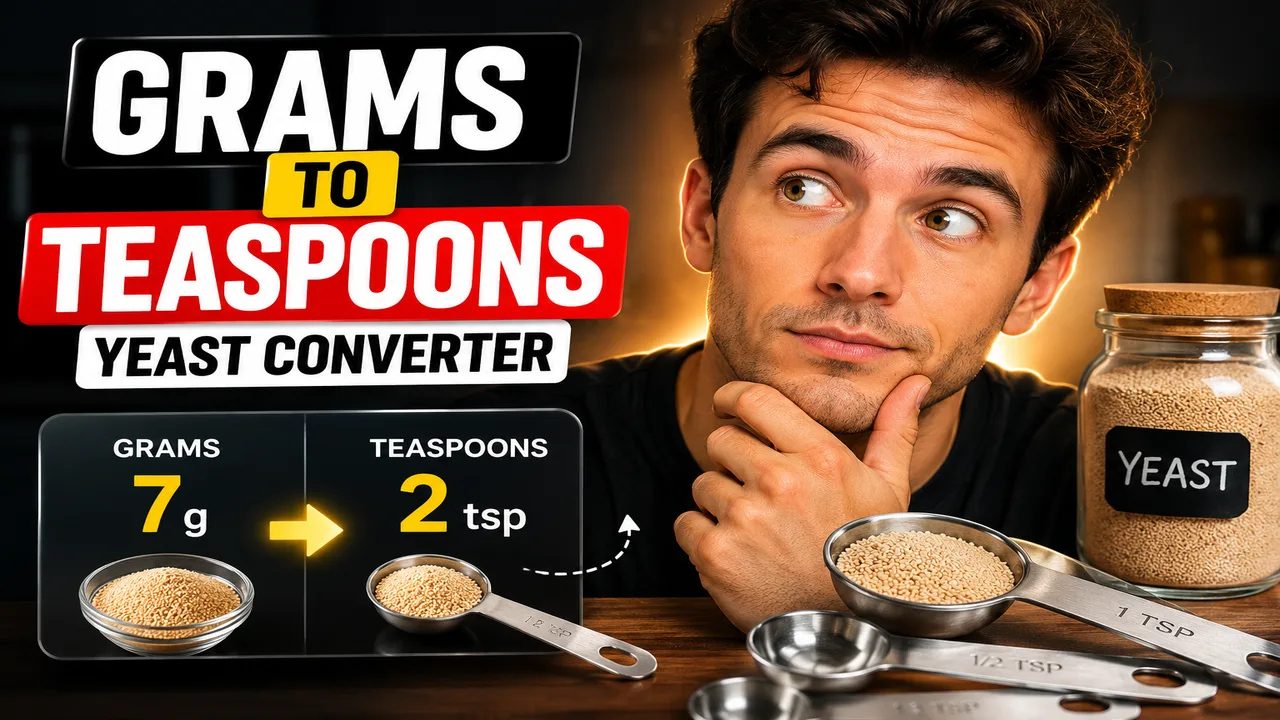
Grams To Teaspoons Yeast Converter
TL;DR Summary
The Grams To Teaspoons Yeast Converter changes a measured yeast weight in grams into an estimated number of level US teaspoons using a yeast-type-specific conversion. The result is a practical kitchen estimate rather than a guaranteed measurement, and the supplied tool information does not establish a specific data-storage or server-processing policy.
About This Tool
The Grams To Teaspoons Yeast Converter helps bakers turn a yeast quantity measured by weight into a volume measured in teaspoons. This is useful when a recipe gives yeast in grams but your kitchen measuring tools are marked in teaspoons, or when you have a kitchen scale and want to compare the weight with a familiar spoon measurement.
Yeast is often sold and measured by weight, while many home baking recipes use teaspoons or other volume measures. Because yeast granules have a measurable bulk density, the same weight does not always occupy exactly the same volume as another ingredient. Yeast type also matters. Active dry yeast and instant yeast have different granule characteristics, so the converter uses a separate grams-per-teaspoon reference for each supported type.
The tool is designed around two common dry yeast choices: active dry yeast and instant yeast. You select the yeast type and enter the amount in grams. The calculator then divides the gram amount by the corresponding reference weight for one level teaspoon and displays the estimated teaspoon quantity.
What You Enter
- Yeast type: Choose Active Dry Yeast or Instant Yeast.
- Yeast amount: Enter the quantity of yeast in grams. Decimal values are supported.
No flour amount, dough size, water temperature, proofing time, or recipe quantity is required for the basic grams-to-teaspoons conversion. Those factors may matter when deciding how much yeast a recipe should use, but they are separate from converting an existing yeast weight into an estimated spoon volume.
What You Get
The main result is the estimated number of teaspoons (tsp). The result also identifies the selected yeast type and the grams-per-teaspoon conversion basis used for the calculation. This makes it easier to understand why two yeast types can produce slightly different teaspoon results from the same gram input.
For example, using a reference value of 3.1 grams per level teaspoon for active dry yeast, 7 grams converts to about 2.26 teaspoons. Using 3.3 grams per level teaspoon for instant yeast, 7 grams converts to about 2.12 teaspoons. These values illustrate why selecting the correct yeast type matters.
How to Use
- Step 1: Select whether you are measuring active dry yeast or instant yeast.
- Step 2: Enter the yeast weight shown by your kitchen scale, package, or recipe in grams.
- Step 3: Review the calculated teaspoon amount shown by the converter.
- Step 4: Use a level measuring teaspoon if you are measuring the converted quantity by volume.
Technical Explanation and Formula
The standard calculation is a simple weight-to-volume conversion:
Teaspoons = Grams ÷ Grams per Teaspoon
For active dry yeast, the reference used by this converter is approximately 3.1 grams per level teaspoon.
Active Dry Yeast:
Teaspoons = grams ÷ 3.1
For instant yeast, the reference used is approximately 3.3 grams per level teaspoon.
Instant Yeast:
Teaspoons = grams ÷ 3.3
In these formulas, grams is the yeast weight entered by the user, grams per teaspoon is the reference weight assigned to the selected yeast type, and teaspoons is the estimated volume result.
The calculation does not need a complicated baking formula because it is converting an existing mass measurement into an approximate volume measurement. The result should be viewed as an estimate because actual spoon weight can vary with brand, granule size, humidity, settling, and how the yeast is placed into the measuring spoon.
Worked Example
Suppose you have 7 grams of active dry yeast.
Teaspoons = 7 ÷ 3.1
Teaspoons ≈ 2.26 tsp
If the same 7 grams were instant yeast:
Teaspoons = 7 ÷ 3.3
Teaspoons ≈ 2.12 tsp
The difference comes from the reference weight used for each yeast type. Current 2026 reference material also commonly describes a standard 7-gram dry yeast packet as roughly 2¼ teaspoons, although exact volume can vary with the product and measuring method. :contentReference[oaicite:4]{index=4}
Quick Reference
| Yeast Type | Reference Weight | 7 g Example |
|---|---|---|
| Active Dry Yeast | 3.1 g per tsp | ≈ 2.26 tsp |
| Instant Yeast | 3.3 g per tsp | ≈ 2.12 tsp |
Why the Result Is an Estimate
A gram is a unit of mass, while a teaspoon is a unit of volume. The conversion therefore depends on how much yeast mass fits into a given volume. Granules can differ in size and packing, and a spoon can be filled in slightly different ways. A level spoon, a rounded spoon, and a compressed spoon do not necessarily contain the same mass.
The conversion is most useful for everyday recipe work when a recipe and your available measuring tools use different units. If a recipe specifies yeast by weight and you own a precise kitchen scale, measuring the yeast by weight is generally the more direct approach. The teaspoon conversion is useful when you need a practical volume equivalent.
Active Dry vs. Instant Yeast
Do not treat the yeast-type selection as decorative. The converter uses a different weight-per-teaspoon reference for active dry and instant yeast. That means the same number of grams can produce different teaspoon results.
There is also a separate baking issue when substituting one yeast type for another: yeast products can differ in formulation and leavening behavior. A grams-to-teaspoons converter only converts the quantity you enter. It does not determine whether a recipe should use more or less yeast for a substitution, nor does it predict proofing time or dough rise.
Common Uses
- Converting a recipe's yeast weight into teaspoons.
- Checking approximately how many teaspoons are in a measured yeast portion.
- Comparing gram-based and spoon-based baking measurements.
- Scaling a bread or dough recipe when the yeast amount is already known by weight.
- Checking the approximate teaspoon equivalent of a package quantity.
Why Use This Grams To Teaspoons Yeast Converter & How Our Grams To Teaspoons Yeast Converter Beats the Competition
The practical difference between this calculator and other methods is mainly the amount of manual work required. It provides a dedicated input for yeast type and grams, then applies the corresponding conversion basis. Other approaches can also work, but they may require you to remember a conversion factor or build the formula yourself.
| Method | Ease of Use | Calculation Speed | Best For | Limitations |
|---|---|---|---|---|
| Toolhox Converter | Enter yeast type and grams | Immediate calculator result | Quick recipe conversions | Uses reference values; actual spoon weight can vary |
| Manual Calculation | Requires the conversion factor | Depends on the user | Users comfortable with the formula | More opportunity for arithmetic or unit errors |
| Spreadsheet | Requires setup | Fast after setup | Repeated or batch calculations | More setup than a single conversion needs |
| Professional Baking or Recipe Software | Varies by product | Depends on the software | Broader recipe or production workflows | May include functions beyond a simple yeast conversion |
Assumptions and Limitations
This converter assumes the teaspoon result represents a level US teaspoon of loose dry yeast. It is not a direct measurement of yeast volume and should not be treated as laboratory-grade density data.
Actual yeast weight per teaspoon can vary by brand, granule size, settling, humidity, and measuring technique. Current reference sources give approximately 3.1 g per teaspoon for active dry yeast and 3.3 g per teaspoon for instant yeast, but these are practical reference averages rather than a guarantee for every product. :contentReference[oaicite:5]{index=5}
The tool also does not calculate yeast potency, fermentation speed, dough rise, proofing time, hydration, flour percentage, or recipe-specific yeast requirements. It converts the quantity you provide. If you are substituting one yeast type for another, follow the recipe or yeast manufacturer's substitution guidance separately.
For very small quantities, a digital kitchen scale can be more useful than a teaspoon conversion because small differences in spoon filling can create a meaningful percentage change. For recipes where yeast quantity directly affects fermentation timing, use the recipe's stated measurement and the product manufacturer's guidance when available.
When to Check the Recipe or Product Label
Check the original recipe when it gives a specific yeast type or measurement. Also check the yeast package when the packet size or product type is unclear. A package sold in one market may not contain the same weight as a package sold in another market.
Most importantly, do not assume that a teaspoon conversion changes the required amount of yeast for a recipe. This calculator answers a narrower question: how many teaspoons correspond approximately to the number of grams entered for the selected dry yeast type.
Use the result as a convenient kitchen conversion. When exact mass matters, especially for very small quantities or sensitive baking formulas, measuring the yeast directly in grams is the better reference.