Solar Panel Bracket Spacing Calculator
Use the Solar Panel Bracket Spacing Calculator to estimate equal bracket spacing from support length, edge offset, and maximum allowed spacing for planning.
Please complete this field to continue.
Please complete this field to continue.
Please complete this field to continue.
Please complete this field to continue.
Results
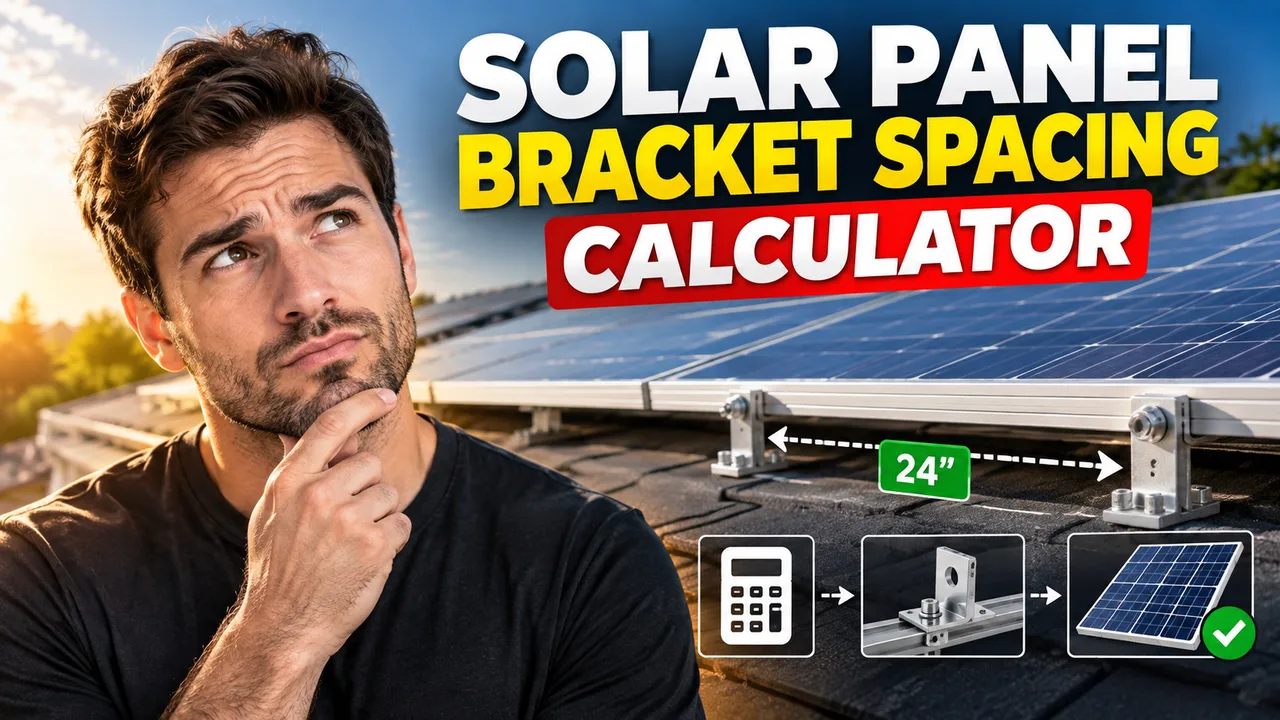
Solar Panel Bracket Spacing Calculator
TL;DR Summary
The Solar Panel Bracket Spacing Calculator estimates equal spacing between solar mounting brackets along a rail or support by using the support length, end offset, and maximum allowed bracket spacing you provide. It is a planning estimate rather than a structural engineering design, and the supplied tool information does not establish any specific data-storage or privacy behavior.
About This Tool
The Solar Panel Bracket Spacing Calculator helps you work out a practical equal-spacing layout for solar panel mounting brackets. Instead of dividing a rail or support by guesswork, you can enter the length that needs to be supported, the offset from each end, and the maximum bracket spacing allowed by your mounting system or design documentation.
This type of calculation is useful during solar installation planning, mounting layout work, preliminary material planning, and basic checking of a proposed bracket arrangement. It can also help installers and project planners understand how the number of brackets changes when the available support length or permitted spacing changes.
The calculator is intentionally based on user-supplied design limits. That is important because there is not one universal U.S. bracket-spacing value that applies to every solar panel, roof, rail, mounting product, or location. Current U.S. guidance requires rooftop photovoltaic systems to account for structural loads, while the International Residential Code provisions for PV systems also point users to manufacturer installation instructions. The U.S. Department of Energy recommends properly rated racking and consideration of wind loads and other site conditions. :contentReference[oaicite:0]{index=0}
For that reason, the maximum allowed bracket spacing should come from the applicable mounting-system documentation, engineered span information, project drawings, or other approved design information. For example, a mounting manufacturer may publish a maximum rail span that depends on the rail model and design conditions. IronRidge describes span as the distance between roof attachments and states that the attachment spacing must not exceed the applicable engineered maximum span. :contentReference[oaicite:1]{index=1}
What You Enter
The calculator uses four inputs:
- Rail or Support Length: The total length of the rail or support section being considered.
- Edge Offset at Each End: The distance from each end of the support to the nearest bracket centerline.
- Maximum Allowed Bracket Spacing: The largest spacing permitted by the applicable mounting-system documentation or structural design.
- Length Unit: Inches or feet.
The edge offset is applied at both ends. This means the calculator first removes two equal edge offsets from the total support length. The remaining distance is the usable bracket-spacing length.
What the Calculator Produces
The calculator returns three main results:
- Minimum Brackets: The smallest whole number of brackets needed so the calculated equal spacing does not exceed the maximum spacing you entered.
- Calculated Bracket Spacing: The equal distance between adjacent brackets after the required bracket count is determined.
- Usable Support Length: The support length remaining after the two end offsets are removed.
The result uses the same length unit selected for the input values. If you select inches, spacing and usable length are reported in inches. If you select feet, they are reported in feet.
How to Use
- Step 1: Enter the total rail or support length that will carry the solar mounting system.
- Step 2: Enter the required edge offset at each end of the support. Use zero only when the bracket layout permits a bracket at the end reference point.
- Step 3: Enter the maximum bracket spacing allowed by the applicable mounting-system documentation, span table, or structural design.
- Step 4: Select inches or feet so all three measurements use the same unit.
- Step 5: Review the calculated minimum number of brackets and the resulting equal bracket spacing.
- Step 6: Compare the result with the mounting-system manufacturer's instructions and the project's structural requirements before installation.
Technical Explanation and Formula
The calculator uses a simple equal-spacing layout formula. It does not determine the structural maximum spacing by itself.
Step 1: Calculate usable support length.
Usable Support Length = Support Length − (2 × Edge Offset)
Where:
- Support Length is the total rail or support length.
- Edge Offset is the distance from each end to the nearest bracket centerline.
- Usable Support Length is the distance over which bracket spacing is distributed.
Step 2: Calculate the minimum bracket count.
Minimum Brackets = Ceiling(Usable Support Length ÷ Maximum Allowed Spacing) + 1
The ceiling function rounds the result up to the next whole number. One bracket is then added because a span between brackets has one fewer interval than the number of brackets.
Step 3: Calculate actual equal spacing.
Actual Bracket Spacing = Usable Support Length ÷ (Minimum Brackets − 1)
This makes the resulting spacing equal between adjacent brackets and ensures the calculated spacing does not exceed the maximum spacing supplied by the user.
Worked Example
Suppose a rail is 144 inches long, the required edge offset is 6 inches at each end, and the maximum allowed bracket spacing is 48 inches.
First calculate the usable length:
144 − (2 × 6) = 132 inches
Next calculate the minimum number of brackets:
Ceiling(132 ÷ 48) + 1 = Ceiling(2.75) + 1 = 4 brackets
Finally calculate the actual equal spacing:
132 ÷ (4 − 1) = 44 inches
The result is therefore 4 brackets with approximately 44 inches between adjacent bracket centerlines, assuming the entered maximum spacing is the applicable design limit.
Why the Maximum Spacing Input Matters
The maximum allowed spacing is not a universal value. Solar mounting systems vary by rail profile, attachment hardware, module arrangement, roof structure, wind exposure, snow or other environmental loads, and the specific design standard being applied. The U.S. Department of Energy notes that PV racking should be properly rated for applicable loads and that rooftop systems should be evaluated for structural strength and site conditions. :contentReference[oaicite:2]{index=2}
Manufacturer span information can also be product-specific. For example, published rail information may specify allowable spans under defined assumptions such as roof type, exposure, roof slope, building height, and a particular ASCE design standard. Those conditions should not be replaced by a generic spacing number. :contentReference[oaicite:3]{index=3}
Bracket Spacing vs. Panel Row Spacing
This calculator deals with bracket spacing along a support or rail. It does not calculate the distance between separate rows of solar panels. Row-to-row spacing can involve panel tilt, shading, roof geometry, solar access, fire pathways, and other project-specific requirements.
It also does not calculate the distance between module clamps on a panel frame. Clamp locations are controlled by the module manufacturer's permitted mounting zones and the mounting-system instructions.
Why Use This Solar Panel Bracket Spacing Calculator & How Our Calculator Beats the Competition
| Method | Ease of Use | Calculation Speed | Best For | Limitations |
|---|---|---|---|---|
| Toolhox Calculator | Enter four defined inputs | Immediate calculation | Equal-spacing planning from a known maximum spacing | Does not determine structural design limits |
| Manual Calculation | Requires arithmetic | Depends on the user | Simple one-off checks | More opportunity for arithmetic or rounding mistakes |
| Spreadsheet | Requires a prepared sheet | Fast after setup | Repeated project calculations and custom layouts | Requires spreadsheet setup and maintenance |
| Professional Engineering Software | More setup required | Depends on the software and model | Detailed structural and load analysis | More information and technical modeling may be required |
The practical advantage of this calculator is that it separates the structural design question from the spacing arithmetic. You supply the maximum spacing that applies to your mounting system or design, and the calculator determines how many equally spaced brackets are needed and what the resulting spacing will be.
Assumptions and Limitations
This is a spacing-planning calculator, not a structural engineering calculator. It assumes the brackets can be placed at equal intervals between the two specified end offsets and that the maximum spacing supplied by the user is valid for the actual mounting system and project.
The calculation does not determine wind pressure, snow load, seismic demand, rail strength, fastener capacity, roof rafter capacity, roof attachment strength, module frame strength, cantilever limits, fire-access requirements, waterproofing details, or local permitting requirements.
U.S. residential PV provisions require rooftop PV systems to be designed for applicable structural loads and installed according to applicable manufacturer instructions. The applicable building code can also depend on the jurisdiction and adopted code edition. :contentReference[oaicite:4]{index=4}
Do not use a generic spacing value in place of an applicable manufacturer span table or engineered design. The U.S. Department of Energy also identifies wind, structural attachment, racking strength, and critical fastened joints as important PV-system design considerations. :contentReference[oaicite:5]{index=5}
Before installation, verify the calculated layout against the exact rail, bracket, attachment hardware, module installation instructions, roof structure, local building requirements, and project-specific structural design. Where structural capacity or loading is uncertain, a qualified solar professional or structural engineer should review the installation.
Results depend entirely on the measurements and maximum allowable spacing entered by the user. Because the supplied tool information does not document server, browser, or storage behavior, users should avoid entering sensitive information unless the page's privacy policy explains how submitted information is handled.