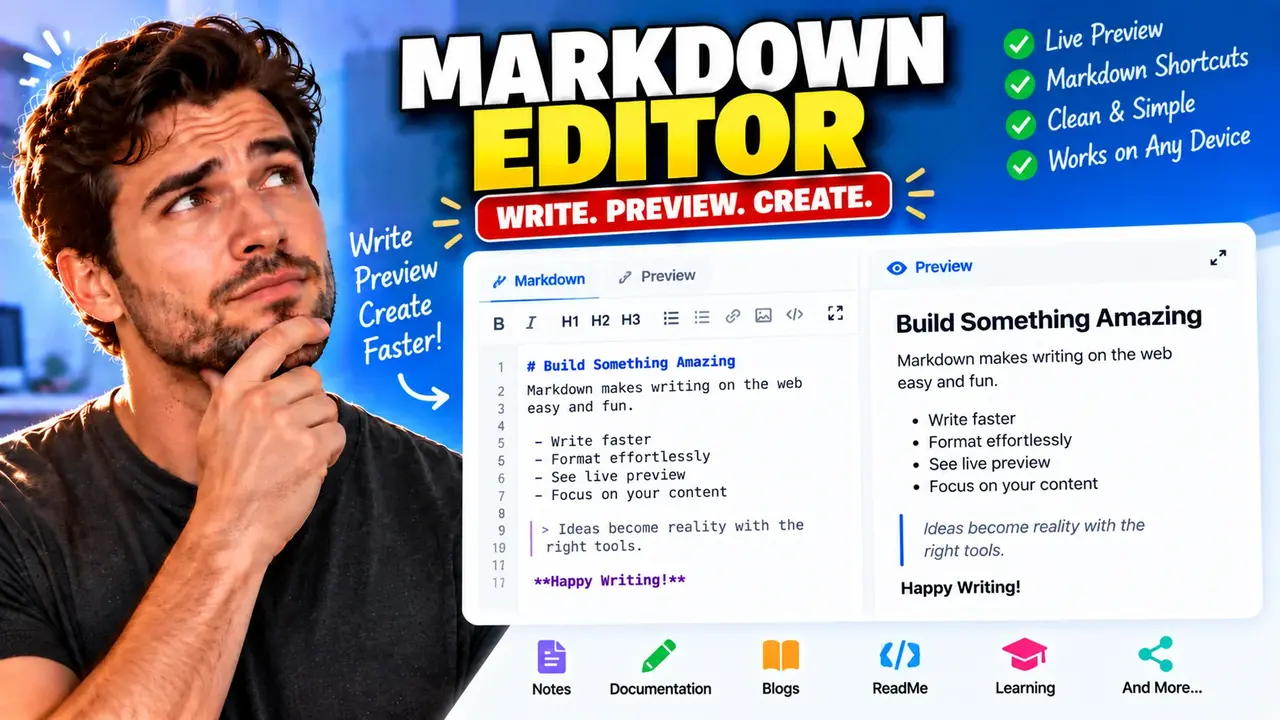
Online Markdown Editor
TL;DR Summary
Markdown Editor is a web-based writing tool for creating and working with Markdown content in a simple editing environment. The supplied tool information does not confirm its exact processing, storage, or server behavior, so avoid entering sensitive information unless the page clearly explains how submitted content is handled.
What Is Markdown Editor?
Markdown Editor is designed for people who want to write text using Markdown rather than relying only on visual formatting controls. Markdown is a lightweight way to add structure and formatting to plain text by using simple characters and patterns. Common examples include using a hash symbol for headings, asterisks for emphasis, and hyphens for lists.
The main purpose of a Markdown editor is to give you a focused place to create and edit Markdown content. This can make structured writing easier to manage when the final content needs to remain readable as plain text or be used in a system that supports Markdown.
Typical Markdown content can include headings, paragraphs, emphasis, links, lists, code blocks, and other Markdown syntax. However, the supplied tool context identifies the tool only as “Markdown Editor” and does not provide a confirmed feature list. Therefore, this page does not assume that a particular preview mode, export function, file importer, autosave system, toolbar, or Markdown extension is available.
Who Can Use Markdown Editor?
A Markdown editor can be useful for anyone who needs to create or revise Markdown text. This may include writers, bloggers, documentation authors, students, developers, content teams, and people preparing structured notes.
Developers often use Markdown for README files, technical documentation, project notes, and other text-based documents. Writers may use it for content that will later be published through a platform that accepts Markdown. Documentation authors can use Markdown syntax to keep headings, lists, links, and code examples clearly structured.
The tool can also be useful when you want to focus on the text and its structure instead of manually applying formatting to individual words. Markdown syntax is text-based, so the document can remain understandable even when viewed without a visual editor.
What You Enter
The primary input for a Markdown editor is Markdown text. You enter or edit the content that you want to format using Markdown syntax.
For example, a simple Markdown document can contain a heading such as # Project Notes, followed by normal paragraphs and a list. Markdown syntax is written directly as part of the document, so the exact characters you enter can affect how the content is interpreted by a Markdown-compatible system.
The supplied information does not specify additional required fields, settings, units, file types, or optional controls. Because of that, this description does not claim that the editor accepts a particular file format or provides a specific import or export workflow.
What the Editor Produces
The main working result is Markdown content that you can review and continue editing. The exact presentation of the result depends on the features implemented on the live tool page.
Markdown itself is plain text with formatting instructions embedded in the text. For example, a heading can be written with a leading hash symbol, while an unordered list can use hyphens. A Markdown-compatible renderer can then interpret those characters and present the corresponding formatted content.
| Markdown purpose | Common syntax example |
|---|---|
| Heading | # Heading |
| Bold text | **bold text** |
| Italic text | *italic text* |
| Unordered list | - List item |
| Ordered list | 1. List item |
| Link | [Link text](https://example.com) |
These examples describe standard Markdown syntax. They are examples of the language itself, not a claim that every Markdown extension or syntax feature is specifically implemented by this tool.
How to Use Markdown Editor
- Step 1: Open Markdown Editor and place your cursor in the editing area provided by the tool.
- Step 2: Enter new Markdown text or edit the Markdown content you are working on.
- Step 3: Add Markdown syntax where you need headings, emphasis, lists, links, code, or other supported structure.
- Step 4: Review the content in the editor and check that the Markdown syntax is written correctly.
- Step 5: Copy or use the resulting Markdown according to the options available on the live tool page.
Understanding Markdown Structure
Markdown is based on readable text combined with simple formatting markers. A heading, for example, commonly starts with one or more hash symbols. An unordered list commonly starts each item with a hyphen, asterisk, or plus sign. Bold text is commonly surrounded by double asterisks, while italic text is commonly surrounded by single asterisks.
Links use a combination of link text and a destination URL. A typical Markdown link follows the pattern [text](URL). Code can be represented using backticks for short inline code or fenced code blocks for longer examples.
One benefit of this structure is that Markdown remains relatively easy to read as raw text. It also makes document structure visible in the source instead of hiding formatting inside a rich-text interface.
Technical Logic
Markdown Editor is a formatter and editor rather than a calculator, so there is no mathematical formula or unit conversion to apply. The core task is editing Markdown-formatted text.
The exact internal Markdown parser, rendering engine, supported Markdown specification, extensions, sanitization rules, and output handling are not provided in the supplied tool information. They should therefore not be assumed. If the live editor displays a rendered preview, that preview is produced by the implementation used by the page and may differ from another Markdown renderer.
Example Markdown
A simple Markdown document might look like this:
# Project Notes

This is a short introduction.

## Tasks

- Review the draft
- Update the documentation
- Publish the final version

**Status:** Ready for review.
This example demonstrates a heading, paragraph, subheading, unordered list, and bold text. The exact visual result depends on the Markdown renderer or display system used after the Markdown is processed.
Common Markdown Editing Mistakes
Small syntax differences can change how Markdown is interpreted. A missing closing marker can affect emphasis. A malformed link can prevent a destination from working as intended. Incorrect list indentation can change the structure of nested content. Heading markers should also be checked when document hierarchy matters.
When preparing technical documentation, check code examples carefully. Characters that have special meaning in Markdown may need to be placed inside code formatting when you want them displayed literally.
Why Use Markdown Editor & How Our Markdown Editor Beats the Competition
Markdown Editor provides a dedicated place to work with Markdown instead of requiring you to edit Markdown inside a general-purpose application. The practical choice between methods depends on the features you need and the complexity of your document.
| Method | Ease of Use | Editing Approach | Best For | Limitations |
|---|---|---|---|---|
| Toolhox Markdown Editor | Designed for Markdown editing | Direct Markdown text editing | Creating or revising Markdown content | Exact features and supported extensions are not specified in the supplied tool information |
| Manual text editor | Depends on the editor | Direct text editing | Users who already know Markdown | May not provide Markdown-specific features |
| Spreadsheet | Not designed for Markdown | Cell-based editing | Tabular information | Not a natural format for structured Markdown documents |
| Professional documentation software | Depends on the product | May combine editing, publishing, and documentation features | Larger documentation workflows | Can provide more features than needed for simple Markdown editing |
The table describes general differences between editing approaches. It does not claim that Toolhox has a specific feature advantage over a named competing product.
When Markdown Editor Is Useful
Use Markdown Editor when your work is primarily Markdown text and you want a dedicated editing space. It can be useful for drafting structured notes, documentation, README-style content, blog drafts, technical explanations, and other Markdown-based material.
It is also useful when you need to inspect the actual Markdown syntax rather than only seeing a formatted result. Looking at the source can help you identify missing markers, incorrect links, list structure problems, and other formatting issues before moving the content into another Markdown-compatible system.
Assumptions and Limitations
The available source material confirms the tool name but does not provide a detailed implementation specification. This means the exact editor controls, supported Markdown dialect, preview behavior, file handling, saving behavior, export options, and browser processing model cannot be confirmed here.
Do not assume that Markdown Editor supports every Markdown extension. Different Markdown systems can interpret advanced syntax differently. Features such as tables, task lists, footnotes, raw HTML, mathematical notation, or extended code-fence behavior may depend on the renderer being used.
Privacy behavior is also not specified in the supplied tool information. Avoid entering passwords, private documents, personal records, confidential business information, or other sensitive material unless the live page clearly explains how that information is handled.
Markdown Editor should also not be treated as a replacement for a full publishing, documentation, or version-control workflow when those capabilities are required. After editing, review your Markdown in the destination system because the destination renderer may apply different rules.
Practical Tips
- Keep heading levels in a logical order.
- Check links for correct Markdown syntax and destination addresses.
- Use code formatting when Markdown characters need to appear as literal text.
- Review list indentation when creating nested lists.
- Check the final Markdown in the system where it will be published or rendered.
- Do not enter sensitive information unless the page provides clear privacy and data-handling details.
Overall, Markdown Editor is intended for direct work with Markdown content. Its value depends on the editing workflow and the features exposed by the live Toolhox page. The supplied information does not support claims about a particular parser, storage method, rendering engine, or additional editor feature.