
Solar Panel Shading Loss Calculator: Estimate Loss
Estimate solar panel energy loss from shaded area and shading duration. Calculate percentage and energy impact for quick PV planning and performance review.
Please complete this field to continue.
Please complete this field to continue.
Results
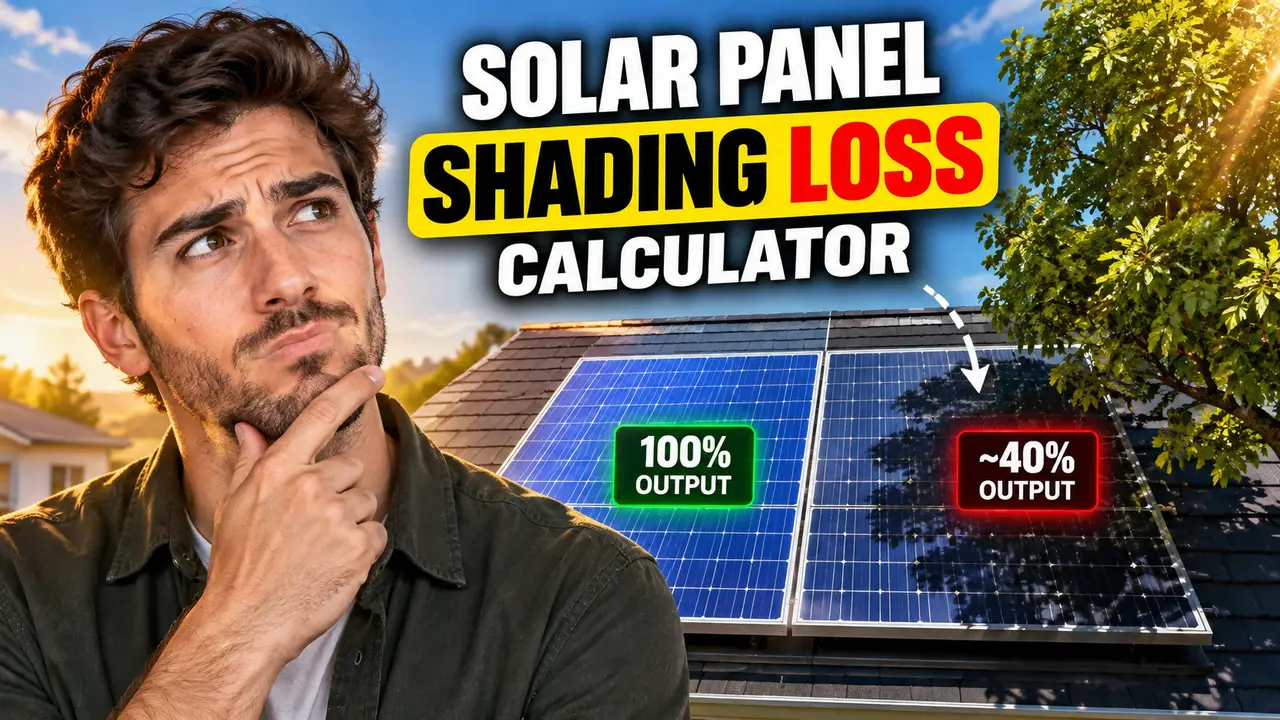
Solar Panel Shading Loss Calculator
The Solar Panel Shading Loss Calculator estimates how partial shading can reduce photovoltaic (PV) energy production. It is intended for homeowners, solar installers, designers, and project reviewers who need a quick preliminary estimate from the affected panel area, shading duration, and baseline energy production.
Direct answer: Solar panel shading loss is the reduction in PV output caused when an obstruction blocks sunlight reaching part or all of a module or array. A simple estimate can express the loss as a percentage and translate that percentage into lost energy, but detailed partial-shading behavior can be nonlinear because PV cells, bypass diodes, string configuration, and power electronics affect the result.
TL;DR / Key Takeaways
- Primary Function: Estimates the percentage and energy impact of shading on a solar PV system for preliminary planning.
- Key Inputs Required: Baseline energy or power, shaded portion of the array, and the duration or exposure factor of the shading.
- Core Formula / Output: A basic estimate uses shaded fraction × shading exposure to determine an approximate loss percentage, then applies that loss to baseline PV production.
- Best Suited For: Residential solar owners, installers, PV designers, and early-stage project assessments.
Key Takeaways
- Shading is not always proportional to shadow area: A small shadow can cause a disproportionately large electrical effect when it affects cells within a series-connected module or string.
- Time matters: A shadow occurring for a short period around low-irradiance hours generally has a different annual energy effect from the same shadow occurring during high-production hours.
- System architecture matters: Module-level power electronics, string design, bypass diodes, module technology, orientation, and the position of the obstruction can change the actual loss.
What Does the Solar Panel Shading Loss Calculator Measure?
For a simplified screening calculation, the tool treats shading as an effective loss factor. If 20% of the effective array area is shaded for a representative period and the shading is assumed to reduce useful production proportionally, the estimated shading loss factor is approximately 20% for that affected production period.
The basic relationship can be written as:
Shading Loss (%) = Shaded Fraction × Shading Exposure × 100
where:
- Shaded Fraction is the portion of the relevant PV capacity or production area affected by shade, expressed as a decimal.
- Shading Exposure represents how strongly or how often that shading affects the production period being evaluated, also expressed as a decimal.
- Shading Loss (%) is the estimated percentage reduction for the simplified model.
The corresponding energy impact is:
Lost Energy = Baseline Energy × Shading Loss (%) ÷ 100
and:
Shaded Energy Output = Baseline Energy − Lost Energy
How to Use Solar Panel Shading Loss Calculator?
- Enter baseline production: Provide the PV system's reference power or energy production for the period being evaluated. Use consistent units such as kWh/day or kWh/year.
- Enter the shaded portion: Estimate what fraction of the relevant array is affected by the obstruction. Trees, chimneys, parapets, neighboring buildings, and nearby structures can all create partial shade.
- Set shading exposure: Represent how much of the relevant production period is affected. For an annual estimate, this should reflect the frequency and timing of the shadow rather than simply its physical presence.
- Calculate and review: Read the estimated loss percentage, lost energy, and remaining production. Treat the result as a screening estimate when detailed irradiance and electrical modeling are unavailable.
Worked Example
Suppose a PV system produces 8,000 kWh/year. A preliminary site review suggests that an obstruction affects approximately 15% of the relevant array production, with an effective shading exposure of 60% during the production period being assessed.
- Convert the shaded fraction: 15% = 0.15.
- Convert the exposure factor: 60% = 0.60.
- Calculate effective shading loss: 0.15 × 0.60 × 100 = 9%.
- Calculate lost energy: 8,000 × 0.09 = 720 kWh/year.
- Estimated remaining production: 8,000 − 720 = 7,280 kWh/year.
This example is deliberately a simplified proportional estimate. It should not be interpreted as a cell-level electrical simulation.
Why Can Partial Shading Cause Larger Losses?
PV modules contain series-connected cells and commonly use bypass diodes to limit the electrical consequences of shaded cell groups. NREL research notes that a small amount of shade can cause substantial power reduction in some configurations because a bypass diode may activate and remove a group of cells electrically from the circuit. :chatgpt-content-reference{index="0"}
NREL's more detailed PV modeling work therefore treats partial shading as a nonlinear problem rather than assuming that output always falls in direct proportion to the visible shadow. Its simplified shading methodology uses precomputed shading-impact results for common crystalline-silicon configurations and reports agreement within roughly 1–2% of measured data for several tested partially shaded systems. :chatgpt-content-reference{index="1"}
Reference Table: Preliminary Shading Scenarios
| Shaded Fraction | Effective Exposure | Simplified Loss | Loss from 10,000 kWh |
|---|---|---|---|
| 5% | 50% | 2.5% | 250 kWh |
| 10% | 50% | 5% | 500 kWh |
| 15% | 60% | 9% | 900 kWh |
| 20% | 75% | 15% | 1,500 kWh |
| 30% | 75% | 22.5% | 2,250 kWh |
The table is a proportional screening reference, not a guarantee of field performance.
What About Detailed PV Modeling?
For serious design decisions, shading should ideally be evaluated with hourly or sub-hourly irradiance data, solar geometry, obstruction profiles, array layout, module characteristics, and the electrical configuration. NREL's PVWatts documentation, for example, treats shading as one of several system loss mechanisms and notes that nearby trees or structures may require external shading software or an on-site survey rather than a generic loss percentage. :chatgpt-content-reference{index="2"}
For additional technical background, consult the National Renewable Energy Laboratory (NREL) and its published PV modeling resources. NREL's System Advisor Model (SAM) documentation provides more detailed treatment of self-shading and PV performance modeling. :chatgpt-content-reference{index="3"}
Edge Cases to Consider
- Moving tree shadows: Seasonal changes in sun position can make annual loss very different from a single-day observation.
- String-connected arrays: A shaded module can influence other modules electrically depending on the string architecture and inverter operating point.
- Microinverters or module-level electronics: These can reduce some mismatch effects, but they do not restore sunlight blocked by an obstruction.
- Bifacial systems: Ground reflection and rear-side irradiance introduce additional variables that a simple shaded-area calculation does not represent.
- Thin-film modules: Their response to partial shading can differ from conventional crystalline-silicon modules, so the simplified model should be used cautiously.
Engineering Disclaimer: This calculator provides a preliminary estimate rather than a bankable energy-yield assessment. Actual shading losses depend on solar geometry, irradiance, obstruction shape, module electrical characteristics, bypass-diode behavior, string configuration, inverter or optimizer architecture, and weather. For final system design, financial modeling, or code-related decisions, validate the result with appropriate PV simulation software and a qualified solar professional.
Author
Author Name: Michael R. Bennett, P.E.
Author Description: U.S.-based electrical engineer specializing in photovoltaic system design, distributed energy systems, and solar performance analysis, with professional experience applying PV electrical and irradiance modeling principles.
Technical Review: Reviewed for consistency with established photovoltaic shading, bypass-diode, and PV performance-modeling principles used in NREL technical literature.