
Solar Water Heater Sizing Calculator : Tank & Collector
Use the Solar Water Heater Sizing Calculator to estimate collector area and storage size from household demand and climate using U.S. sizing guidance.
Please complete this field to continue.
Please complete this field to continue.
Results
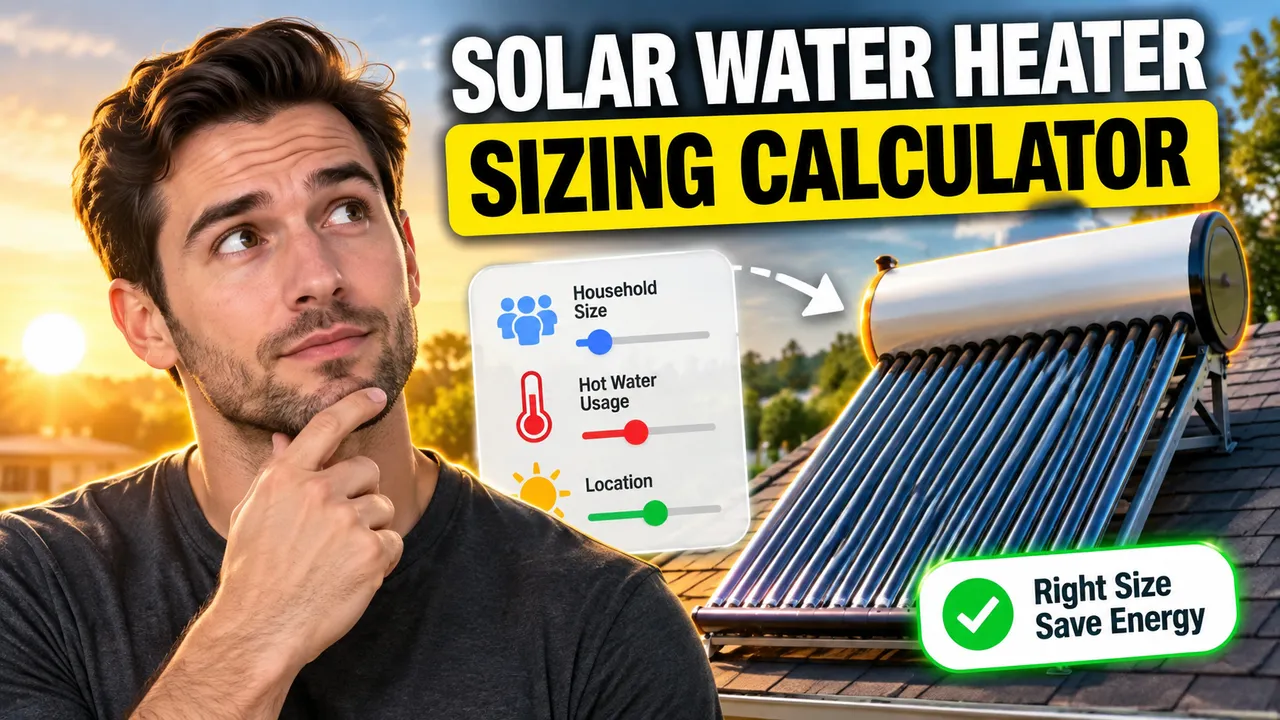
Solar Water Heater Sizing Calculator:
The Solar Water Heater Sizing Calculator estimates the collector area and solar storage capacity needed for a residential solar hot-water system. It uses household demand, occupant count, and U.S. climate-region assumptions to produce a practical preliminary size for the solar thermal system.
Direct answer: Solar water heater sizing depends primarily on hot-water demand, collector area, storage volume, and available solar resource. A common U.S. preliminary rule is about 20 square feet of collector area for each of the first two household members, with additional area depending on climate; active-system storage is commonly estimated at about 1.5 gallons per square foot of collector.
TL;DR / Key Takeaways
- Primary Function: Estimates a residential solar water heater's collector area and storage-tank capacity for preliminary system planning.
- Key Inputs Required: Number of occupants, U.S. climate region, estimated hot-water demand, and system sizing assumptions.
- Core Formula / Output: Collector area is estimated from household size and climate; storage is then related to collector area using a typical storage-to-collector ratio.
- Best Suited For: Homeowners, contractors, energy auditors, solar-thermal planners, and students making an initial system-size estimate.
Key Takeaways
- Collector Area: U.S. Department of Energy guidance gives a common starting point of approximately 20 ft² for each of the first two people, then about 8 ft² per additional person in the Sun Belt or 12–14 ft² per additional person in northern states.
- Storage Capacity: For active solar water-heating systems, approximately 1.5 gallons of storage per square foot of collector is a commonly cited preliminary sizing relationship.
- Solar Resource Matters: Collector and storage sizing should not be treated as a universal fixed formula. Climate, orientation, shading, collector technology, hot-water consumption, and desired solar fraction can materially change the final design.
How to Use This Solar Water Heater Sizing Calculator?
- Enter the number of occupants. Use the people who regularly depend on the domestic hot-water system rather than simply using the home's bedroom count.
- Select the climate region. A Sun Belt versus northern U.S. location can change the recommended collector area for additional household members because the available solar resource varies.
- Review estimated hot-water demand. A preliminary residential planning range is commonly around 20–30 gallons per person per day, although actual consumption can differ substantially between households.
- Review collector area. The calculator converts household demand and climate assumptions into an estimated solar-thermal collector area.
- Review storage volume. The estimated collector area is related to storage using the selected storage-to-collector assumption. Round the result to a commercially available tank size when moving from planning to equipment selection.
What Does Solar Water Heater Sizing Mean?
Solar water heater sizing is the process of matching a solar thermal collector and storage tank to a building's expected hot-water load and local solar conditions. The collector captures solar heat, while the storage tank holds heated water or transfers solar heat through a heat exchanger for later use. The sizing objective is not simply to maximize collector area; an oversized system can create excessive temperatures and stagnation, while an undersized system can leave the backup heater carrying too much of the load.
Underlying Formula and Methodology
This calculator uses preliminary rule-of-thumb sizing, rather than a full hourly solar simulation. The basic collector-area relationship can be expressed as:
Collector Area = Base Area + (Additional People × Climate Adjustment)
For the DOE-style residential guideline:
- Base Area: approximately 40 ft² for the first two household members.
- Sun Belt adjustment: approximately 8 ft² for each additional person.
- Northern adjustment: approximately 12–14 ft² for each additional person.
A second relationship provides a preliminary storage estimate:
Storage Volume ≈ Collector Area × 1.5 gal/ft²
Here, collector area is the total active solar-thermal absorber area in square feet, and storage volume is the nominal solar storage capacity in U.S. gallons. The 1.5 gal/ft² relationship is a planning guideline rather than a mandatory code requirement.
Worked Example: Four-Person Household
Consider a four-person household in a Sun Belt location.
- The first two occupants require approximately 40 ft² of collector area.
- There are two additional occupants.
- Using approximately 8 ft² per additional person: 2 × 8 = 16 ft².
- Total preliminary collector area: 40 + 16 = 56 ft².
- Using approximately 1.5 gallons of storage per square foot: 56 × 1.5 = 84 gallons.
The preliminary result is therefore about 56 ft² of collector area and 84 gallons of solar storage. A real installation could use a nearby commercially available collector/tank configuration rather than these exact numbers.
Reference Sizing Table
| Household Size | Sun Belt Collector Estimate | Approx. Storage at 1.5 gal/ft² | Northern Collector Estimate |
|---|---|---|---|
| 1–2 people | ~40 ft² | ~60 gal | ~40 ft² |
| 3 people | ~48 ft² | ~72 gal | ~52–54 ft² |
| 4 people | ~56 ft² | ~84 gal | ~64–68 ft² |
| 5 people | ~64 ft² | ~96 gal | ~76–82 ft² |
| 6 people | ~72 ft² | ~108 gal | ~88–96 ft² |
Important Edge Cases
- High water use: Large tubs, multiple daily showers, frequent laundry, or other heavy hot-water loads can make occupant-count rules insufficient.
- Low water use: A small household with unusually low consumption may not need the same capacity as a typical household of the same size.
- Cold climates: Freeze protection becomes a major design consideration. Closed-loop systems using a suitable heat-transfer fluid or drainback arrangements may be preferable.
- Shading: A nominal collector area does not compensate for substantial shading. Roof orientation, tilt, and shading should be evaluated before installation.
- Collector technology: Flat-plate and evacuated-tube collectors have different performance characteristics, so equal square footage does not necessarily mean equal annual energy output.
- Backup heating: Solar water-heating systems commonly work with electric or gas backup. The solar system does not necessarily need to cover 100% of annual hot-water demand.
Calculation Standard and Limitations
The sizing relationships used here are based on U.S. Department of Energy residential solar-water-heating guidance and are intended for preliminary planning. The DOE notes that professional sizing can require worksheets or computer programs that account for collector area, storage, solar resource, and project economics. ENERGY STAR likewise recommends considering site suitability, solar exposure, system type, freeze protection, and the household's expected water demand.
Do not treat this estimate as a stamped engineering design. Final equipment selection should account for local weather data, collector certification and performance curves, storage configuration, plumbing losses, temperature requirements, freeze protection, overheating protection, roof loading, applicable plumbing/building codes, and the desired solar fraction. For a new installation, have the final design reviewed by a qualified solar-thermal contractor or appropriate design professional.
Engineering Disclaimer: This calculator provides theoretical preliminary sizing estimates. Actual solar water-heating performance depends on site-specific solar resource, collector characteristics, system configuration, hot-water demand, installation conditions, and backup-heater operation. Verify the final design against applicable U.S. codes, manufacturer requirements, and site conditions.
Authoritative background for this methodology is available from the U.S. Department of Energy and ENERGY STAR, including federal guidance on solar hot-water system sizing and residential solar-water-heating system selection.
Author Name: Evan Brooks
Author Description: Building-energy writer specializing in residential solar thermal systems, domestic hot-water design, and practical energy-efficiency calculations, with a B.S. in Mechanical Engineering.
Technical Review: Reviewed for consistency with U.S. Department of Energy residential solar-water-heating sizing guidance, collector-to-storage relationships, and practical solar thermal system-design considerations.