
Solar Panel Lease Vs Buy Calculator : Cost Comparison
Calculate Solar Panel Lease Vs Buy Costs and compare lifetime savings, monthly payments, incentives, and ownership value to choose the lower-cost solar option.
Please complete this field to continue.
Please complete this field to continue.
Please complete this field to continue.
Please complete this field to continue.
Please complete this field to continue.
Please complete this field to continue.
Please complete this field to continue.
Please complete this field to continue.
Please complete this field to continue.
Please complete this field to continue.
Please complete this field to continue.
Please complete this field to continue.
Results
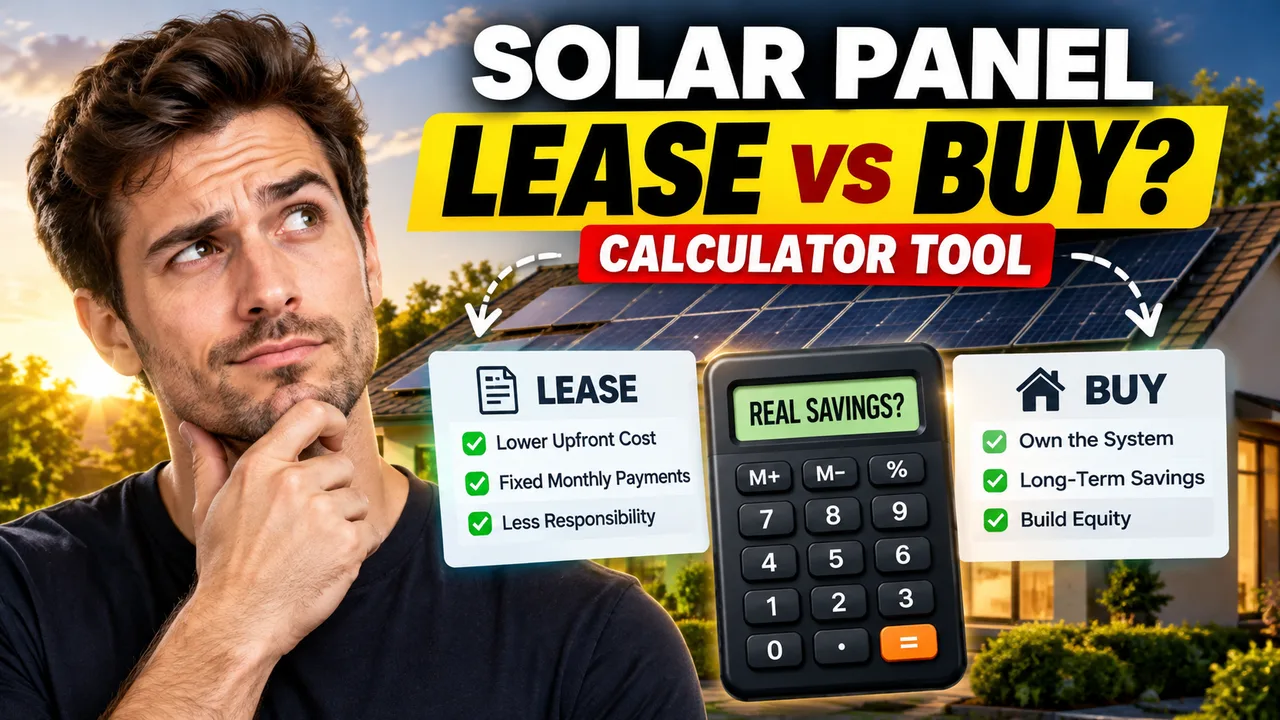
Solar Panel Lease Vs Buy Calculator
What does the Solar Panel Lease Vs Buy Calculator do? The Solar Panel Lease Vs Buy Calculator compares the long-term economics of owning a solar PV system with leasing it. It can compare upfront costs, financing payments, lease payments, utility savings, incentives, escalation rates, maintenance, and the remaining value of the system over a selected analysis period.
Direct answer: Buying solar generally creates an owned asset and can produce greater long-term savings when the purchase price, financing cost, utility savings, and system life are favorable. Leasing usually reduces upfront cost and transfers system ownership and some operating responsibilities to a third party, but the contract's payment structure and escalation rate can materially change the total cost.
The comparison should not be reduced to the lowest monthly payment. A lease can look cheaper during the first few years while costing more over the full contract term. Conversely, a financed purchase can have higher early payments but leave the homeowner with an owned system after the loan is repaid. The U.S. Department of Energy recommends evaluating solar purchase, loan, lease, and power purchase agreement structures before signing a contract.
Important 2026 tax context: Federal residential clean energy tax treatment changed after the 2025 legislation. The IRS states that the Residential Clean Energy Credit under Section 25D is not allowed for qualifying expenditures made after December 31, 2025. Therefore, this calculator should not automatically assume a 30% federal residential solar credit for a new 2026 installation. Any applicable state, local, utility, or other incentive should be entered separately and verified for the specific project.
TL;DR / Key Takeaways
- Primary Function: Compares the total financial cost and potential savings of buying solar versus leasing it over a chosen analysis period.
- Key Inputs Required: Purchase price, financing terms, lease payment and escalator, expected utility savings, incentives, and analysis period.
- Core Formula / Output: Compares cumulative cash flow and, where applicable, discounted present value to identify the lower-cost option and estimated break-even point.
- Best Suited For: U.S. homeowners evaluating solar proposals, financing offers, lease contracts, or competing system ownership options.
Key Takeaways
- Ownership matters: A purchased system becomes a homeowner asset, while a solar lease generally leaves the PV equipment owned by the third-party provider.
- Escalation matters: A lease with an annual payment escalator can become substantially more expensive than a flat-payment lease over a long contract period.
- Tax assumptions matter: Federal incentives should be treated as explicit inputs rather than assumed benefits, especially for systems installed after the 2025 expiration of Section 25D.
- Contract terms matter: Transfer provisions, maintenance responsibilities, buyout clauses, roof work, and home-sale requirements can materially affect the economic result.
How to Use Solar Panel Lease Vs Buy Calculator?
- Enter the purchase price. Add the total cash price of the solar system, including eligible installation costs.
- Enter purchase financing. If using a solar loan, provide the financed amount, APR, loan term, and any upfront payment.
- Enter lease economics. Add the initial monthly lease payment, contract term, and annual escalator, if applicable.
- Estimate energy savings. Enter the expected first-year utility-bill savings and an annual electricity-price escalation assumption.
- Add incentives and ownership costs. Enter applicable rebates, credits, maintenance costs, battery costs, or other project-specific cash flows rather than assuming them.
- Choose the analysis period. Use the period that matches your decision horizon, then calculate the cumulative cost, savings, break-even timing, and comparative result.
Underlying Formula and Methodology
The core comparison is a cash-flow model rather than a single monthly-payment calculation.
Simple cumulative net cost:
Net Cost = Upfront Cost + Financing Payments + Operating Costs − Incentives − Utility Savings
For a financed purchase, the model can represent each period's loan payment separately. For a lease, the recurring lease payment and any escalation are projected across the contract term.
Lease payment in year n:
Lease Paymentₙ = Initial Annual Lease Payment × (1 + Escalator)⁽ⁿ⁻¹⁾
- Initial Annual Lease Payment = first-year lease payment in dollars.
- Escalator = annual lease-payment increase expressed as a decimal.
- n = contract year.
When a discount rate is supplied, the calculator can also compare present value rather than treating a dollar paid ten years from now as identical to a dollar paid today.
Present value of a future cash flow:
PV = Cash Flowₙ ÷ (1 + r)ⁿ
- PV = present value in today's dollars.
- Cash Flowₙ = cost or saving occurring in period n.
- r = selected annual discount rate.
- n = number of periods from the starting date.
Worked Example
Assume a homeowner is comparing a $30,000 solar purchase with a lease beginning at $180 per month. Assume the purchase is financed for 10 years at an illustrative 6% APR, while the lease has a 2.9% annual payment escalator. Assume first-year utility savings of $2,400 and a 20-year comparison period. These figures are illustrative only; they are not market averages or a quote.
- The lease starts at $2,160 per year ($180 × 12).
- At a 2.9% escalator, the second-year annual lease payment becomes approximately $2,223.
- The purchase side includes the financing cash flow and any applicable incentives, maintenance, and other ownership costs.
- Both options receive the modeled utility savings according to the same production and electricity-price assumptions.
- The calculator then compares the cumulative and, if enabled, discounted cash flows to determine which structure produces the lower modeled net cost.
The important insight is that the lease escalator and contract duration can change the result substantially. A low initial lease payment does not prove that leasing is cheaper over the entire analysis period.
Reference Comparison Table
| Scenario | Ownership | Upfront Cost | Key Financial Variable |
|---|---|---|---|
| Cash purchase | Homeowner | Highest initially | Purchase price and incentives |
| Solar loan | Homeowner | Usually lower initially | APR, term, fees, and payment structure |
| Solar lease | Third-party provider | Often lower initially | Monthly payment and escalator |
| PPA | Third-party provider | Often low upfront | Price per kWh and escalation |
What the Calculator Does Not Decide
The result is a financial comparison, not a guarantee of future savings. Solar production depends on system size, orientation, shading, equipment performance, weather, degradation, and utility rules. Electricity prices and export compensation can also change. Lease contracts may contain transfer, buyout, roof-replacement, maintenance, insurance, or home-sale provisions that are difficult to capture with a simple headline number.
For contract review, homeowners should read the actual lease or purchase agreement and verify applicable incentives with the relevant government agency, utility, or qualified tax professional. The U.S. Department of Energy Homeowner's Guide to Solar provides consumer guidance on buying, leasing, and financing solar. The IRS guidance on the 2025 energy-credit changes should be checked before relying on federal tax assumptions.
Engineering and financial disclaimer: This calculator provides an estimate for preliminary consumer comparison. It does not constitute tax, legal, investment, engineering, or financial advice. Actual savings depend on the executed contract, system performance, utility rates, incentives, financing terms, and applicable federal, state, and local rules.
Information Gain & Uniqueness Check: The useful distinction of this tool is that it compares ownership and third-party financing on the same cash-flow timeline rather than comparing only monthly payments. The model can expose the effects of lease escalation, financing duration, utility-price escalation, incentives, discounted cash flow, and the break-even year. The 2026 federal-credit treatment is also separated from generic historical solar-credit assumptions.
Author Name: Evan Carter, B.S. Electrical Engineering
Author Description: Solar PV and residential energy-systems writer specializing in homeowner solar economics, financing structures, and energy-cost comparisons.
Technical Review: Reviewed for solar ownership terminology, cash-flow comparison methodology, lease-versus-purchase treatment, and U.S. residential energy-credit considerations.