
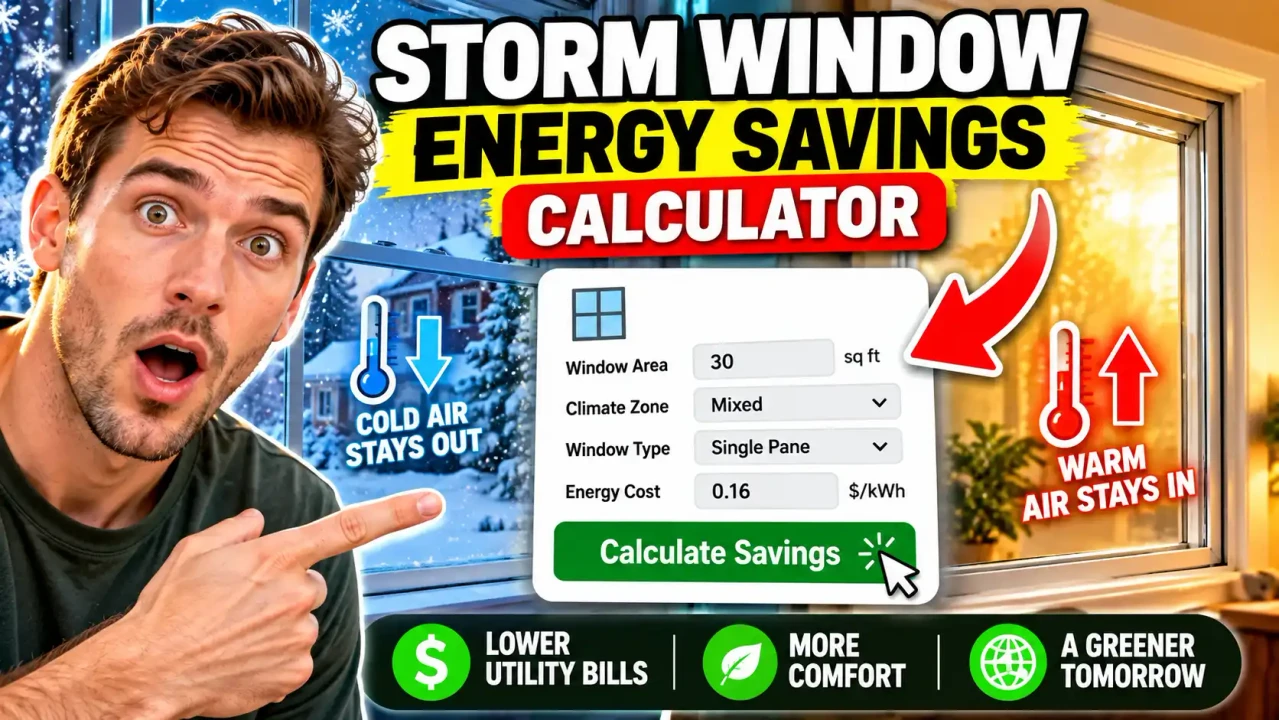
Storm Window Energy Savings Calculator Estimate
Quick answer: The Storm Window Energy Savings Calculator Estimate is a calculator-page concept for estimating the potential energy and cost savings from adding storm windows to existing windows. A useful estimate compares current window-related energy costs with projected costs after storm window installation, accounting for window area, heating and cooling energy use, local energy prices, installation costs, and expected efficiency improvements. Actual savings depend on the building, climate, existing windows, and storm window performance.
TL;DR / Key Takeaways
- Primary Function: Estimate potential energy-bill savings from storm window upgrades.
- Key Inputs: Existing window condition, window area, energy costs, expected performance improvement, and project cost.
- Core Output: Estimated annual energy-cost savings, potential payback period, and longer-term financial benefits when sufficient inputs are available.
- Best Suited For: Homeowners, landlords, building renovators, and energy-efficiency planners comparing storm windows with existing-window improvements.
Important implementation note: The calculator's actual input fields, calculation formula, supported units, and output behavior have not been provided. The methodology and examples below describe a recommended estimation model, not verified behavior of a deployed calculator.
What Does a Storm Window Energy Savings Calculator Estimate?
Storm windows add another glazing layer to an existing window assembly. Depending on the design, installation quality, air leakage, and condition of the original window, this additional layer can reduce heat transfer and drafts. The resulting energy savings may reduce heating demand in cold weather and, under suitable conditions, cooling demand in warm weather.
A storm window energy savings estimate helps answer three practical questions:
- How much could annual energy expenses decrease after installation?
- How long might the installation take to recover its cost through energy savings?
- How do different window areas, energy prices, and assumed savings rates affect the financial result?
The estimate should distinguish energy savings from bill savings. Energy savings describe reductions in electricity, natural gas, heating oil, or another energy source. Bill savings convert those reductions into money using the applicable energy rate. A reduction in heat loss does not automatically translate into the same percentage reduction in the entire household energy bill, because windows are only one component of the building envelope.
How to Use Storm Window Energy Savings Calculator Estimate?
For a meaningful estimate, collect the following information if the calculator provides corresponding input fields.
- Window area: Record the combined area of the windows being upgraded. Use a consistent area unit and avoid counting the same window twice.
- Current energy expenses: Identify the annual heating and cooling costs attributable to the affected windows, if known. Whole-house bills should not be treated as window-only costs.
- Expected savings percentage: Use a documented estimate from an energy assessment, product data, or a clearly identified planning assumption. Avoid treating a generic percentage as a guaranteed result.
- Project cost: Include storm window materials, installation labor, preparation, and other relevant project expenses.
- Energy-price assumptions: If the model calculates physical energy savings first, provide the appropriate price per energy unit for each relevant fuel or electricity source.
Run the calculation, review the assumptions, and compare the estimated annual savings with the installation cost. If the result includes a payback period, remember that a simple payback calculation does not account for financing, maintenance, changing energy prices, discount rates, or the future value of money.
Input and Output Example
The following hypothetical example demonstrates a simple financial model. These values are illustrative and are not claimed to be the calculator's actual defaults or a prediction for a particular building.
Example Input
| Parameter | Example value |
|---|---|
| Annual energy costs attributable to affected windows | $600 |
| Assumed reduction in those costs | 15% |
| Installed storm window project cost | $900 |
Example Calculation
Estimated annual savings
$600 × 0.15 = $90 per year
Simple payback period
$900 ÷ $90 = 10 years
Example Output
- Estimated annual bill savings: $90
- Estimated simple payback: 10 years
- Estimated cumulative savings over 10 years: $900, before maintenance, financing, energy-price changes, and other costs
This example assumes the stated window-related energy costs and savings percentage are reasonable. If the $600 figure represents the entire household energy bill rather than the portion affected by the windows, the calculation would likely overstate the savings attributable to storm windows.
Storm Window Savings Formula and Methodology
A transparent calculator can use a simple percentage-based model when a reliable estimate of current window-related energy costs is available.
Annual energy-cost savings:
Annual Savings = Affected Annual Energy Cost × Assumed Savings Rate
Simple payback period:
Payback (years) = Total Installed Project Cost ÷ Annual Energy-Cost Savings
Estimated net savings over a selected period:
Net Savings = (Annual Savings × Number of Years) − Initial Project Cost
Where:
- Affected Annual Energy Cost: The portion of annual heating and cooling expenses expected to change because of the window improvement.
- Assumed Savings Rate: The estimated fractional reduction in those affected costs. For example, 15% is represented as 0.15.
- Total Installed Project Cost: The combined upfront expense of materials, labor, and other included installation costs.
- Number of Years: The analysis period used to estimate cumulative financial effects.
If the calculator instead estimates physical energy savings, a more detailed model may calculate reduced energy use in kilowatt-hours, therms, or another appropriate unit and multiply each reduction by the corresponding energy rate. Heating-system efficiency, cooling-system efficiency, fuel type, weather, and seasonal energy demand may be needed for that approach.
These equations are planning formulas. They do not establish the real performance of a particular window assembly, and they should not be interpreted as a standardized engineering prediction.
Storm Window Savings Reference Table
The table below illustrates how the simple financial model responds to different assumed savings rates. It uses $600 in annual energy costs attributable to affected windows and excludes installation cost from this first comparison.
| Assumed savings rate | Calculation | Annual savings |
|---|---|---|
| 5% | $600 × 0.05 | $30 |
| 10% | $600 × 0.10 | $60 |
| 15% | $600 × 0.15 | $90 |
| 20% | $600 × 0.20 | $120 |
| 25% | $600 × 0.25 | $150 |
These percentages are sensitivity-analysis scenarios, not universal storm window savings benchmarks. The appropriate value depends on the existing window assembly, storm window type, climate, air leakage, installation quality, and building energy use.
What Factors Influence Storm Window Energy Savings?
- Existing window condition: Poorly sealed or single-pane windows may offer more opportunity for improvement than already efficient, well-maintained assemblies.
- Storm window design: Glazing properties, frame construction, weatherstripping, and installation details affect performance.
- Climate and exposure: Heating degree days, cooling demand, solar exposure, and seasonal temperature differences affect potential savings.
- Air leakage: Gaps around existing windows and the storm window installation can change the outcome substantially.
- Energy prices: The same physical reduction in energy use can have different financial value in different regions and under different tariffs.
- Installation costs: Custom sizing, accessibility, window count, labor, and preparation can affect payback.
Technical Edge Cases and Limitations
- Zero annual savings: If the estimated annual savings are zero, simple payback is undefined rather than a finite number.
- Negative savings: A negative estimate can indicate inconsistent assumptions or additional operating costs. It should be investigated instead of being presented as a positive benefit.
- Missing energy data: If current window-related energy costs are unknown, a percentage-only estimate may give a misleading impression of precision.
- Mixed energy sources: Electricity and gas costs should be modeled using the correct rates and units rather than combining physical energy quantities without conversion.
- Whole-house energy bills: Applying a window-related savings rate to all household energy spending can overestimate benefits.
- Very short analysis periods: A project may not recover its upfront cost within the selected period, even if it lowers annual energy use.
- Long-term projections: Flat-rate calculations ignore energy-price inflation, equipment changes, maintenance, and discounting unless those variables are explicitly modeled.
Technical disclaimer: Results are preliminary planning estimates. Actual energy performance depends on building conditions, climate, product specifications, and installation quality. Consider a qualified building-energy assessment before making a major renovation or investment decision.
Author and Technical Review
Author Name: Michael Anderson
Author Description: Building Energy Efficiency Specialist focused on residential energy performance, building-envelope improvements, and energy-cost estimation.
Technical Review: The recommended estimation methodology uses transparent percentage-based energy-cost savings and simple payback equations. Before publication as a description of a functioning calculator, verify the deployed calculator's actual fields, formulas, unit handling, output rounding, and zero-savings behavior.
