Grams To Fluid Ounces Calculator For Essential Oil Dilution
Convert essential oil grams to estimated U.S. fluid ounces using density for essential oil dilution and formulation measurements.
Please complete this field to continue.
Please complete this field to continue.
Results
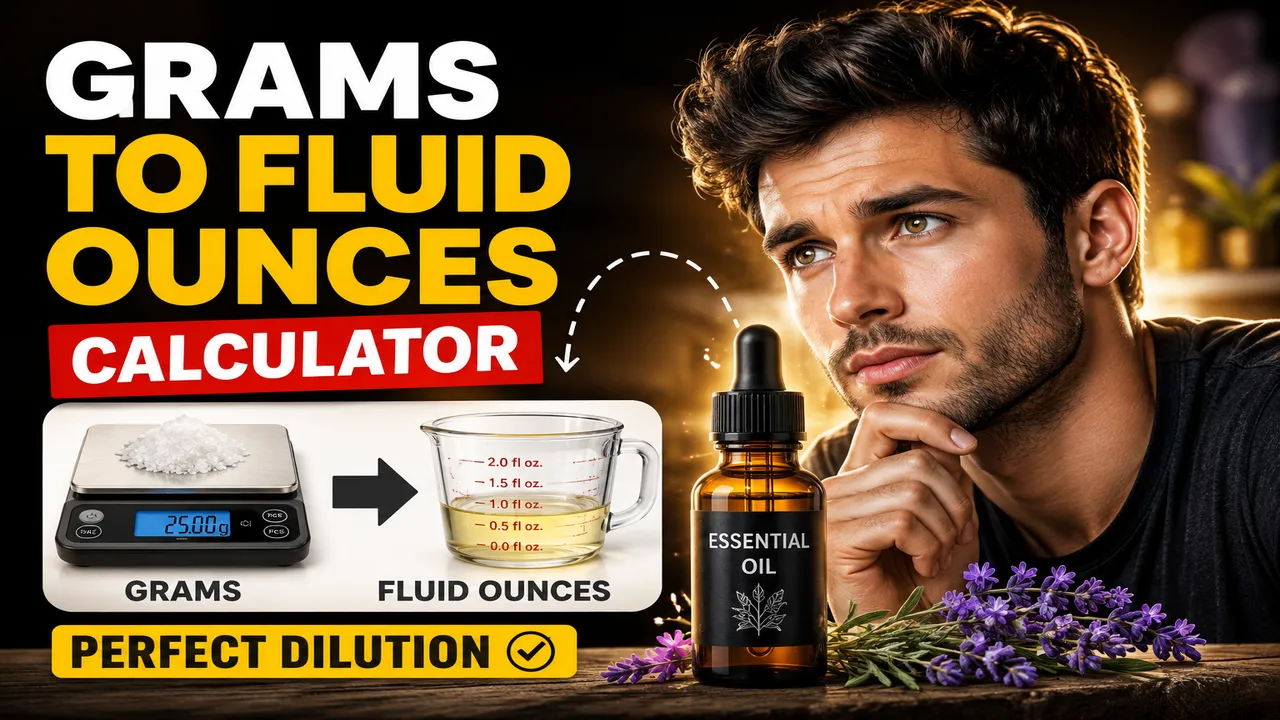
Grams To Fluid Ounces Calculator For Essential Oil Dilution
TL;DR Summary
This calculator is designed to convert a measured mass of essential oil in grams into an estimated volume in U.S. fluid ounces for dilution and formulation work. The result depends on the density used for the oil, so it should be treated as an estimate rather than a substitute for a measured volume or professional formulation guidance; the supplied tool information does not document a specific privacy or data-storage policy.
What This Calculator Does
The Grams To Fluid Ounces Calculator For Essential Oil Dilution helps convert an essential oil quantity from mass to volume. This is useful when a recipe, formulation, batch record, or dilution method gives an essential oil amount in grams but you need an approximate volume in U.S. fluid ounces.
Grams and fluid ounces measure different physical properties. A gram measures mass, while a fluid ounce measures volume. Because essential oils do not all have the same density, there is no single universal grams-to-fluid-ounces conversion for every essential oil. A reliable conversion therefore needs a density value that represents the oil being measured.
This distinction matters in essential oil dilution. For example, two oils with the same mass can occupy slightly different volumes if their densities differ. Using a simple fixed conversion such as treating every gram as the same volume can therefore introduce an error. A density-based calculation gives a more appropriate estimate for a particular oil.
Who Can Use It?
This tool can be useful for people working with essential oil recipes, aromatherapy formulations, cosmetic or personal-care formulations, small-batch products, laboratory-style measurements, and other situations where an essential oil quantity needs to be expressed in both mass and volume.
It can also help when comparing instructions that use different units. One source may specify an oil in grams, while another may use milliliters or U.S. fluid ounces. Converting the mass into an estimated volume makes those measurements easier to compare.
Inputs and Outputs
The core calculation requires two physical values:
- Mass: the amount of essential oil, measured in grams.
- Density: the density of the particular essential oil, expressed in grams per milliliter (g/mL).
The primary calculated value is the estimated volume in U.S. fluid ounces. The calculation can also be understood through an intermediate milliliter value, which helps show how the conversion works.
The density is important because it connects mass and volume. If the density value is changed, the calculated fluid-ounce result changes as well. For this reason, users should use a density value appropriate to the specific essential oil, temperature, and measurement conditions whenever such information is available.
How to Use
- Step 1: Enter the mass of the essential oil in grams.
- Step 2: Enter the density of the essential oil in grams per milliliter (g/mL) when a density input is provided.
- Step 3: Calculate the estimated volume in milliliters and U.S. fluid ounces.
- Step 4: Use the result as a volume conversion reference for your dilution or formulation work.
- Step 5: For precise formulation, compare the calculated value with the density specification and measurement method appropriate for the specific oil.
Technical Explanation and Formula
The standard mass-to-volume relationship is:
Volume in mL = Mass in grams ÷ Density in g/mL
After calculating milliliters, convert the volume to U.S. fluid ounces using:
U.S. fluid ounces = Volume in mL ÷ 29.5735295625
Combining the two steps gives:
U.S. fluid ounces = Mass in grams ÷ Density in g/mL ÷ 29.5735295625
In this formula:
- Mass is the essential oil quantity in grams.
- Density is the oil density in grams per milliliter.
- 29.5735295625 mL is the standard volume of one U.S. fluid ounce.
- Volume is the calculated amount in milliliters before conversion to fluid ounces.
The calculation should not round the intermediate milliliter value unnecessarily. Rounding the final displayed result is generally more appropriate for a user-facing calculator. The exact number of displayed decimal places should be treated as a presentation choice unless a particular formulation standard requires a specific precision.
Worked Example
Suppose you have 10 grams of an essential oil and use a hypothetical density of 0.90 g/mL for the calculation.
First calculate volume:
10 g ÷ 0.90 g/mL = 11.1111 mL
Then convert milliliters to U.S. fluid ounces:
11.1111 mL ÷ 29.5735295625 = approximately 0.3758 U.S. fl oz
So, under that density assumption, 10 grams corresponds to approximately 0.376 U.S. fluid ounces.
This example demonstrates the calculation method only. The density value is illustrative and should not be treated as the actual density of a particular essential oil.
Quick Reference
| Measurement | Meaning |
|---|---|
| Gram (g) | Unit of mass |
| Milliliter (mL) | Unit of volume |
| U.S. fluid ounce (fl oz) | Unit of volume |
| Density (g/mL) | Mass contained in one milliliter |
Why Density Matters for Essential Oils
Essential oils are mixtures of naturally occurring chemical compounds, and their physical properties can vary. Density can also be affected by factors such as the particular oil, composition, temperature, and measurement conditions. That is why a mass-to-volume conversion should use an appropriate density instead of assuming that all essential oils have the same density.
For the most reliable result, use a density value from a suitable technical specification, certificate, supplier document, or measurement for the exact material being used. If you do not know the density, the resulting volume cannot be determined accurately from mass alone.
Essential Oil Dilution Considerations
Converting grams to fluid ounces does not by itself determine an appropriate essential oil dilution percentage. Dilution also depends on the total amount of carrier or finished product and the intended concentration.
For example, knowing that a certain mass of oil corresponds to a particular estimated volume does not automatically tell you how much carrier oil should be added. A dilution calculation and a mass-to-volume conversion are related but separate calculations.
When a formulation requires a specific concentration, calculate the desired dilution separately and use the converted volume only where volume-based measurement is appropriate.
Assumptions and Limitations
- The calculation treats the supplied density as representative of the essential oil being measured.
- The result uses the U.S. fluid ounce as a volume unit.
- The conversion does not establish the density of an essential oil automatically unless a verified density value is supplied by the tool or user.
- Mass and volume are not interchangeable without a density relationship.
- Changes in density can change the calculated fluid-ounce result.
- The calculated volume is an estimate when the density is an estimate.
- The result does not determine whether an essential oil is safe for a particular topical, cosmetic, inhalation, or other application.
- The result does not replace product-specific formulation instructions, supplier specifications, or professional advice where those are required.
When You Should Not Rely on the Result Alone
Do not rely on a grams-to-fluid-ounces conversion alone when exact formulation specifications are required. If a product specification, manufacturing procedure, laboratory method, or supplier documentation requires a measured mass or a specific density, follow that specification rather than substituting a generic conversion.
You should also avoid treating the calculated volume as an exact measurement when the density is uncertain. For small formulation quantities, even a modest difference in density can affect the final volume. A calibrated measuring method may be more appropriate when the volume must be controlled closely.
Why Use This Grams To Fluid Ounces Calculator For Essential Oil Dilution & How Our Calculator Beats the Competition
The practical value of a dedicated calculator is that it focuses on the specific conversion between mass and volume that essential oil users may need. It also makes the density assumption visible rather than hiding the physical relationship between grams and fluid ounces.
| Method | Ease of Use | Calculation Steps | Best For | Limitations |
|---|---|---|---|---|
| Toolhox Calculator | Direct calculator workflow | Mass, density, then volume conversion | Quick essential-oil mass-to-volume estimates | Depends on the density used and does not replace precise measurement |
| Manual Calculation | Requires arithmetic | Mass divided by density, then mL converted to fl oz | Users who want to calculate by hand | More opportunity for arithmetic or unit-conversion errors |
| Spreadsheet Calculation | Requires spreadsheet setup | Formula must be entered and maintained | Repeated calculations or custom records | Requires setup and correct formulas |
| Professional Formulation Software | Depends on the software | May include broader formulation workflows | Complex formulation and production work | May be unnecessary for a simple mass-to-volume conversion |
The main trade-off is simplicity versus broader formulation control. A dedicated conversion tool can address the mass-to-volume calculation, while more advanced formulation systems may address many additional variables. Neither approach removes the need for an appropriate density value when converting mass to volume.
Summary
The Grams To Fluid Ounces Calculator For Essential Oil Dilution is intended to help translate an essential oil measurement from grams into an estimated U.S. fluid-ounce volume. The key principle is simple: mass must be divided by density to obtain volume, and the resulting milliliters can then be converted to U.S. fluid ounces.
For dependable results, use a density value that matches the essential oil and conditions being evaluated. Treat the result as a conversion estimate when the density is estimated, and use the applicable product or formulation specification whenever an exact measurement is required.