Voltage To Watts Calculator Dc Online
Calculate DC power from voltage and current with the Voltage To Watts Calculator Dc. Enter volts and amps to get watts using the standard P = V × I formula.
Please complete this field to continue.
Please complete this field to continue.
Results
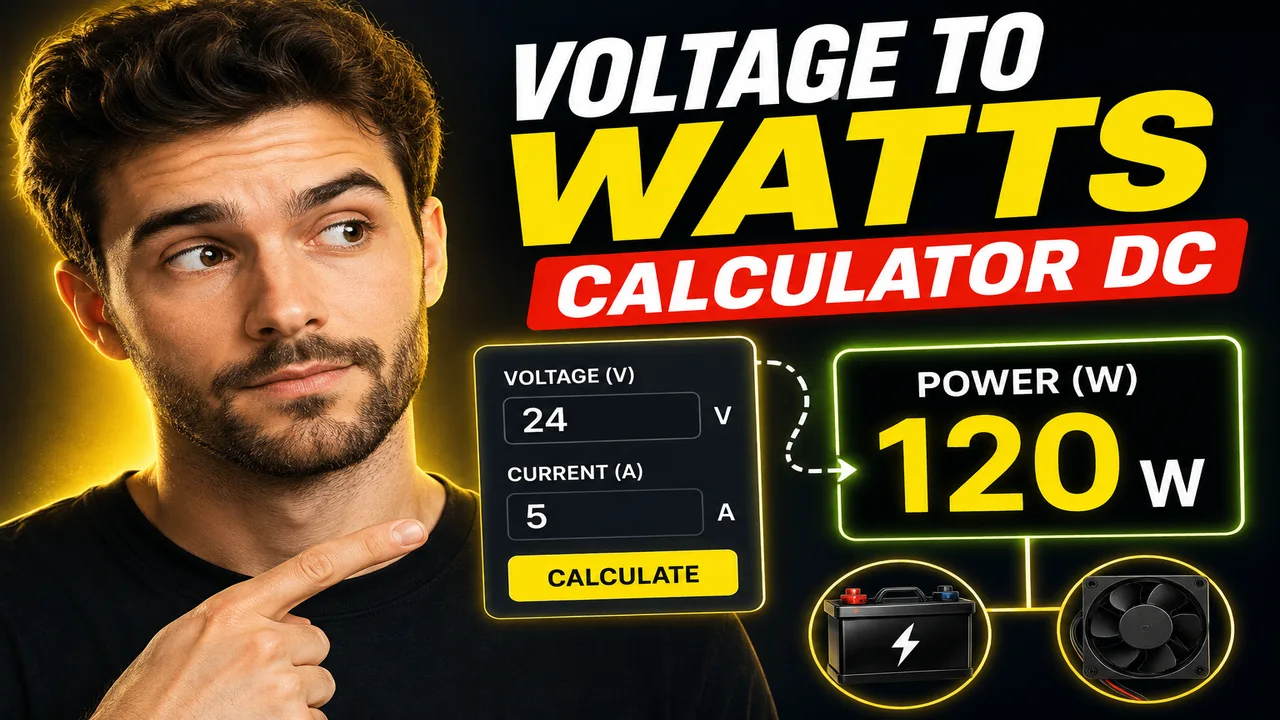
Voltage To Watts Calculator Dc
TL;DR Summary
The Voltage To Watts Calculator Dc calculates electrical power in watts from DC voltage and current using the standard formula P = V × I. It is intended for quick calculations and does not replace detailed electrical design or equipment-specific specifications. The supplied tool information does not document how entered data is stored or transmitted, so avoid entering sensitive information unless the page provides specific privacy details.
About This Tool
The Voltage To Watts Calculator Dc is a simple electrical power calculator for direct-current circuits. It helps you determine how many watts a DC electrical load represents when you know the voltage and current. This is useful when working with batteries, DC power supplies, electronic devices, LED systems, motors, control circuits, and other DC equipment.
The calculation needs two values: voltage and current. Enter the DC voltage in volts (V) and the current in amperes (A). The calculator then multiplies those values to produce power in watts (W). For example, a 12 V DC circuit drawing 5 A has a calculated power of 60 W.
The basic relationship is straightforward. Electrical power is the rate at which electrical energy is transferred or used. For a DC circuit, power can be calculated by multiplying voltage by current. The U.S. Department of Energy describes electrical power in a DC circuit with P = IV, where P is power, I is current, and V is voltage.
What Inputs Does the Calculator Need?
The tool uses two required inputs:
- Voltage: The DC voltage across the load, entered in volts (V).
- Current: The current through the load, entered in amperes (A).
There are no additional resistance, power factor, frequency, phase-angle, or energy-duration inputs in the supplied calculator specification. The tool is therefore designed around the direct DC power calculation from voltage and current.
What Does the Calculator Output?
The primary result is power in watts (W). Watts describe electrical power, not total energy used over a period of time. A 60 W load operating for one hour, for example, represents 60 watt-hours of energy use under a constant-load assumption. This calculator itself calculates watts from voltage and current; it does not calculate operating-time energy consumption.
How to Use
- Step 1: Enter the DC voltage in volts. For example, enter 12 for a 12 V DC source.
- Step 2: Enter the DC current in amperes. For example, enter 5 for a 5 A load.
- Step 3: Review the calculated power result in watts.
- Step 4: Compare the result with the applicable device, power supply, wiring, battery, or system specifications before making an installation or equipment decision.
Technical Explanation and Formula
The standard DC electrical power formula is:
P = V × I
Where:
- P = electrical power in watts (W)
- V = voltage in volts (V)
- I = current in amperes (A)
Because one volt multiplied by one ampere equals one watt, the units work directly:
V × A = W
For example, if a DC device operates at 24 V and draws 2 A:
P = 24 × 2 = 48 W
The calculator keeps the multiplication unrounded and displays the final watt value to two decimal places. This avoids unnecessary rounding during the calculation while giving the user a consistent displayed result.
This formula is appropriate when the voltage and current values represent the DC circuit or load being evaluated. The U.S. Department of Energy states that, in a DC circuit, power is equal to current multiplied by voltage. :contentReference[oaicite:3]{index=3}
Worked Examples
| DC Voltage | Current | Calculation | Power |
|---|---|---|---|
| 5 V | 2 A | 5 × 2 | 10 W |
| 12 V | 5 A | 12 × 5 | 60 W |
| 24 V | 2 A | 24 × 2 | 48 W |
| 48 V | 10 A | 48 × 10 | 480 W |
Understanding Voltage, Current, and Watts
Voltage and current are different electrical quantities. Voltage describes the electrical potential difference, while current describes the flow of electric charge. Power combines the two quantities. A higher voltage at the same current produces more calculated watts, and a higher current at the same voltage also produces more calculated watts.
For example, doubling voltage while keeping current constant doubles the calculated power. Likewise, doubling current while keeping voltage constant doubles the calculated power. This makes the calculator useful for quickly checking how changes in a DC supply or load affect its calculated electrical power.
What This Calculator Does Not Calculate
The Voltage To Watts Calculator Dc does not determine whether a particular power supply, battery, wire, fuse, switch, connector, or electronic component is correctly sized. It also does not calculate voltage drop, battery runtime, charging time, heat dissipation, wire ampacity, efficiency losses, or equipment safety margins.
Those factors can require additional information. For example, a real system may have conversion losses, changing current demand, resistance in wiring, temperature effects, startup current, or manufacturer-specific operating limits. A simple P = V × I calculation does not account for those additional conditions.
Why Use This Voltage To Watts Calculator Dc & How Our Voltage To Watts Calculator Dc Beats the Competition
| Method | Ease of Use | Calculation Speed | Best For | Limitations |
|---|---|---|---|---|
| Toolhox Calculator | Enter voltage and current directly | Immediate calculation after input | Quick DC watts calculations | Limited to the supplied voltage-current power relationship |
| Manual Calculation | Requires multiplication | Depends on the user | Simple calculations without a tool | More opportunity for input or arithmetic mistakes |
| Spreadsheet | Requires setting up cells or formulas | Fast after setup | Repeated calculations and custom worksheets | Requires spreadsheet setup and maintenance |
| Professional Engineering Software | Usually more setup is required | Depends on the application | Detailed electrical system analysis | More complex than needed for a basic P = V × I calculation |
The practical advantage of this Toolhox calculator is its focused scope. Instead of requiring a spreadsheet or a larger electrical analysis program for a basic DC power calculation, you only need to provide voltage and current. The result is presented as watts. That makes it suitable for quick checks and simple calculations.
Assumptions and Limitations
- The voltage entered is the DC voltage relevant to the load being evaluated.
- The current entered is the DC current through that load.
- Voltage and current are entered in volts and amperes.
- The standard relationship P = V × I is used.
- The displayed result is rounded to two decimal places.
- The calculator does not account for efficiency unless efficiency is already reflected in the supplied voltage and current values.
- The calculator does not determine equipment ratings, wiring requirements, fuse sizes, battery capacity, or safety requirements.
- The result should be treated as a calculation from the supplied values, not as a complete electrical system design.
For equipment selection, electrical installation, high-current systems, mains-connected equipment, or safety-critical work, use the applicable manufacturer specifications, electrical codes, and qualified professional review where appropriate. A watts calculation alone does not establish that a system is safe or correctly designed.