
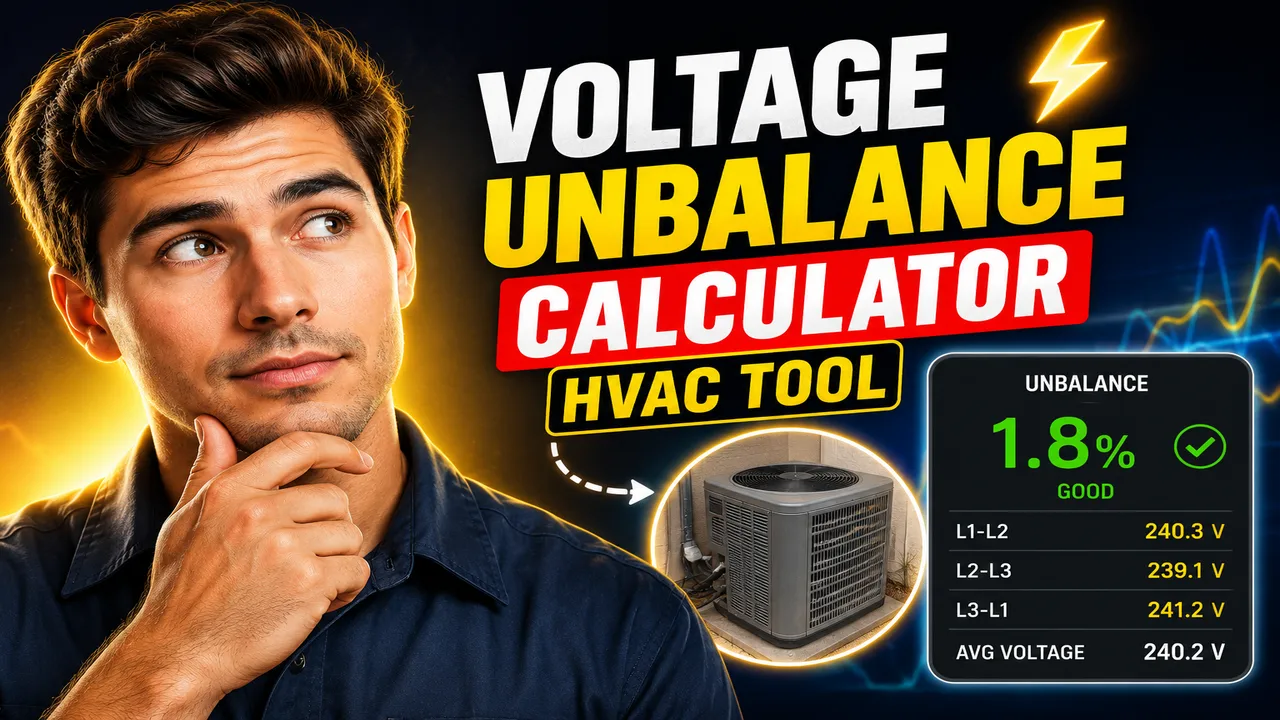
Voltage Unbalance Calculator Hvac Tool Online
Quick answer: The Voltage Unbalance Calculator HVAC Tool Online calculates three-phase voltage unbalance from phase-to-phase voltage measurements. It determines the average voltage, finds the largest deviation from that average, and expresses the result as a percentage.
Voltage unbalance is an important electrical condition to check when troubleshooting or commissioning three-phase HVAC equipment. Motors, compressors, pumps, fans, and other three-phase equipment depend on reasonably balanced phase voltages. Even a relatively small voltage imbalance can produce a much larger current imbalance and increase motor heating.
This calculator is intended for users who have measured three phase voltages and want a quick percentage calculation based on the maximum-deviation-from-average method. The calculation is especially useful during HVAC service, electrical commissioning, preventive maintenance, and troubleshooting.
TL;DR / Key Takeaways
- Primary Function: Calculates percentage voltage unbalance from three phase-voltage measurements.
- Key Inputs: The three measured phase-to-phase voltages.
- Core Output: Average voltage, maximum deviation, and percentage voltage unbalance.
- Best Suited For: Three-phase HVAC motors, compressors, fans, pumps, and electrical troubleshooting.
How to Use Voltage Unbalance Calculator Hvac Tool Online?
Enter the three measured voltages from the same three-phase system. Use consistent units and measurements taken under the same operating condition. The calculator determines the arithmetic average, compares each phase voltage with that average, identifies the greatest absolute deviation, and converts that deviation into a percentage of the average voltage.
What should I enter?
Enter the three measured line-to-line voltages, such as 460 V, 462 V, and 458 V. Do not mix line-to-line measurements with line-to-neutral measurements in the same calculation.
What does the output mean?
The percentage represents the largest departure of any measured phase voltage from the three-phase average, relative to that average. A lower percentage indicates closer voltage balance.
Voltage Unbalance Formula
The maximum-deviation method can be expressed as:
Average Voltage = (V1 + V2 + V3) / 3
Maximum Deviation = maximum(|V1 − Average|, |V2 − Average|, |V3 − Average|)
Voltage Unbalance (%) = (Maximum Deviation / Average Voltage) × 100
Here, V1, V2, and V3 are the three measured phase voltages. The calculation uses the absolute deviation, so it does not matter whether the highest or lowest phase produces the largest difference from the average.
This maximum-deviation-from-average definition is identified by NEMA as the percent voltage-unbalance calculation. ASHRAE also describes NEMA's method when discussing voltage unbalance in relation to motors and HVAC electrical considerations.
Worked HVAC Example
Suppose a three-phase HVAC unit has these measured line-to-line voltages:
| Measurement | Voltage | Deviation from Average |
|---|---|---|
| V1 | 460 V | 0 V |
| V2 | 462 V | 2 V |
| V3 | 458 V | 2 V |
Average voltage: (460 + 462 + 458) / 3 = 460 V
Maximum deviation: 2 V
Voltage unbalance: (2 / 460) × 100 = 0.435%
The calculated voltage unbalance is therefore approximately 0.43%.
Voltage Unbalance Reference Table
| Input Condition | Calculation Step | Result Used |
|---|---|---|
| Three phase voltages | Add V1 + V2 + V3 | Total measured voltage |
| Three phase voltages | Divide total by 3 | Average voltage |
| Each phase versus average | Use absolute difference | Individual deviations |
| Three deviations | Select the largest value | Maximum deviation |
| Maximum deviation + average | Deviation ÷ average × 100 | Voltage unbalance percentage |
Why Voltage Unbalance Matters in HVAC
Three-phase HVAC motors are sensitive to phase-voltage imbalance. ASHRAE's motor and controls guidance notes that a small voltage imbalance can cause a substantially larger current imbalance, increasing operating temperature and potentially contributing to overload trips, motor failure, or burnout. ASHRAE also notes that voltage unbalance can arise from unbalanced loading and system-impedance differences.
The calculation should therefore be treated as an electrical diagnostic measurement rather than simply a percentage-conversion exercise. If an HVAC system shows excessive imbalance, investigate the electrical system, connections, supply conditions, loading, and equipment manufacturer's requirements rather than relying on the calculated percentage alone.
Technical Edge Cases and Limitations
- Unequal phase voltages: The largest absolute deviation from the average determines the result.
- Exactly balanced voltages: Equal phase readings produce 0% voltage unbalance.
- Unit mismatch: All three voltage measurements must use the same unit.
- Line-to-line versus line-to-neutral: Do not mix measurement types within one calculation.
- Measurement conditions: Readings should represent the same operating condition so that the comparison is meaningful.
- Extreme or invalid values: Missing, nonnumeric, or physically inappropriate inputs should not be interpreted as a valid electrical assessment.
Important limitation: This calculation describes voltage unbalance using the maximum-deviation-from-average method. It does not by itself diagnose the cause of the imbalance, calculate negative-sequence components, determine motor derating, or replace equipment-specific evaluation.
Engineering Reference
NEMA's MG 1 material defines percent voltage unbalance as 100 times the maximum voltage deviation from the average voltage divided by the average voltage. ASHRAE's Motors, Motor Controls, and Variable-Frequency Drives guidance likewise identifies the NEMA method and discusses the effects of voltage imbalance on three-phase motors.
Technical Disclaimer: This calculator provides a mathematical voltage-unbalance estimate from the entered measurements. HVAC electrical decisions should also consider the equipment nameplate requirements, manufacturer instructions, measurement conditions, applicable electrical requirements, and qualified professional judgment.
Author: Daniel Mercer, P.E.
Author Description: Daniel Mercer is an electrical engineer focused on power distribution, three-phase motor systems, and HVAC electrical applications.
Technical Review: The calculation methodology and HVAC interpretation were technically reviewed from the perspective of three-phase motor voltage-unbalance measurement and the maximum-deviation-from-average method.
