Hvac Air Changes Per Hour Calculator Online Now
Calculate HVAC air changes per hour from room size and airflow. Hvac Air Changes Per Hour Calculator estimates ACH for basic ventilation planning in a space.
Please complete this field to continue.
Please complete this field to continue.
Please complete this field to continue.
Please complete this field to continue.
Results
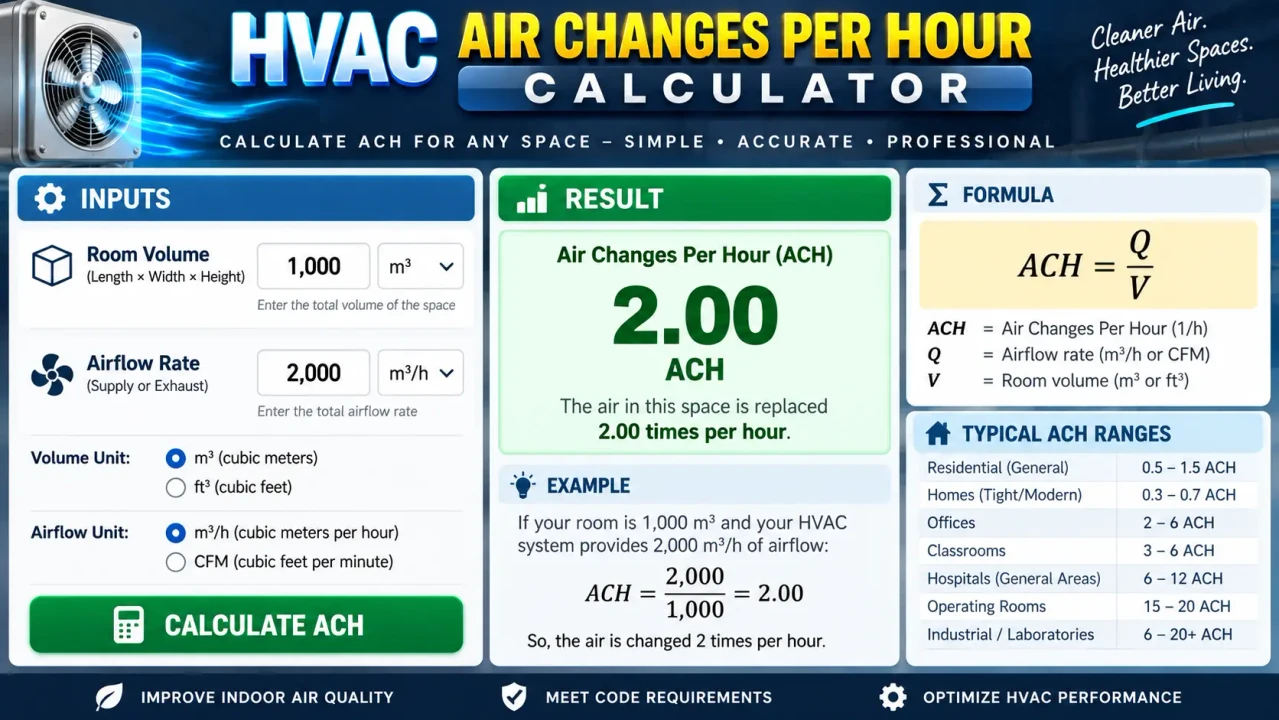
Hvac Air Changes Per Hour Calculator
TL;DR Summary
The Hvac Air Changes Per Hour Calculator estimates air changes per hour (ACH) from room dimensions and airflow in cubic feet per minute (CFM). It is a basic ventilation calculation and should not be treated as a complete HVAC design or professional engineering assessment; the supplied tool information does not specify how user-entered data is stored or transmitted.
About This Tool
The Hvac Air Changes Per Hour Calculator helps you estimate how many times the air volume of a room is exchanged in one hour. Air changes per hour, commonly shortened to ACH, is a useful way to describe the relationship between airflow and the size of a space. It can help HVAC users, building operators, maintenance teams, contractors, students, and other users make a basic check of ventilation airflow.
The calculator uses four inputs: airflow, room length, room width, and room height. Airflow is entered in cubic feet per minute, or CFM. The three room dimensions are entered in feet. From those values, the calculator determines the room volume in cubic feet and converts the CFM value into an hourly airflow volume. It then divides the hourly airflow by the room volume to produce the ACH result.
For example, a room that is 20 feet long, 15 feet wide, and 8 feet high has a volume of 2,400 cubic feet. If the measured airflow is 400 CFM, the hourly airflow is 24,000 cubic feet per hour. Dividing 24,000 by 2,400 gives an ACH of 10.00. This means the calculated airflow volume is equal to ten times the room volume over one hour.
ACH is a rate, not a statement that every part of a room is actually replaced with perfectly mixed air. Real rooms can have uneven airflow, short-circuiting, stagnant areas, pressure differences, recirculated air, filtration, and other conditions that affect how air moves through the space. ASHRAE distinguishes between different air-change concepts, including supply-air exchange and outdoor-air ventilation, so the meaning of an ACH value depends on what airflow is being measured.
What You Enter
- Airflow: Enter the airflow rate in cubic feet per minute (CFM). Use a measured or applicable airflow value rather than guessing when the result will be used for an actual system assessment.
- Room Length: Enter the room's length in feet.
- Room Width: Enter the room's width in feet.
- Room Height: Enter the relevant room height in feet.
The tool does not require a separate room-volume input because volume can be calculated from the three room dimensions. Likewise, the hourly airflow does not need to be entered because it can be calculated from the CFM input by multiplying CFM by 60 minutes per hour.
What the Calculator Produces
The main result is Air Changes Per Hour (ACH). The calculator also displays the calculated room volume in cubic feet and the corresponding airflow per hour in cubic feet per hour. These supporting values make it easier to review the calculation and spot an incorrect room dimension or airflow entry.
The result is displayed to two decimal places. The underlying calculation is performed using the entered values before the final displayed result is rounded. This keeps the calculation straightforward while making the result easy to read.
How to Use
- Step 1: Enter the measured or applicable HVAC airflow in CFM.
- Step 2: Enter the room length, width, and height in feet.
- Step 3: Review the calculated room volume in cubic feet.
- Step 4: Review the airflow per hour, which is the CFM value multiplied by 60.
- Step 5: Read the final ACH result and use it as a basic air-change-rate estimate.
Technical Explanation and Formula
The standard ACH calculation used for this type of tool is:
ACH = (Airflow CFM × 60) ÷ Room Volume
The room volume is:
Room Volume = Length × Width × Height
When using feet and CFM:
- Airflow CFM = airflow in cubic feet per minute.
- 60 = minutes in one hour.
- Room Volume = room volume in cubic feet.
- ACH = air changes per hour.
The units must be compatible. If airflow is entered in CFM, room dimensions should be in feet so the calculated room volume is in cubic feet. If measurements are originally recorded in inches, meters, or another unit, convert them to feet before entering them into this version of the calculator.
CDC materials describe ACH as the ratio of airflow to room volume and show the same CFM × 60 conversion. ASHRAE also defines air change rate as airflow compared with the volume of the space. :contentReference[oaicite:1]{index=1}
Worked Example
Suppose a room measures 20 ft × 15 ft × 8 ft and has an airflow rate of 400 CFM.
| Value | Calculation | Result |
|---|---|---|
| Room volume | 20 × 15 × 8 | 2,400 ft³ |
| Hourly airflow | 400 × 60 | 24,000 ft³/hr |
| ACH | 24,000 ÷ 2,400 | 10.00 ACH |
The result of 10.00 ACH means the calculated airflow volume over one hour is ten times the room's measured volume. It does not, by itself, prove that the room receives ten complete, evenly distributed replacements of outdoor air.
Understanding ACH in HVAC Work
ACH can describe different airflow concepts depending on the application. A supply-air calculation can include recirculated air, while an outdoor-air ventilation calculation focuses on outdoor air entering the space. ASHRAE notes that a space air exchange rate can include recirculated as well as outdoor air in the supply air. :contentReference[oaicite:2]{index=2}
This distinction matters when using ACH for ventilation, indoor-air-quality, or contaminant-control decisions. A high supply-air ACH does not automatically mean that the same amount of outdoor air is being introduced. Similarly, filtration or air-cleaning equipment can affect effective air-cleaning performance without being identical to outdoor-air ventilation.
For this reason, use the airflow value that matches the question you are trying to answer. If you are checking a supply-air exchange rate, use the applicable supply airflow. If you are assessing outdoor-air ventilation, use the outdoor-air flow that is relevant to that assessment.
Preset Examples and Quick Reference
| Room Size | Airflow | Room Volume | ACH |
|---|---|---|---|
| 10 × 10 × 8 ft | 200 CFM | 800 ft³ | 15.00 ACH |
| 12 × 10 × 8 ft | 160 CFM | 960 ft³ | 10.00 ACH |
| 20 × 15 × 8 ft | 400 CFM | 2,400 ft³ | 10.00 ACH |
These examples are mathematical examples of the ACH formula, not recommended HVAC rates for a particular building type.
Why Use This Hvac Air Changes Per Hour Calculator & How Our Hvac Air Changes Per Hour Calculator Beats the Competition
| Method | Ease of Use | Calculation Speed | Best For | Limitations |
|---|---|---|---|---|
| Toolhox Calculator | Enter four values | Immediate calculated result | Basic ACH estimates | Uses room dimensions in feet and airflow in CFM; does not replace a full HVAC assessment |
| Manual Calculation | Requires the formula and arithmetic | Depends on the user | Checking individual calculations | More opportunity for arithmetic or unit-entry errors |
| Spreadsheet Calculation | Requires spreadsheet setup | Fast after setup | Repeated calculations and custom worksheets | Requires formulas and inputs to be maintained correctly |
| Professional Engineering Software | Usually requires more setup | Depends on the software and model | Detailed HVAC analysis and design work | More complex than a basic ACH calculation and may require professional judgment |
The practical purpose of this calculator is to make the basic ACH equation easier to apply. It focuses on the relationship between airflow and room volume rather than attempting to model an entire HVAC system.
Assumptions and Limitations
This calculator assumes a rectangular space whose volume can be represented by length × width × height. It also assumes that the entered airflow is expressed in CFM and that all room dimensions are expressed in feet. Irregular room shapes, changing ceiling heights, connected spaces, open doors, transfer air, leakage, and other physical conditions may require a different approach to determining the effective space volume.
The calculated ACH is an airflow-rate estimate. It does not measure actual air mixing or prove that air is distributed evenly throughout the room. CDC guidance notes that imperfect mixing and air stagnation can affect how quickly airborne contaminants are removed. :contentReference[oaicite:3]{index=3}
The calculator also does not determine whether a particular ACH value is appropriate for a specific occupancy, healthcare room, industrial process, code requirement, or indoor-air-quality objective. Required ventilation rates can depend on the building type, use of the space, applicable codes, standards, equipment, outdoor conditions, and other design factors.
Do not use the result alone to make safety-critical ventilation, infection-control, code-compliance, or HVAC design decisions. For projects where airflow performance or compliance matters, use measured system data and the applicable engineering standards, codes, and professional review.