Online Html Viewer
TL;DR Summary
Online Html Viewer is a web-based utility intended for viewing HTML content as a rendered web page instead of reading the markup alone. Its exact processing and data-handling behavior are not specified in the supplied tool information, so avoid entering sensitive HTML or confidential content unless the page clearly explains how submitted data is handled.
What Is Online Html Viewer?
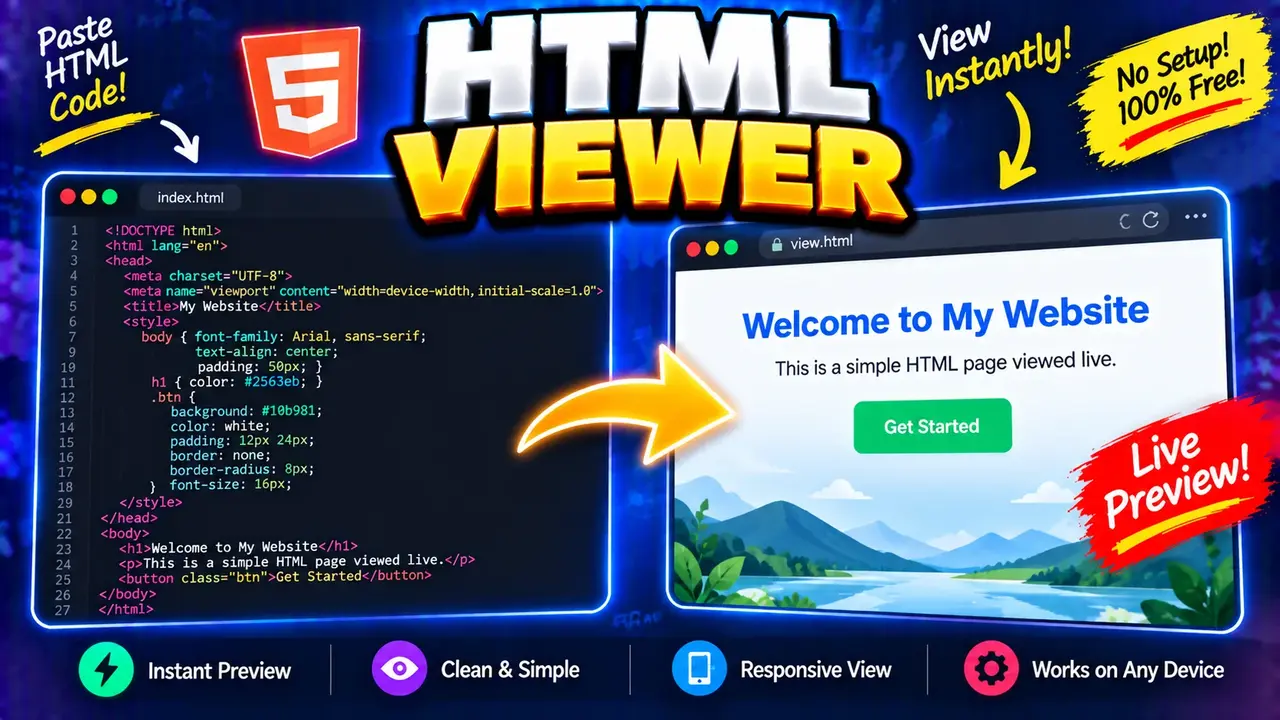
Online Html Viewer is a browser-based HTML viewing tool for people who need to inspect HTML and see how that markup appears when rendered. HTML, or HyperText Markup Language, is the standard markup language used to structure content on web pages. It uses elements such as headings, paragraphs, links, lists, images, tables, and other page components.
Reading HTML source code and viewing the resulting page are two different tasks. Source code shows the tags and markup. A rendered view shows the visual result created from that markup. An Online Html Viewer can help bridge that gap by giving users a practical way to view HTML content in a web interface.
This type of tool can be useful when checking a small HTML snippet, reviewing generated markup, learning how HTML elements work, or inspecting the visible result of code before using it on a website. It can also be useful for developers, students, content authors, designers, and anyone who works with HTML but does not want to set up a full development environment for a simple viewing task.
What Can You Use It For?
An Online Html Viewer is useful for basic HTML inspection and preview tasks. For example, you may want to look at a heading, paragraph, hyperlink, list, table, or other HTML structure as a rendered page. Instead of judging the appearance only from tags such as <h2>, <p>, or <table>, a rendered HTML view can make the resulting structure easier to understand.
It can also support simple troubleshooting. If markup does not look the way you expected, viewing the rendered result can help you spot structural issues. The tool should be treated as a viewing and inspection aid rather than as a replacement for a full browser developer workflow, code editor, accessibility audit, or production testing process.
Inputs and Outputs
The supplied information identifies the tool as an Online Html Viewer, but it does not provide a detailed field specification or document an exact internal implementation. The natural input for this tool is HTML content that the user wants to view. Depending on the actual page interface, that content may be entered or pasted into an HTML input area.
The expected output is a rendered or viewable representation of the supplied HTML. The purpose is to make the HTML easier to inspect as a page rather than presenting only its source markup.
| Item | What it means |
|---|---|
| Input | HTML content supplied by the user |
| Output | A view or preview of the HTML content |
| Primary use | Inspecting HTML as rendered web content |
| Units | Not applicable |
| Calculation | Not applicable |
How to Use Online Html Viewer
- Step 1: Prepare the HTML content you want to inspect. Use a small HTML snippet when you are checking a specific element or section.
- Step 2: Enter or paste the HTML into the tool's available input area, following the controls shown on the page.
- Step 3: Use the viewer to inspect the resulting HTML presentation and compare it with what you intended the markup to produce.
- Step 4: If the rendered result is different from what you expected, review the original HTML for missing tags, incorrect nesting, or other markup issues.
- Step 5: Make any needed changes to your HTML and view the revised content again.
Technical Explanation
Online Html Viewer is not a calculator, so there is no mathematical formula, unit conversion, or numerical calculation to apply. Its core task is based on HTML markup and rendering.
In a normal HTML rendering workflow, the browser interprets HTML elements and builds a document structure from them. For example, a heading element identifies heading content, a paragraph element identifies a paragraph, and list elements identify lists. The browser then presents that structure as a web page.
A simple example is:
<h2>My Heading</h2>
<p>This is a paragraph.</p>
The markup contains two HTML elements. The first identifies a level-two heading, while the second identifies a paragraph. An HTML viewer is intended to make the resulting structure visible in a rendered form.
The exact internal rendering process, supported HTML features, handling of CSS or JavaScript, sanitization behavior, and browser isolation behavior are not specified in the supplied tool information. Therefore, this page does not assume that every HTML, CSS, or JavaScript feature is supported. Users should check the actual tool interface when they need behavior beyond basic HTML viewing.
Common HTML Content to Inspect
| HTML content | Typical reason to view it |
|---|---|
| Headings | Check heading structure and visible presentation |
| Paragraphs | Review basic text structure |
| Links | Inspect how linked content is presented |
| Lists | Check ordered and unordered list structure |
| Tables | Inspect tabular HTML content |
| Small HTML snippets | Quickly review a specific piece of markup |
When an HTML Viewer Is Useful
This tool is most useful when you need a quick visual check of HTML. It can be helpful while learning HTML because beginners can compare markup with the page structure it produces. It can also help content creators review HTML-based content before moving it into another system.
Developers may use a simple viewer for an initial visual check of a small code sample. However, larger projects often require a code editor, browser developer tools, version control, automated tests, accessibility testing, and other development tools. An Online Html Viewer should not be treated as a complete replacement for those workflows.
Why Use This Online Html Viewer & How Our Online Html Viewer Beats the Competition
The practical value of an online HTML viewer is that it focuses on the simple task of viewing HTML. The comparison below describes general methods rather than claiming that any specific competitor has particular features. The supplied tool information does not provide benchmark data or verified competitor specifications.
| Method | Ease of Use | Typical Workflow | Best For | Limitations |
|---|---|---|---|---|
| Toolhox Online Html Viewer | Simple | Enter or paste HTML and view the result | Quick HTML inspection | Exact supported features depend on the tool implementation |
| Manual Browser File | Moderate | Create or save an HTML file, then open it in a browser | Local HTML testing workflows | Requires creating or managing a file |
| Code Editor Preview | Moderate | Edit HTML and use an editor's preview or browser workflow | Ongoing development | More setup may be needed than for a simple viewer |
| Professional Development Tools | Varies | Use full development and debugging workflows | Larger or more complex web projects | More features and setup than a basic viewing task requires |
Assumptions and Limitations
The main assumption is that the tool is intended to let users view HTML content in a rendered form. The supplied information does not document a detailed list of accepted HTML elements, CSS support, JavaScript support, external resource handling, file upload support, browser sandboxing, or server-side processing.
Because those implementation details are not confirmed, users should not assume that advanced HTML behavior will work exactly as it does on a production website. A result shown in a basic viewer may not represent every condition found in a live site, including external resources, browser settings, content security policies, scripts, fonts, responsive layouts, or other dependencies.
Privacy behavior is also not specified in the supplied tool information. Do not enter passwords, private documents, personal records, API keys, proprietary source code, or other sensitive material unless the page clearly explains how submitted content is handled.
For production web development, use the appropriate browser testing and development tools in addition to an HTML viewer. If you are checking accessibility, security, standards compliance, or behavior across multiple browsers and devices, a simple HTML preview should not be treated as a complete test.
Summary
Online Html Viewer is intended for a straightforward HTML viewing workflow. It can help users move from source markup to a visible representation of the page, making basic HTML inspection easier. Since detailed implementation and privacy information are not supplied, advanced rendering behavior and data handling should be confirmed on the actual tool page before relying on it for sensitive or production-critical work.