
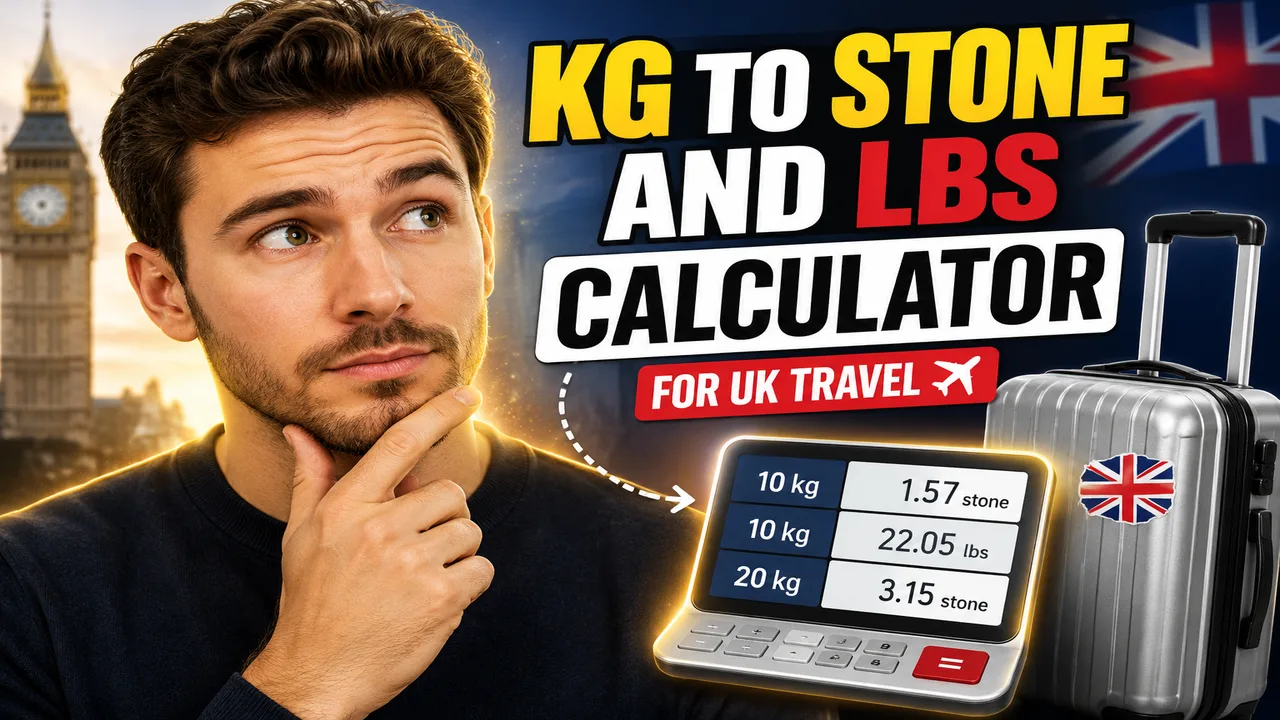
Kg To Stone And Lbs Calculator For UK Travel Now
Quick answer: The Kg To Stone And Lbs Calculator For UK Travel Now is a weight conversion calculator that converts kilograms (kg) into British stone (st) and pounds (lb). It helps travellers, visitors, and anyone familiar with UK weight measurements understand metric weights in the traditional UK format.
When travelling to the United Kingdom, you may encounter weights expressed in stone and pounds rather than kilograms, particularly in everyday conversations about body weight. The Kg To Stone And Lbs Calculator For UK Travel Now provides a straightforward way to understand these measurements without manually calculating conversion factors.
The calculator is designed around the relationship between kilograms, pounds, and stone. Enter a weight in kilograms and use the conversion result to understand its equivalent in the UK stone-and-pounds system. The result can be useful for interpreting weight references, comparing measurements, and communicating weight values while travelling.
Why Convert Kilograms to Stone and Pounds?
Kilograms are the standard metric unit of mass, while stone and pounds remain familiar weight units in everyday British usage. One stone equals exactly 14 pounds. A weight expressed in stone and pounds therefore consists of a whole number of 14-pound units and any remaining pounds.
- UK travel: Understand weight references expressed in stone and pounds.
- Personal weight records: Compare a kilogram measurement with the traditional UK format.
- Everyday communication: Express a metric weight in a format familiar to many UK residents.
- Measurement learning: Understand how kilograms, pounds, and stone relate to one another.
How to Use Kg To Stone And Lbs Calculator For UK Travel Now?
- Enter the kilogram value: Type the weight you want to convert, such as 70 kg or 82.5 kg.
- Calculate the conversion: Use the calculator's conversion control to obtain the equivalent measurement.
- Read the result: Interpret the result as whole stone and remaining pounds, where that output is provided.
- Check the precision: Remember that rounded decimal values may differ slightly from an exact conversion.
Enter a numeric kilogram value rather than a value already expressed in pounds or stone. If the input is empty, non-numeric, or outside the calculator's accepted range, correct it before calculating. The precise validation and display behaviour depends on the implemented calculator.
Input and Output Example
Consider a traveller who wants to convert a weight of 75 kilograms into UK stone and pounds.
Input: 75 kg
Calculation:
75 kg × 2.20462262185 = approximately 165.3467 lb
165.3467 ÷ 14 = approximately 11.8105 stone
Equivalent weight: 11 stone and approximately 11.35 pounds, commonly rounded to 11 st 11.3 lb.
This example illustrates the mathematical conversion. The displayed number of decimal places may depend on the calculator's rounding settings.
Kg to Stone and Pounds Conversion Formula
The conversion uses the standard relationship between the kilogram and the international avoirdupois pound. One pound is exactly 0.45359237 kilograms, so one kilogram corresponds to approximately 2.20462262185 pounds. Since one stone contains 14 pounds, the conversion can be performed in two stages.
Formula 1: Kilograms to Pounds
Pounds = Kilograms × 2.20462262185
- Kilograms: The original mass value supplied by the user.
- Pounds: The converted mass expressed in pounds.
- 2.20462262185: A rounded representation of the kilogram-to-pound conversion factor.
Formula 2: Pounds to Stone and Remaining Pounds
Total stone = floor(Total pounds ÷ 14)
Remaining pounds = Total pounds − (Total stone × 14)
The floor operation selects the whole-number stone value. The remainder is the number of pounds left after removing those complete stone units.
For a direct conversion from kilograms:
Total stone = floor(Kilograms × 2.20462262185 ÷ 14)
Remaining pounds = (Kilograms × 2.20462262185) − (Total stone × 14)
Kg to Stone and Pounds Reference Table
The following reference values provide quick comparisons for common kilogram measurements. Decimal pound values are rounded to two decimal places, while stone-and-pounds values are shown in a readable UK format.
| Kilograms | Total Pounds | Stone and Pounds |
|---|---|---|
| 40 kg | 88.18 lb | 6 st 4.18 lb |
| 45 kg | 99.21 lb | 7 st 1.21 lb |
| 50 kg | 110.23 lb | 7 st 12.23 lb |
| 55 kg | 121.25 lb | 8 st 9.25 lb |
| 60 kg | 132.28 lb | 9 st 6.28 lb |
| 65 kg | 143.30 lb | 10 st 3.30 lb |
| 70 kg | 154.32 lb | 11 st 0.32 lb |
| 75 kg | 165.35 lb | 11 st 11.35 lb |
| 80 kg | 176.37 lb | 12 st 8.37 lb |
| 85 kg | 187.39 lb | 13 st 5.39 lb |
| 90 kg | 198.42 lb | 14 st 2.42 lb |
| 100 kg | 220.46 lb | 15 st 10.46 lb |
How the Conversion Works
The calculation is a unit conversion, not an estimate of a person's health or body composition. The underlying conversion factors establish the mathematical relationship between the units. The US National Institute of Standards and Technology provides reference material for customary measurement units and their metric equivalents.
For a whole-stone result, divide the total pounds by 14 and retain the whole-number portion. Multiply that number by 14 to determine the pounds accounted for by complete stones. Subtract that amount from the total pounds to obtain the remaining pounds.
For example, 70 kg is approximately 154.3236 pounds. Eleven stone equals 154 pounds, leaving approximately 0.3236 pounds. Rounded to two decimal places, the result is 11 st 0.32 lb.
For a reference source, consult the NIST Guide to the SI, which documents the conversion relationship for the avoirdupois pound, and the NIST Handbook 44, which includes measurement conversion tables.
Technical Edge Cases and Limitations
| Input or Situation | Conversion Consideration |
|---|---|
| Zero kilograms | Mathematically converts to zero pounds and zero stone. |
| Decimal kilograms | Can be converted using the same formula; the result may contain fractional pounds. |
| Negative kilograms | Not appropriate for ordinary body-weight or travel-weight interpretation; use non-negative values. |
| Empty or non-numeric input | Requires valid numeric input before a meaningful conversion can be calculated. |
| Very large values | The conversion formula remains valid mathematically, but display precision and accepted input ranges depend on the implementation. |
| Rounded results | Rounding the remaining pounds can produce a value that appears slightly different from the unrounded calculation. |
Rounding and Interpretation
Keep the unrounded total pounds during the calculation and round only when displaying the final result. If the remaining pounds are rounded to 14.00, the display should be normalized to the next whole stone and zero remaining pounds. This prevents a result from appearing to exceed the normal 0–14 pound remainder range.
Conversion accuracy also depends on using the correct units. A kilogram value must not be treated as pounds, and a decimal stone value must not be interpreted as a stone-and-pound pair. For example, 11.5 stone means 11.5 × 14 = 161 pounds, whereas 11 st 5 lb means 159 pounds.
Frequently Asked Questions
How many pounds are in one kilogram?
One kilogram is approximately 2.20462262185 pounds. The exact pound-to-kilogram relationship is defined by 1 lb = 0.45359237 kg.
How many pounds are in one stone?
One UK stone contains exactly 14 pounds. To convert a total pound value into stone and pounds, divide the pounds by 14 and calculate the remainder.
How do I convert 75 kg into stone and pounds?
75 kg is approximately 165.35 pounds, equivalent to 11 stone and 11.35 pounds. Rounded to one decimal place for the remaining pounds, this is 11 st 11.3 lb.
Can I convert decimal kilogram values?
Yes. The conversion formula works with decimal inputs such as 62.5 kg or 77.25 kg. The number of decimal places shown in the final result depends on the calculator's display precision.
Why can the displayed result differ slightly from a manual calculation?
Small differences usually arise from rounding the kilogram-to-pound conversion factor or rounding the remaining pounds at different stages. Using the full conversion factor during calculation and rounding only the final display reduces these differences.
Is stone the same as a decimal stone value?
No. A stone-and-pounds measurement uses a whole number of stones plus a remaining number of pounds. A decimal stone value represents a fraction of a stone. For example, 10.5 stone equals 10 stone and 7 pounds.
Related Measurement Guidance
When comparing weights for UK travel, keep the original kilogram measurement alongside the converted result if you need to verify the calculation later. For luggage or equipment, also check the relevant airline or transport provider's published weight limits; a unit conversion alone does not establish whether an item meets a particular allowance.
Author Information
Author: Michael Turner, Measurement Conversion Specialist.
Technical Review: The conversion methodology is based on the kilogram-to-avoirdupois-pound relationship and the definition of one stone as 14 pounds. This explanation covers the mathematical method and rounding considerations; it does not certify the behaviour of any particular deployed calculator.
Technical Disclaimer: This tool provides unit-conversion results only. It does not assess health, determine body composition, or establish travel baggage eligibility. Confirm consequential measurements against the relevant official requirements.
