Solar Street Light Distance Calculator
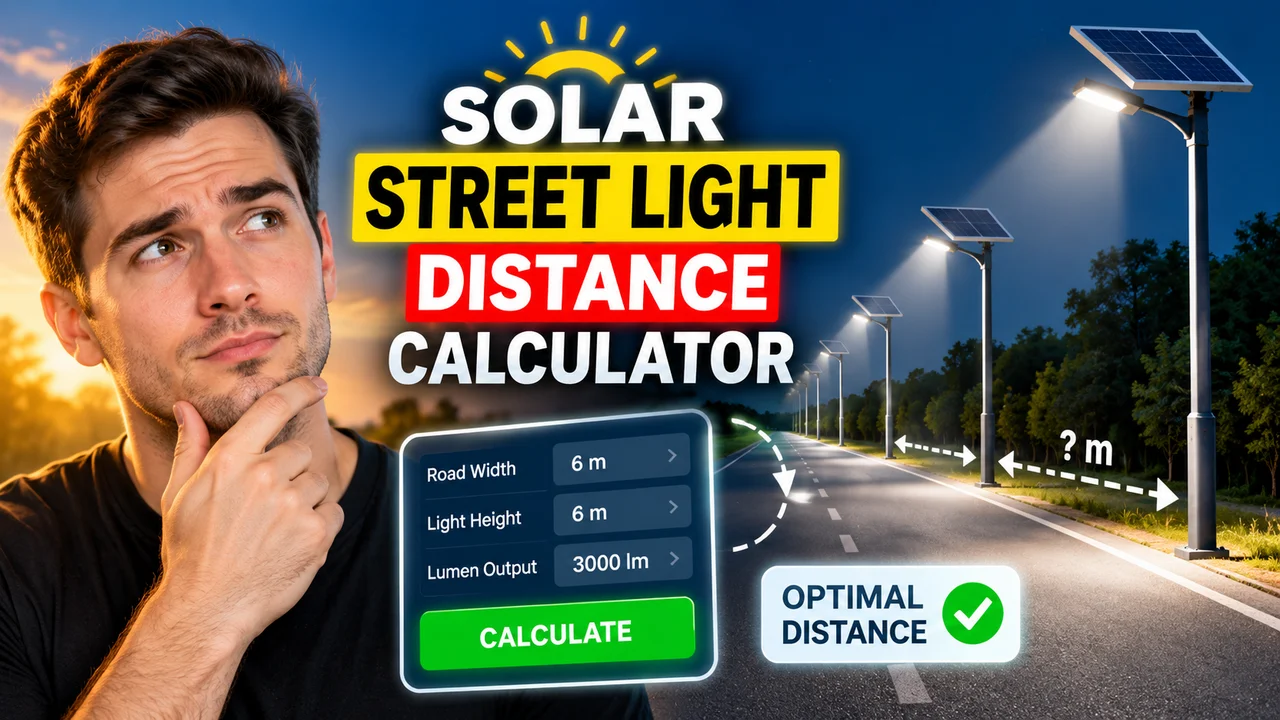
Calculate solar street light spacing from luminaire lumens, utilization, light loss, target illuminance, and road width. Get a planning estimate in feet online.
Please complete this field to continue.
Please complete this field to continue.
Please complete this field to continue.
Please complete this field to continue.
Please complete this field to continue.
Results
Solar Street Light Distance Calculator
TL;DR Summary
The Solar Street Light Distance Calculator estimates the spacing between roadway lighting poles from initial luminaire lumens, coefficient of utilization, light loss factor, target maintained illuminance, and the width of roadway being lit. It is a planning estimate based on a standard roadway lighting spacing equation and should not replace a complete photometric or engineering design. The page does not provide enough information to make a specific claim about how entered data is stored or processed, so avoid entering sensitive information.
About This Tool
The Solar Street Light Distance Calculator helps estimate how far apart solar street light poles may be placed when planning roadway lighting. The key idea is simple: the amount of light produced by the luminaire, the portion of that light that reaches the roadway, expected light losses, the lighting level you need, and the width of roadway being served all affect the calculated spacing.
This calculator is useful for preliminary planning of solar-powered street lighting on roads, access routes, residential streets, paths, parking areas, and similar outdoor applications where a street-lighting layout is being considered. It can help a designer, contractor, property owner, project planner, or other user understand how changes in the lighting inputs affect the estimated distance between successive luminaires.
The calculator asks for five inputs. First, enter the initial luminaire lumens. This should be the initial lumen output of the complete LED luminaire rather than simply the electrical wattage of the solar light. Second, enter the coefficient of utilization (CU) for the roadway. CU describes how effectively the luminaire's light is used over the roadway width and should come from the selected luminaire's photometric information. Third, enter the light loss factor (LLF). This accounts for expected reductions in useful light output over the design period. Fourth, enter the average maintained illuminance you want on the roadway in footcandles. Finally, enter the lighted roadway width in feet.
These inputs are important because luminaire spacing cannot be determined reliably from solar-panel wattage, battery size, or LED wattage alone. A solar street light can have different optical distributions, lumen outputs, mounting arrangements, and maintenance characteristics. The optical performance of the selected luminaire therefore matters when determining roadway spacing.
How to Use
- Step 1: Enter the initial lumen output of the solar street-light luminaire. Use the luminaire's initial photometric rating rather than the electrical wattage.
- Step 2: Enter the coefficient of utilization for the roadway width being illuminated. Use the value provided in the manufacturer's photometric documentation when available.
- Step 3: Enter the light loss factor. This represents the expected reduction in useful lighting output from factors such as lumen depreciation and luminaire dirt depreciation.
- Step 4: Enter the desired average maintained horizontal illuminance in footcandles and the width of roadway being served in feet.
- Step 5: Review the estimated spacing in feet and its metric equivalent in meters. Treat the result as a planning value that needs to be checked against the complete lighting design.
Technical Explanation and Formula
The calculator uses the standard roadway luminaire spacing equation documented by the Federal Highway Administration:
Spacing = (LL × CU × LLF) ÷ (Eh × W)
Where:
- Spacing = estimated distance between successive luminaires, in feet when the inputs use lumens, footcandles, and feet.
- LL = initial luminaire lumens.
- CU = coefficient of utilization for the roadway width.
- LLF = light loss factor.
- Eh = average maintained design horizontal illuminance in footcandles.
- W = width of the lighted roadway in feet.
FHWA describes this equation as a method for calculating roadway luminaire pole spacing. The roadway width should represent the portion of the roadway that the luminaire is intended to light, rather than automatically using the width of an entire multi-lane roadway. :contentReference[oaicite:3]{index=3}
The calculation does not directly use solar-panel capacity, battery capacity, charging efficiency, autonomy, or geographic solar resource. Those are separate parts of solar lighting system design. Solar power affects whether the lighting system can operate as intended, while the spacing calculation focuses on the light delivered to the roadway.
Mounting height also matters in a complete lighting design, even though it is not an independent input to this simplified spacing equation. FHWA notes that mounting height, luminaire distribution, pole placement, spacing, roadway geometry, lighting levels, and uniformity are interrelated. The agency also states that there is no single exact formula for selecting the optimal pole height and luminaire wattage for every roadway. :contentReference[oaicite:4]{index=4}
Illustrative Example
Suppose an illustrative luminaire has 10,000 initial lumens, a CU of 0.70, an LLF of 0.85, a maintained illuminance target of 1.00 footcandle, and a lighted roadway width of 30 feet.
Spacing = (10,000 × 0.70 × 0.85) ÷ (1.00 × 30)
Spacing = 198.3 feet
The metric equivalent is approximately 60.4 meters. This is an example of the calculation method, not a recommendation that every solar street light should be installed at this distance.
What the Result Means
A larger calculated spacing means the entered lighting inputs support a greater distance between successive luminaires under the simplified average-illuminance calculation. Increasing initial lumens, CU, or LLF increases the calculated spacing. Increasing the target illuminance or roadway width decreases the calculated spacing.
This relationship should not be interpreted as permission to increase pole spacing without checking the actual lighting distribution. Two luminaires can have the same lumen output but produce different roadway results because their optical distributions are different. FHWA guidance emphasizes the importance of luminaire distribution and lighting uniformity in roadway design. :contentReference[oaicite:5]{index=5}
Preset Examples / Quick Reference
| Input | Meaning | Unit |
|---|---|---|
| Initial luminaire lumens | Initial light output of the luminaire | lumens |
| CU | Fraction of useful light used for the roadway | dimensionless |
| LLF | Factor accounting for expected light losses | dimensionless |
| Maintained illuminance | Desired average horizontal lighting level | footcandles |
| Roadway width | Width served by the luminaire | feet |
| Calculated spacing | Estimated distance between luminaires | feet and meters |
Why Use This Solar Street Light Distance Calculator & How Our Calculator Beats the Competition
The practical advantage of a dedicated calculator is that it keeps the main roadway-spacing variables together. It is more direct than repeatedly writing the equation by hand, while still leaving the underlying inputs visible so the result can be checked.
| Method | Ease of Use | Calculation Speed | Best For | Limitations |
|---|---|---|---|---|
| Toolhox Calculator | Enter five lighting inputs | Immediate calculation | Quick preliminary spacing estimates | Does not replace complete photometric design |
| Manual Calculation | Requires applying the formula manually | Depends on the user | Checking the equation or doing a single calculation | More opportunity for arithmetic or unit errors |
| Spreadsheet | Requires spreadsheet setup | Fast after setup | Repeating calculations across many scenarios | Requires maintaining formulas and inputs |
| Professional Engineering Software | More involved | Depends on the design workflow | Detailed roadway lighting analysis | Requires detailed project and luminaire information |
Assumptions and Limitations
This calculator is an estimate based on the roadway luminaire spacing equation. It does not perform a complete point-by-point photometric simulation. It also does not select a solar panel, battery, charge controller, pole, luminaire, mounting height, optical distribution, or roadway lighting classification.
The CU value can have a major effect on the result and should come from appropriate photometric information for the selected luminaire and roadway geometry. The LLF should also represent the design assumptions being used. Entering a generic value may produce a useful planning estimate but does not establish that the resulting installation will meet a project's required lighting level or uniformity.
Roadway geometry, pole arrangement, mounting height, luminaire distribution, pavement characteristics, glare, light trespass, intersections, curves, grades, pedestrian areas, and safety requirements can all affect a final lighting design. FHWA specifically notes that pole spacing should be established through lighting calculations and that spacing may need adjustment for driveways, utility conflicts, and other site conditions. :contentReference[oaicite:6]{index=6}
The result should therefore be treated as a preliminary planning estimate. For a public roadway, high-speed road, intersection, pedestrian facility, or project subject to an agency specification, the final layout should be reviewed using the applicable roadway lighting criteria and the actual luminaire's photometric data. FHWA's current lighting guidance emphasizes project-specific lighting calculations rather than a one-size-fits-all approach. :contentReference[oaicite:7]{index=7}