
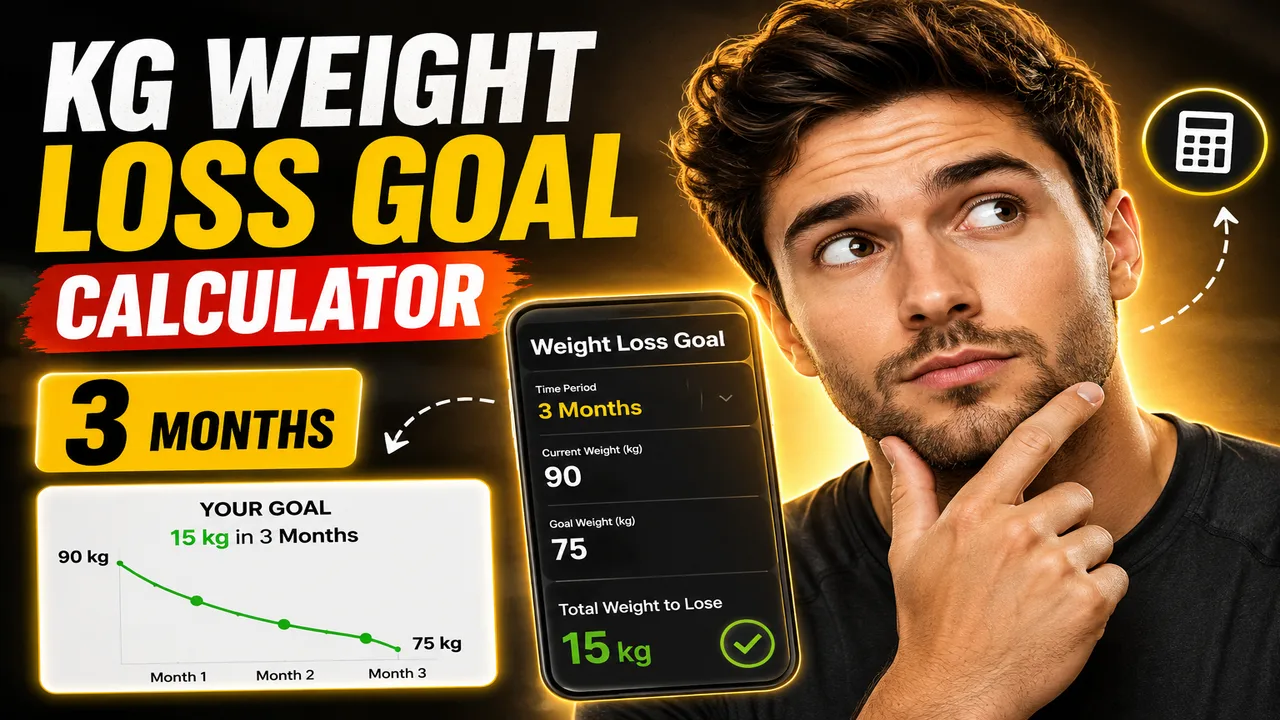
Kg Weight Loss Goal Calculator For 3 Months Online
Quick answer: The Kg Weight Loss Goal Calculator For 3 Months Online is a weight-management calculator designed to help users estimate a target weight change over a three-month period. By comparing a starting weight with a desired goal, users can understand the total kilograms they aim to lose and the approximate weekly and monthly pace required to reach that goal.
Planning a weight-loss goal is easier when a long-term target is divided into smaller, measurable milestones. The Kg Weight Loss Goal Calculator For 3 Months Online is intended for people who want to understand their three-month weight-loss target in kilograms and translate it into a practical time-based estimate.
This page explains the calculation method, demonstrates how a three-month target can be broken down, and provides examples for interpreting the results. The exact input fields and output formatting depend on the calculator's implemented interface; the examples below illustrate the underlying mathematics rather than a verified live-tool output.
Key Takeaways
- Primary purpose: Estimate a planned weight change over three months.
- Main measurements: Starting weight, target weight or planned kilograms to lose, and the planning period.
- Core results: Total weight difference and estimated average monthly and weekly change.
- Best suited for: People who want a measurable weight-management target rather than an undefined goal.
How to Use Kg Weight Loss Goal Calculator For 3 Months Online?
- Identify your starting weight. Record your current body weight in kilograms using a consistent weighing method.
- Set a target. Decide on a target weight or a proposed number of kilograms to lose over the next three months.
- Check the time period. Use approximately three calendar months, or 12 to 13 weeks, when estimating the average pace.
- Interpret the estimate. Review the calculated difference and average rate, then consider whether the target is appropriate for your individual circumstances.
If the live calculator provides additional fields, follow the labels displayed in the interface. Do not assume that it collects age, height, activity level, calorie intake, or medical information unless those fields are actually present.
Input and Output Example
Suppose a person weighs 80 kg and chooses a target weight of 74 kg for a three-month planning period.
Example input
| Parameter | Example value | Meaning |
|---|---|---|
| Starting weight | 80 kg | Weight at the beginning of the plan |
| Target weight | 74 kg | Desired weight at the end of the period |
| Planning period | 3 months | Approximate duration for the estimate |
Example calculation
Total planned weight loss
80 kg − 74 kg = 6 kg
Average monthly weight change
6 kg ÷ 3 months = 2 kg per month
Average weekly weight change
Using 12 weeks as a simplified planning period:
6 kg ÷ 12 weeks = 0.5 kg per week
Illustrative result
| Result | Estimate |
|---|---|
| Total planned loss | 6 kg |
| Average monthly loss | 2 kg per month |
| Average weekly loss | 0.5 kg per week |
These values are mathematical averages, not a prediction that body weight will decrease by the same amount every week. The example does not establish that losing 6 kg is appropriate for every person starting at 80 kg.
Weight Loss Goal Calculator Formula
A basic three-month weight-loss estimate can be calculated using the following formulas.
1. Total planned weight loss
Total loss (kg) = Starting weight (kg) − Target weight (kg)
2. Average monthly weight loss
Monthly average (kg) = Total planned loss (kg) ÷ 3
3. Average weekly weight loss
Weekly average (kg) = Total planned loss (kg) ÷ Number of planning weeks
4. Target weight after a specified change
Target weight (kg) = Starting weight (kg) − Planned loss (kg)
Formula variables
- Starting weight: The initial body weight in kilograms.
- Target weight: The intended body weight at the end of the planning period.
- Total planned loss: The difference between starting and target weights.
- Planning weeks: The number of weeks used for the average-rate calculation. Twelve weeks is a convenient approximation; three calendar months do not always equal exactly 12 weeks.
These formulas describe a simple target-planning calculator. They do not calculate daily energy expenditure, calorie deficits, body-fat percentage, or an individual's medically appropriate weight range.
Three-Month Weight Loss Reference Table
The following table shows how different hypothetical targets translate into average monthly and weekly rates over 12 weeks. It is a mathematical reference, not a recommendation to lose a particular amount of weight.
| Planned loss in 3 months | Monthly average | Weekly average |
|---|---|---|
| 1.5 kg | 0.5 kg | 0.125 kg |
| 3 kg | 1 kg | 0.25 kg |
| 4.5 kg | 1.5 kg | 0.375 kg |
| 6 kg | 2 kg | 0.5 kg |
| 9 kg | 3 kg | 0.75 kg |
| 12 kg | 4 kg | 1 kg |
Actual weight change varies between people and over time. Starting weight, fluid balance, health conditions, medications, nutrition, physical activity, sleep, and other factors may affect the observed trend. A simple arithmetic rate cannot account for all these influences.
How the Three-Month Calculation Works
The calculation begins with a weight difference and distributes that difference across a chosen period. If the calculator accepts starting and target weights, it subtracts the target from the starting value. If it accepts a planned loss directly, it can use that number as the total change.
The monthly average divides the planned change by three. The weekly average divides it by the number of weeks selected for the calculation. Because three calendar months may cover approximately 12 to 13 weeks, a result can differ slightly depending on the period convention used.
For example, a planned loss of 6 kg corresponds to 0.5 kg per week over 12 weeks, but approximately 0.46 kg per week over 13 weeks. Neither average implies a linear biological response. Daily weight readings can fluctuate even when a longer-term trend is moving toward a goal.
Edge Cases and Calculation Limitations
- Target equals starting weight: The planned difference is 0 kg, so the average planned loss is also 0 kg.
- Target exceeds starting weight: Subtracting the target from the starting weight produces a negative loss value. This represents a planned weight increase, not weight loss.
- Zero or negative weight: These are not valid body-weight inputs for ordinary adult weight planning and should not be interpreted as meaningful results.
- Missing or non-numeric values: A calculation requires valid numerical weight inputs. The exact error behavior depends on the implemented tool.
- Different units: Convert pounds to kilograms before using a kilogram-based formula. Do not mix values in different units in the same subtraction.
- Rounding: Keep sufficient precision during the calculation and round only the displayed result. Small rounding differences may occur when weekly averages are shown to a limited number of decimal places.
- Different calendar periods: A three-month span may contain a different number of days or weeks depending on the start date.
Healthy Goal Setting and Medical Considerations
A calculated target is not the same as a medically appropriate target. Suitability depends on individual factors, including current weight, height, age, pregnancy status, medical history, medications, nutritional needs, and whether weight loss is clinically indicated.
The US Centers for Disease Control and Prevention discusses gradual weight loss and notes that people who lose weight at a steady, gradual pace are more likely to keep it off than people who lose weight rapidly. Its guidance is available at CDC: Losing Weight.
For background on adult weight status and the role and limitations of body mass index, consult the National Heart, Lung, and Blood Institute's BMI information. BMI is a screening measure, not a complete diagnosis of individual health.
Do not use a three-month arithmetic estimate as a substitute for medical advice, particularly if you are under 18, pregnant, have a history of disordered eating, have a chronic condition, or are taking medication that affects weight. A qualified healthcare professional or registered dietitian can help determine a suitable goal and monitoring approach.
Frequently Asked Questions
How do I calculate weight loss over three months?
Subtract your target weight from your starting weight to find the total planned loss. Divide that difference by three for an average monthly change, or by 12 or 13 for an approximate weekly average.
How many kilograms can I aim to lose in three months?
There is no single suitable target for everyone. A reasonable goal depends on your starting weight and health circumstances. Use the calculator to understand the mathematics, then assess the target with appropriate professional guidance when needed.
Does the calculator predict my exact weight after three months?
No simple weight-difference formula can predict an exact future measurement. The result represents a planned target or arithmetic average, while actual body weight can vary due to fluid changes, nutrition, activity, and other factors.
Can I calculate weekly and monthly weight-loss averages?
Yes, if you know the total planned weight change. Divide the total by three for a monthly average and by the number of weeks in the planning period for a weekly average.
Why does my weekly weight change differ from the calculator's estimate?
The calculator distributes a planned change evenly across time. Real-world weight readings are not perfectly linear and can fluctuate because of hydration, food intake, digestion, exercise, hormones, and other individual factors.
Can I use pounds instead of kilograms?
The formulas on this page use kilograms. Convert pounds to kilograms by multiplying pounds by 0.45359237, or use a compatible pounds-based calculation without mixing units.
Author
Author Name: Daniel Brooks
Author Description: Health and wellness content specialist focused on explaining weight-management calculations, measurement units, and practical goal-setting concepts.
Technical Review: The arithmetic examples and unit relationships in this guide are presented for clarity. They explain a general three-month weight-change calculation and do not constitute validation of the live calculator's implementation or individualized medical guidance.
Technical Disclaimer: This calculator-style methodology provides arithmetic estimates only. It does not diagnose a health condition or determine whether a weight-loss goal is safe for a specific individual.
