Gsm To Ounces Per Square Yard
Convert grams per square meter (GSM) to ounces per square yard (oz/yd²) using a standard fabric weight conversion.
Please complete this field to continue.
Results
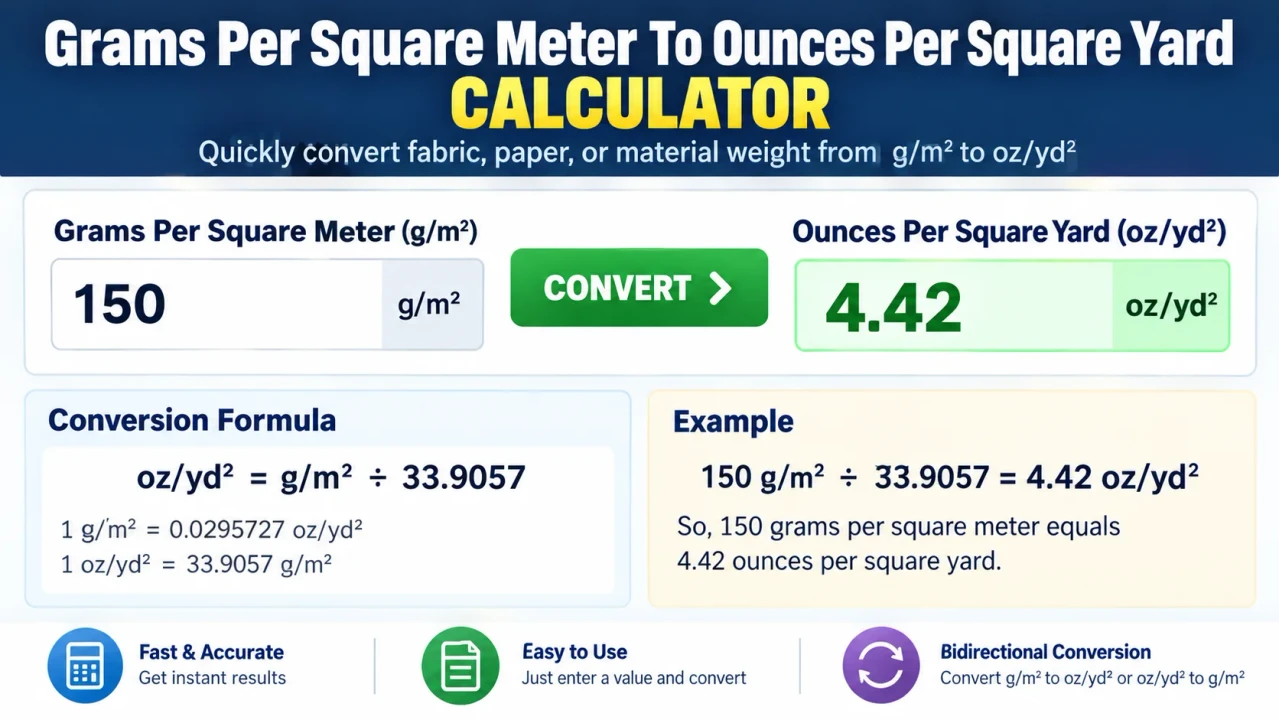
Grams Per Square Meter To Ounces Per Square Yard Calculator
TL;DR Summary
The Grams Per Square Meter To Ounces Per Square Yard Calculator converts fabric or material weight from grams per square meter (GSM or g/m²) to ounces per square yard (oz/yd²). It is intended for quick unit conversion and comparison; results depend on the GSM value entered, and the page does not provide a guarantee of professional textile, manufacturing, or product-specification accuracy.
About This Tool
The Grams Per Square Meter To Ounces Per Square Yard Calculator is a simple unit conversion tool for fabric and other materials whose weight is expressed as mass per unit area. It converts a value in grams per square meter, commonly called GSM, into ounces per square yard, written as oz/yd².
GSM tells you how many grams a one-square-meter area of material weighs. Ounces per square yard describes the same type of measurement using ounces and square yards. Both values measure area weight, so the conversion does not require the fabric width, roll length, or total piece size when the starting value is already expressed in GSM.
This conversion is useful when a supplier, fabric listing, product specification, pattern, or technical document uses a different unit system from the one you normally use. For example, an international fabric supplier may list a material as 200 g/m², while a U.S.-based specification may refer to approximately 5.90 oz/yd². Converting the values to the same unit makes it easier to compare specifications.
The calculator requires one main input: grams per square meter (GSM). Enter the area weight you want to convert. The calculator then returns the equivalent value in ounces per square yard (oz/yd²). The result is displayed to two decimal places.
What Is GSM?
GSM stands for grams per square meter. It is also written as g/m². It describes the mass of a one-square-meter area of material. In textile applications, GSM is commonly used to describe fabric weight.
A higher GSM means more mass per square meter, while a lower GSM means less mass per square meter. However, GSM is not the same thing as thickness. Two fabrics can have similar GSM values while having different thickness, construction, texture, density, or feel.
GSM is therefore best understood as an area-weight measurement rather than a complete description of a fabric's physical properties.
What Is Ounces per Square Yard?
Ounces per square yard, abbreviated as oz/yd², expresses the mass of a square yard of material in ounces. It is another way to describe material weight per unit area.
This distinction matters because a value stated simply as "ounces" does not necessarily mean ounces per square yard. A total piece weight or a weight per linear yard is a different measurement and may require additional information such as material width and length.
How to Use the Calculator
- Step 1: Find the material's weight in grams per square meter (GSM or g/m²).
- Step 2: Enter that GSM value in the calculator input field.
- Step 3: Review the calculated ounces per square yard (oz/yd²) result.
- Step 4: Use the converted value when comparing specifications expressed in different area-weight units.
Technical Explanation and Formula
The standard conversion is:
oz/yd² = GSM ÷ 33.90574744
Where:
- GSM is the material weight in grams per square meter (g/m²).
- oz/yd² is the equivalent material weight in ounces per square yard.
- 33.90574744 is the conversion factor between grams per square meter and ounces per square yard.
The conversion factor comes from the exact relationship between grams and ounces and between square meters and square yards. One ounce is 28.349523125 grams, and one yard is exactly 0.9144 meters. Therefore, one square yard is 0.83612736 square meters. Combining those unit relationships gives approximately 33.90574744 grams per square meter for one ounce per square yard.
For practical use, the calculator divides the entered GSM value by this conversion factor and displays the final result to two decimal places.
Worked Example
Suppose a fabric is listed as 200 g/m².
Calculation:
200 ÷ 33.90574744 = 5.898...
Rounded to two decimal places, the result is:
200 GSM ≈ 5.90 oz/yd²
This means a material specified at 200 grams per square meter has an equivalent area weight of about 5.90 ounces per square yard.
Quick Reference
| GSM | Approx. oz/yd² |
|---|---|
| 50 g/m² | 1.47 oz/yd² |
| 100 g/m² | 2.95 oz/yd² |
| 150 g/m² | 4.42 oz/yd² |
| 200 g/m² | 5.90 oz/yd² |
| 250 g/m² | 7.37 oz/yd² |
| 300 g/m² | 8.85 oz/yd² |
| 350 g/m² | 10.32 oz/yd² |
| 400 g/m² | 11.80 oz/yd² |
Important Unit Distinctions
The calculator converts GSM to ounces per square yard. It does not convert a total fabric weight directly into oz/yd² without knowing the relevant area.
For example, if a supplier tells you that a roll weighs a certain number of ounces, that number alone is not enough to calculate its area weight. You would need enough information to determine the area represented by that weight. Likewise, ounces per linear yard depend on the material width and should not be treated as the same measurement as ounces per square yard.
GSM also should not be confused with fabric thickness, thread count, density in the construction sense, or total roll weight. These are separate properties.
Why Use This Grams Per Square Meter To Ounces Per Square Yard Calculator & How Our Calculator Beats the Competition
| Method | Ease of Use | Calculation Speed | Best For | Limitations |
|---|---|---|---|---|
| Toolhox Calculator | Enter one GSM value | Immediate calculation | Quick GSM-to-oz/yd² conversions | Provides a unit conversion, not a full material analysis |
| Manual Calculation | Requires the formula and conversion factor | Depends on manual calculation | Users who want to calculate by hand | More opportunity for arithmetic or unit-entry mistakes |
| Spreadsheet | Requires a formula setup | Fast after setup | Repeated conversions or custom worksheets | Requires spreadsheet setup and formula maintenance |
| Professional Textile Software | May involve more setup | Depends on the software | Broader textile analysis and production workflows | May provide functionality beyond what is needed for a simple unit conversion |
The main practical benefit of this calculator is that the user only needs the GSM value. The conversion factor is applied automatically, so there is no need to repeatedly write out the conversion formula for a simple GSM-to-oz/yd² calculation.
When This Conversion Is Useful
This conversion can help when comparing fabric specifications from suppliers that use different measurement systems. It can also help when reading product descriptions, technical specifications, sewing information, textile documents, or material listings that use either metric or U.S.-style area-weight units.
For example, if one supplier lists fabric at 180 GSM and another lists fabric at 5.31 oz/yd², converting both values to the same unit can make the specifications easier to compare. The conversion changes the unit, not the underlying material.
Assumptions and Limitations
- The input is assumed to be an area weight expressed in grams per square meter.
- The output is ounces per square yard, not ounces per linear yard or the total weight of a fabric piece.
- The calculation does not determine fabric thickness, weave, stiffness, drape, durability, fiber content, or quality.
- The result is rounded to two decimal places for display.
- Rounding the displayed result can create a small difference if the value is later converted back to GSM.
- The calculator does not account for supplier-specific measurement conventions that use a different area basis.
- If a specification says only "oz" without stating the area basis, confirm what the supplier means before using this conversion.
For purchasing, manufacturing, quality control, or contractual specifications, use the supplier's stated measurement method and verify important values against the original specification or physical measurement. The calculator is intended to support unit conversion and comparison, not replace a required material test or professional review.
Privacy and Input Safety
The supplied tool specification does not establish a specific data-storage or server-processing policy. Avoid entering sensitive or confidential information unless the page clearly explains how submitted information is handled. The calculator only requires a numeric GSM value for the stated conversion.