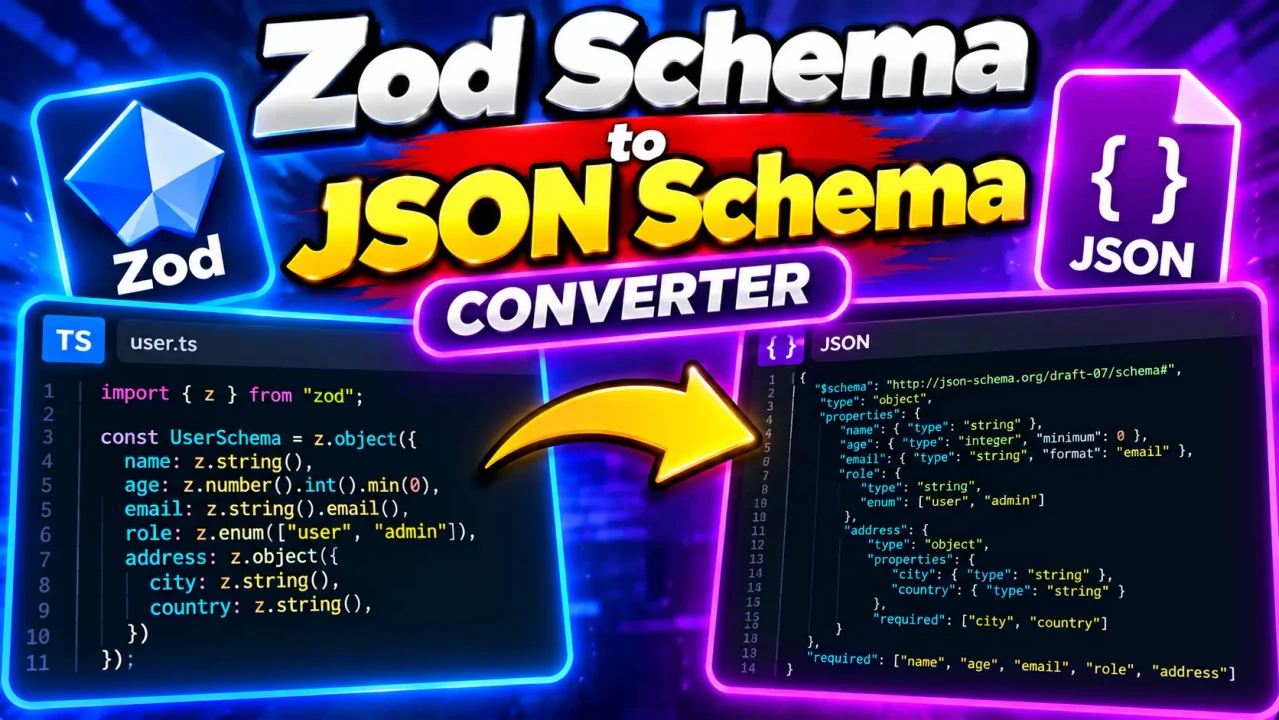
Zod Schema To Json Schema Converter
Quick answer: The Zod Schema To Json Schema Converter is a developer utility intended to transform Zod schema definitions into JSON Schema representations. It helps developers translate validation rules expressed with Zod into a schema format used for describing and validating JSON data. The exact supported Zod features, conversion options, and output dialect depend on the converter's implementation.
Zod and JSON Schema solve related problems but use different representations. Zod is a TypeScript-first schema validation library that lets developers define data structures and validate values in JavaScript or TypeScript. JSON Schema is a vocabulary for describing the structure, constraints, and accepted values of JSON documents.
The Zod Schema To Json Schema Converter bridges these representations by translating recognizable schema definitions into corresponding JSON Schema keywords. This can be useful when a TypeScript application needs to share data contracts with an API, document a JSON payload, or integrate with software that consumes JSON Schema.
Key Takeaways
- Input: A Zod schema definition, subject to the converter's input interface.
- Output: A JSON Schema representation of supported schema constraints.
- Primary audience: TypeScript developers, API engineers, and teams maintaining shared data contracts.
- Important distinction: Conversion does not automatically guarantee that every Zod behavior has an equivalent JSON Schema representation.
Why Convert Zod Schemas to JSON Schema?
Zod schemas are commonly used directly in TypeScript applications. However, external systems may need a language-independent description of the same data structure. JSON Schema provides a standardized way to express many common constraints without requiring the consumer to execute Zod code.
For example, a Zod object can describe a customer's name, email address, and age. A JSON Schema representation can express the corresponding object properties, data types, required fields, and supported constraints. This makes the schema easier to share with compatible API tooling, documentation systems, and JSON validation libraries.
Conversion is particularly useful when:
- You maintain TypeScript data models and need JSON Schema artifacts.
- You want to describe JSON request or response payloads for another application.
- You need to inspect how Zod constraints are represented in a declarative schema.
- You are integrating TypeScript validation definitions with tools that accept JSON Schema.
How to Use Zod Schema To Json Schema Converter?
The exact controls depend on the deployed converter interface. The following workflow describes the general conversion process rather than asserting unverified interface features.
- Prepare the schema: Identify the Zod definition you want to represent in JSON Schema.
- Provide the input: Enter or supply the schema using the input method supported by the tool.
- Run the conversion: Apply the converter to translate supported schema constructs.
- Review the output: Inspect the generated JSON Schema and verify important constraints against the original Zod definition.
What should the input describe?
A useful starting point is a simple Zod object containing primitive fields and explicit constraints. Begin with common constructs such as strings, numbers, booleans, objects, arrays, and required properties before testing more advanced schema features.
What does the output mean?
The output is a JSON Schema document or schema definition intended to describe the accepted JSON data. Depending on the selected JSON Schema dialect and the constructs supported by the converter, the output may use keywords such as type, properties, required, items, minimum, maximum, and format.
Zod to JSON Schema: Input and Output Example
The following illustrative example shows how a simple Zod schema can be represented in JSON Schema. It demonstrates the conceptual mapping; it is not a verified capture of this particular tool's output.
Input: Zod schema
import { z } from "zod";

const ProductSchema = z.object({
  name: z.string(),
  price: z.number().positive(),
  inStock: z.boolean(),
  tags: z.array(z.string())
});
Illustrative output: JSON Schema
{
  "type": "object",
  "properties": {
    "name": {
      "type": "string"
    },
    "price": {
      "type": "number",
      "exclusiveMinimum": 0
    },
    "inStock": {
      "type": "boolean"
    },
    "tags": {
      "type": "array",
      "items": {
        "type": "string"
      }
    }
  },
  "required": [
    "name",
    "price",
    "inStock",
    "tags"
  ],
  "additionalProperties": false
}
This example illustrates several common relationships:
z.string()corresponds to a JSON Schema string type.z.number().positive()can be represented using a numeric type and an exclusive lower bound.z.boolean()corresponds to a boolean type.z.array(z.string())corresponds to an array whose items are strings.- Object field requirements can be expressed through the JSON Schema
requiredarray.
Important: The example includes additionalProperties: false as an illustrative object constraint. Do not assume the converter emits it automatically. Verify the actual output and whether the original Zod schema rejects unknown object properties.
Zod and JSON Schema Mapping Reference
The table below describes common conceptual mappings. Exact output depends on the conversion library, Zod version, JSON Schema dialect, and available configuration.
| Zod construct | Typical JSON Schema representation | Important consideration |
|---|---|---|
z.string() |
{"type":"string"} |
String validation rules may require additional keywords. |
z.number() |
{"type":"number"} |
Integer-only behavior requires separate consideration. |
z.boolean() |
{"type":"boolean"} |
Represents JSON boolean values. |
z.array(z.string()) |
{"type":"array","items":{"type":"string"}} |
Array length constraints may require additional keywords. |
z.object({...}) |
{"type":"object","properties":{...}} |
Required fields and unknown-property handling must be checked. |
z.enum(["draft","published"]) |
{"enum":["draft","published"]} |
Literal choices can often be expressed as an enumeration. |
z.literal("active") |
{"const":"active"} |
Keyword support depends on the target JSON Schema dialect. |
z.string().min(3) |
{"type":"string","minLength":3} |
String length constraints have direct counterparts. |
z.number().min(1) |
{"type":"number","minimum":1} |
The boundary is inclusive. |
z.number().max(100) |
{"type":"number","maximum":100} |
The boundary is inclusive. |
How the Conversion Works
Conceptually, a Zod-to-JSON-Schema converter examines a schema's structure and produces a declarative representation of the constraints that can be expressed in the target dialect. Primitive types map to type keywords, nested objects map to properties, arrays map to item schemas, and supported validation constraints map to keywords or schema composition rules.
The conversion is not necessarily a one-to-one translation. JSON Schema describes JSON data, while Zod can also perform runtime transformations and custom validation in TypeScript. A JSON Schema document cannot automatically reproduce arbitrary JavaScript functions or every behavior applied by a Zod parser.
For reliable integration, compare the generated schema with representative valid and invalid payloads. Where the target system supports JSON Schema validation, validate those payloads against both the original Zod schema and the converted output to identify differences that matter to your application.
Edge Cases and Limitations
Optional and nullable fields
An optional object property and a property that accepts JSON null are different concepts. Optionality generally affects whether a field appears in the object's required list, while nullability affects the values permitted by that field's schema. Check both behaviors in the converted result.
Unions and discriminated unions
Zod union types may require JSON Schema composition keywords such as anyOf or oneOf. The appropriate representation depends on the union's semantics and the converter's implementation. Discriminators may require additional annotations or application-specific conventions.
Defaults and transformations
A Zod default can affect parsing when a value is absent. A JSON Schema default keyword generally documents a suggested value rather than requiring a validator to insert it. Similarly, coercion, preprocessing, and transformations may not be reproducible through a static JSON Schema.
Custom refinements
Custom validation functions can enforce rules that have no direct JSON Schema equivalent. A conversion may omit such rules, represent only part of the constraint, or use implementation-specific extensions. Never assume custom refinements survive conversion without verification.
Unknown properties and object strictness
Object schemas can differ in how they handle unrecognized fields. Inspect keywords such as additionalProperties and, where applicable, unevaluatedProperties. Do not infer strict-object behavior from the presence of type: object alone.
Dialect and version compatibility
JSON Schema keywords vary by dialect. For example, const and certain composition or unevaluated-property features depend on the selected specification version. Confirm which dialect the generated schema targets before supplying it to another validator or API platform.
Invalid or unsupported input
Malformed schema input, unsupported Zod constructs, or incompatible configuration can prevent conversion or produce an incomplete representation. The precise error messages and recovery behavior depend on the actual converter implementation. Review any reported errors and inspect the output before using it in production.
Technical References
- Official Zod documentation — reference for Zod schema construction and validation behavior.
- Official JSON Schema website — reference for JSON Schema specifications, vocabularies, and validation concepts.
Technical Disclaimer: Treat converted schemas as generated artifacts that require review. Validate important constraints, dialect compatibility, and edge cases before using the output as an API contract or replacing existing runtime validation.
Author: Daniel Brooks
Author Description: Software engineer focused on TypeScript, data validation, and developer tooling.
Technical Review: The content explains common Zod-to-JSON-Schema mappings and identifies areas where static schema conversion may differ from runtime validation. The converter's implementation-specific support has not been independently verified.