Voltage Sensitivity Of A Galvanometer Calculator Calculate
Use the Voltage Sensitivity Of A Galvanometer Calculator to calculate deflection per volt from galvanometer angle and applied voltage for physics problems.
Please complete this field to continue.
Please complete this field to continue.
Results
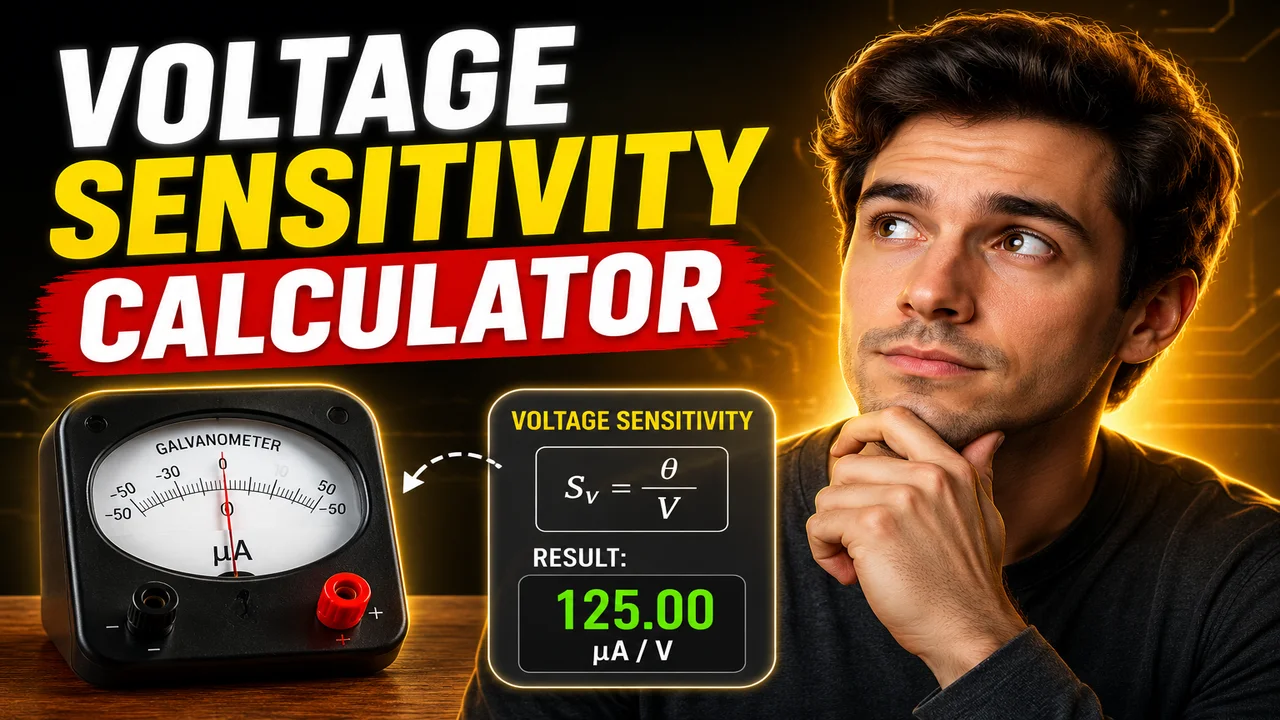
Voltage Sensitivity Of A Galvanometer Calculator
TL;DR Summary
The Voltage Sensitivity Of A Galvanometer Calculator finds a galvanometer's voltage sensitivity by dividing its deflection angle by the voltage applied across it. It is intended for physics study, problem solving, and quick checks; privacy behavior for this page is not specified, so avoid entering sensitive information unless the page explains how submitted data is handled.
About the Voltage Sensitivity Of A Galvanometer Calculator
The Voltage Sensitivity Of A Galvanometer Calculator is a simple physics calculator for finding how much a galvanometer deflects for each volt applied across it. Voltage sensitivity is a useful measure when studying moving-coil galvanometers and the way these instruments respond to electrical potential difference.
A galvanometer is an electrical measuring instrument that produces a mechanical deflection when current flows through its coil. In a basic moving-coil galvanometer, the amount of deflection is related to the current through the instrument. Voltage sensitivity instead expresses the deflection produced for a given voltage. This makes it useful when analyzing a galvanometer as a voltage-sensitive measuring device.
This calculator uses two values: the deflection angle and the voltage across the galvanometer. The deflection angle should be entered in radians, and the voltage should be entered in volts. The calculator then divides the deflection angle by the applied voltage and reports the voltage sensitivity in radians per volt.
What Is Voltage Sensitivity?
Voltage sensitivity is the deflection produced by a galvanometer for one unit of applied voltage. In mathematical form, it is written as the ratio of deflection to voltage. A larger value means that a given voltage produces more angular deflection under the conditions represented by the calculation.
For a moving-coil galvanometer, voltage sensitivity can also be related to current sensitivity and the resistance of the galvanometer. If current sensitivity is known, the standard relationship is Sv = Si/R, where Si is current sensitivity and R is the effective galvanometer resistance. The direct calculation used by this tool, however, only requires deflection and voltage.
What Inputs Do You Need?
The calculator requires two numerical inputs.
- Deflection Angle: Enter the angular deflection of the galvanometer in radians.
- Voltage Across Galvanometer: Enter the potential difference across the galvanometer in volts.
The voltage must be greater than zero because division by zero does not produce a meaningful voltage-sensitivity result. A zero deflection is allowed and produces a sensitivity of zero when a positive voltage is applied.
How to Use the Calculator
- Step 1: Enter the galvanometer's deflection angle in radians.
- Step 2: Enter the voltage applied across the galvanometer in volts.
- Step 3: Select or enter the calculate action provided by the page.
- Step 4: Read the calculated voltage sensitivity in radians per volt.
- Step 5: Check that the input units match the units expected by the formula before using the result in another calculation.
Technical Explanation and Formula
The standard formula for voltage sensitivity is:
Sv = θ / V
where:
- Sv = voltage sensitivity, measured here in radians per volt (rad/V)
- θ = deflection angle, measured in radians (rad)
- V = voltage across the galvanometer, measured in volts (V)
The calculation is direct. First, the calculator reads the deflection angle and voltage. It then divides the deflection angle by the voltage. No intermediate rounding is required. The displayed result is rounded to six decimal places for presentation.
For example, suppose a galvanometer has a deflection angle of 1.57 radians when 15 volts are applied. The calculation is:
Sv = 1.57 / 15 = 0.104666... rad/V
The displayed result would therefore be approximately 0.104667 rad/V.
Understanding the Result
The result tells you how much angular deflection corresponds to one volt under the conditions represented by the inputs. For example, a result of 0.10 rad/V means that the calculated deflection is 0.10 radians for each volt applied, assuming the relationship represented by the calculation remains applicable.
Voltage sensitivity is different from current sensitivity. Current sensitivity describes deflection per unit current, while voltage sensitivity describes deflection per unit voltage. For a galvanometer with effective resistance R, the standard relationship between the two is Sv = Si/R. This is why changing the galvanometer's resistance can affect voltage sensitivity even when current sensitivity is considered separately.
Preset Example
| Deflection Angle | Voltage | Calculation | Voltage Sensitivity |
|---|---|---|---|
| 1.57 rad | 15 V | 1.57 ÷ 15 | 0.104667 rad/V |
This example illustrates the direct nature of the calculation. The values are supplied only to demonstrate the formula and should not be interpreted as a specification for a particular galvanometer.
Common Unit Mistakes
Unit consistency is important. If the deflection is supplied in degrees rather than radians, convert it to radians before applying the formula when the result is required in rad/V. The conversion is:
Radians = Degrees × π / 180
For example, 90 degrees equals π/2 radians. Mixing degrees with a result labeled rad/V without conversion can produce an incorrect numerical result.
The voltage should likewise be entered in volts when the requested result is expressed per volt. If a problem gives voltage in millivolts, convert it first:
Volts = Millivolts / 1000
Why Use This Voltage Sensitivity Of A Galvanometer Calculator & How Our Calculator Beats the Competition
| Method | Ease of Use | Calculation Speed | Best For | Limitations |
|---|---|---|---|---|
| Toolhox Calculator | Enter two values | Immediate calculation | Quick formula checks and study | Uses the direct deflection-to-voltage relationship and does not model a complete galvanometer circuit |
| Manual Calculation | Requires written arithmetic | Depends on the user | Learning the formula step by step | Manual unit and arithmetic errors are possible |
| Spreadsheet Calculation | Requires setup | Fast after setup | Repeated calculations or custom worksheets | Requires a spreadsheet and a correctly configured formula |
| Professional Engineering Software | Usually more setup | Depends on the software and model | Detailed engineering or instrument modeling | May be more complex than needed for a basic formula calculation |
The practical value of this calculator is that the basic relationship is presented as a focused calculation rather than requiring a larger electrical or instrumentation model. It is useful when the deflection angle and voltage are already known and the goal is simply to determine voltage sensitivity.
Assumptions and Limitations
This calculator uses the standard voltage-sensitivity relationship Sv = θ/V. It does not attempt to model every physical characteristic of a real galvanometer. It does not independently determine magnetic field strength, coil area, number of turns, torsional constant, or resistance from the supplied inputs.
The result also depends on the accuracy and units of the values entered. The tool assumes that the deflection angle represents the relevant galvanometer deflection and that the voltage represents the voltage across the galvanometer. If the original problem uses another definition of sensitivity, a different measurement convention, or additional circuit components, the direct formula may not represent the complete problem.
For textbook exercises, the formula can be useful for checking arithmetic and understanding the relationship between deflection and voltage. For laboratory measurements, instrument calibration, circuit design, or other situations where measurement decisions matter, use the appropriate experimental data, instrument specifications, and engineering procedures rather than relying on this result alone.
The calculator is a mathematical aid, not a replacement for laboratory measurement or detailed galvanometer analysis. Always check the units, definition of sensitivity, and circuit conditions given in the original problem before interpreting the result.