
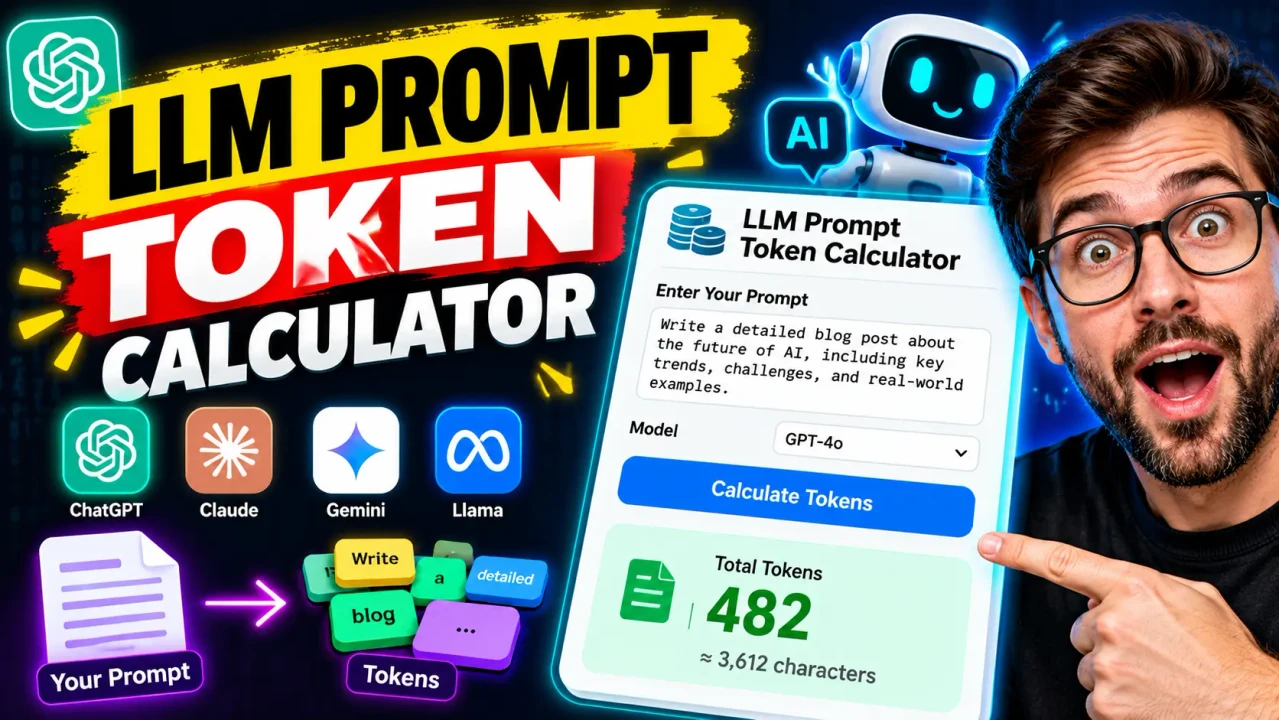
Llm Prompt Token Calculator Online
Quick answer: Llm Prompt Token Calculator Online is a prompt-analysis calculator intended to help users estimate how many tokens a language-model prompt may consume. Token estimates help with prompt-length planning, context-window management, and preliminary API cost calculations.
Language models process text as tokens rather than counting only words or characters. A token may represent a whole word, part of a word, punctuation, or whitespace. Consequently, two prompts with similar word counts can have different token counts.
The Llm Prompt Token Calculator Online is relevant to AI developers, prompt engineers, content creators, researchers, and users who need to understand the approximate size of instructions, questions, and other text sent to a large language model (LLM).
What Can You Use a Prompt Token Calculator For?
- Prompt planning: Estimate the size of instructions, examples, and contextual text before submitting a request.
- Context-window management: Identify prompts that may need shortening to fit a model's available context.
- Cost planning: Use an estimated input-token count as one factor in calculating potential API expenses.
- Prompt optimization: Compare prompt drafts and identify unnecessary repetition or overly long instructions.
- Content preparation: Assess the approximate token size of documentation, articles, code snippets, and other text-based inputs.
The exact features of this calculator, including its tokenizer, model-selection options, output breakdown, and processing method, should be confirmed against the deployed implementation. An estimated count should not be treated as an exact model-specific result unless the calculator uses the corresponding tokenizer.
How to Use Llm Prompt Token Calculator Online?
- Prepare your prompt: Copy the text you plan to submit to your language model. Include relevant instructions and examples when you want to estimate their contribution.
- Enter the text: Paste the prompt into the calculator's text input, if provided.
- Run the calculation: Use the available calculate or count control to request the result.
- Review the estimate: Compare the displayed token count with your model's context limit and intended usage.
- Refine the prompt: Remove redundant wording or repeated context, then recalculate if the interface supports repeated calculations.
Interface controls and available output fields depend on the deployed version of the tool. Do not assume that model selection, file uploads, exports, or automatic cost calculations are available unless they are visible in the actual interface.
Input and Output Example
Consider this short prompt:
Explain photosynthesis in simple terms.
Give three examples and keep the answer under 100 words.
The input is ordinary text containing a request, a formatting instruction, and a length constraint. A token calculator can help estimate the token size of this prompt before it is submitted to a model.
| Field | Example |
|---|---|
| Input | Prompt text shown above |
| Input type | Plain text |
| Expected result | A token count or estimate, depending on implementation |
| Primary use | Prompt-length planning |
No exact token result is asserted here because the calculator's tokenizer and counting implementation have not been established. Exact tokenization depends on the encoding used by the target model.
How Are Prompt Tokens Estimated?
A rough character-based estimate can help users understand prompt size when a model-specific tokenizer is unavailable. For common English text, a frequently used rule of thumb is approximately four characters per token.
Approximate formula:
Estimated tokens ≈ Character count ÷ 4For example, if a prompt contains 1,200 characters:
Estimated tokens ≈ 1,200 ÷ 4
Estimated tokens ≈ 300
This is an illustrative estimate, not a verified output from the Llm Prompt Token Calculator Online. Actual token counts can differ substantially depending on the language, spelling, punctuation, whitespace, code, and tokenizer.
What Affects Token Counts?
| Input characteristic | Effect on tokenization |
|---|---|
| Common English words | Frequently represented efficiently, sometimes as single tokens. |
| Rare or complex words | May be divided into several tokens. |
| Punctuation and whitespace | Can affect how adjacent text is segmented. |
| Source code and symbols | Identifiers, operators, indentation, and syntax can change token counts. |
| Languages other than English | Character-to-token relationships can differ from common English estimates. |
| Conversation structure | Message roles, boundaries, and other request metadata can add tokens beyond visible text. |
For model-specific tokenization, consult the official OpenAI Tokenizer or the relevant model documentation. For programmatic OpenAI text tokenization, the tiktoken library provides an encoding-aware approach.
Token Count, Word Count, and Character Count
These three measurements describe different properties of text. A word counter separates text into words, a character counter measures characters, and a tokenizer segments text according to a model-specific encoding.
| Measurement | What it counts | Best use |
|---|---|---|
| Characters | Text characters, according to the counter's rules | Text-length checks and rough estimates |
| Words | Words according to the counter's word-separation rules | Writing and editorial limits |
| Tokens | Units produced by a tokenizer | Model input sizing and token-based usage planning |
A 500-word prompt does not necessarily use the same number of tokens as another 500-word prompt. The language, vocabulary, symbols, and formatting can all change the result. Token count is therefore the more relevant measurement when planning requests for token-based language models.
Estimating API Usage and Cost
Input-token estimates can contribute to a preliminary API cost calculation, but token count alone does not determine the final charge. Pricing depends on the model, current rates, input and output usage, and any applicable cached-input or other billing categories.
A simplified text-only estimate is:
Estimated input cost =
(Input tokens ÷ 1,000,000) × Input price per million tokens
For illustration, suppose a hypothetical model charges $2 per million input tokens and a request contains an estimated 10,000 input tokens:
Estimated input cost =
(10,000 ÷ 1,000,000) × $2
= $0.02
This example uses an illustrative price, not a current provider rate. Output tokens and other billable components are excluded. Check the provider's current pricing and actual usage records before relying on a budget estimate.
Technical Limitations and Edge Cases
- Approximation versus exact counts: A character-based estimate cannot guarantee the count produced by a particular model's tokenizer.
- Empty input: Empty or whitespace-only text may produce a zero or nonzero count depending on input normalization and implementation.
- Multilingual text: Non-English writing, mixed scripts, and uncommon characters can make rough character-based estimates less reliable.
- Code and structured data: JSON, source code, long identifiers, and symbol-heavy text may tokenize differently from ordinary prose.
- Conversation overhead: A plain-text count may omit message roles, formatting boundaries, tool definitions, or other request structure.
- Multimodal requests: Images, audio, video, and file inputs can require additional model-specific accounting that a plain-text calculator may not support.
- Model context limits: A prompt's estimated token count does not establish whether it fits a particular model's context window or output limits.
For precise API input counts, use the provider's supported token-counting mechanism when available. OpenAI documents a dedicated input-token counting endpoint for supported Responses API inputs, including request structure and supported multimodal content.
Privacy note: The processing location, retention policy, and data-handling behavior of this specific calculator have not been verified. Avoid entering confidential prompts, API keys, passwords, or sensitive personal information unless the deployed tool's privacy practices have been confirmed.
Frequently Asked Questions
Is a prompt token count the same as a word count?
No. Tokens are units produced by a model's tokenizer, while words are counted using word-separation rules. A word may correspond to one or several tokens, depending on its text and encoding.
Can a character count predict the exact number of tokens?
No. Dividing characters by four is only a rough estimate for common English text. Exact counts depend on the tokenizer and the actual input.
Does the token count change between AI models?
It can. Different models may use different tokenization encodings, and complete requests can also include model-specific message formatting or other input components.
Does the prompt token count include the model's response?
A count of the prompt normally concerns input text, not future generated output. Total usage can include input tokens, output tokens, and other applicable token categories.
Can token estimates help calculate API costs?
Yes. An input-token estimate can be multiplied by the applicable input rate to approximate input cost. A complete estimate must also account for output tokens and any other applicable billing categories.
Can a text token calculator count images and files?
Not necessarily. Support depends on the calculator's implementation. Multimodal requests may require a model-specific counting method that accounts for image, file, audio, video, or request-structure tokens.
Is this calculator guaranteed to return exact model token counts?
Exactness cannot be confirmed without knowing the deployed implementation and its tokenizer. For precise counts, use a tokenizer compatible with the target model or the provider's official token-counting interface.
Author Information
Author Name: Daniel Mercer
Author Description: Software engineering and AI developer-tools technical writer focused on language-model workflows, text processing, and API usage concepts.
Technical Review: The explanatory methodology distinguishes rough character-based estimates from model-specific tokenization. The deployed calculator's implementation and output have not been independently verified.
