Voltage Drop Calculator For 48v Dc Solar
Use Voltage Drop Calculator For 48v Dc Solar to estimate cable voltage loss, drop percentage, and load voltage from current, length, wire size, and material.
Please complete this field to continue.
Please complete this field to continue.
Please complete this field to continue.
Please complete this field to continue.
Results
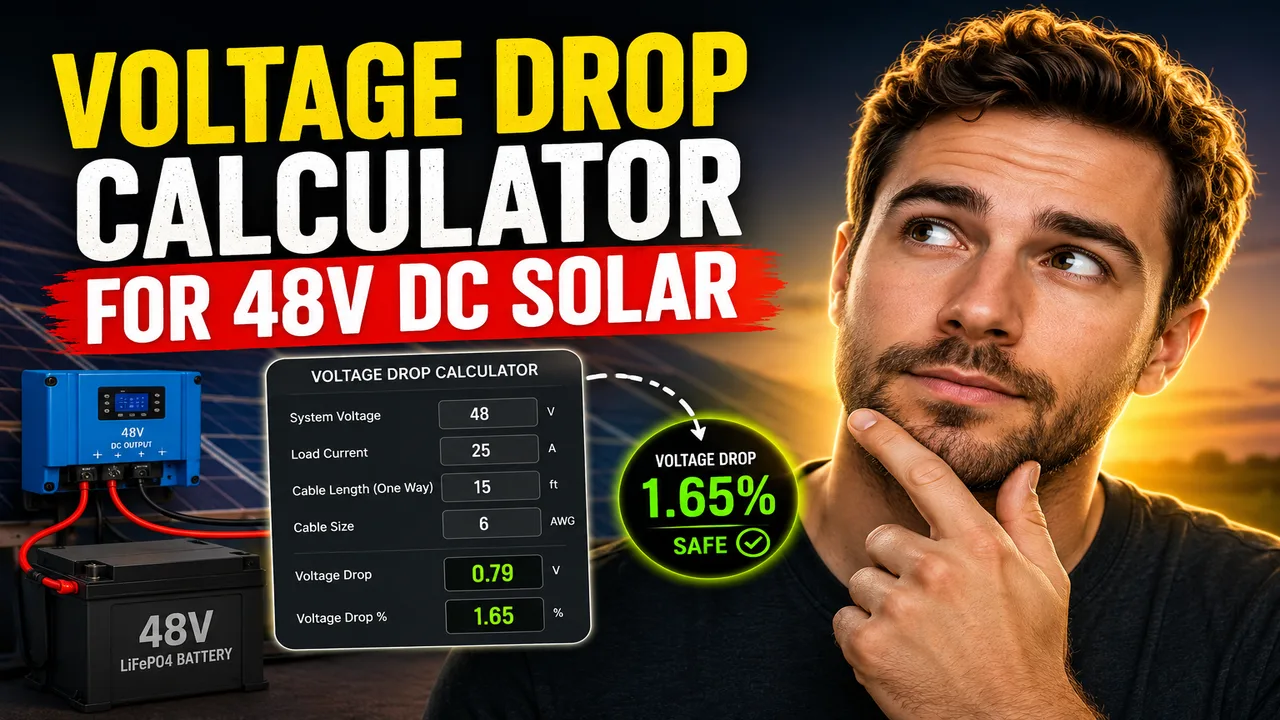
Voltage Drop Calculator For 48v Dc Solar
TL;DR Summary
The Voltage Drop Calculator For 48v Dc Solar estimates the voltage lost in a two-conductor 48 V DC solar cable run from the load current, one-way cable length, wire size, and conductor material. Use the result as an electrical design estimate rather than a complete wire-sizing or code-compliance decision; the supplied tool information does not document how calculator data is stored or transmitted.
What This Tool Does
The Voltage Drop Calculator For 48v Dc Solar is designed to answer a practical question: how much voltage may be lost between a 48 V DC solar power source and the equipment receiving power? Voltage drop matters because every conductor has electrical resistance. When current flows through that resistance, some of the available voltage is lost along the cable.
This tool focuses on a nominal 48 V DC system and a two-wire circuit. It uses the current flowing through the cable, the one-way distance from the source to the load, the conductor size, and the conductor material to estimate the voltage drop. The result is shown in volts, as a percentage of the 48 V nominal system voltage, and as an estimated voltage remaining at the load.
The calculator can be useful for solar installers, electrical designers, DIY solar users, off-grid system builders, battery-system users, and anyone comparing cable sizes for a 48 V DC application. It can also help explain why a long cable run or a high-current load may require a larger conductor.
What You Enter
The calculator uses four inputs. First, enter the load current in amperes (A). This is the current expected to travel through the DC cable. Second, enter the one-way cable length in feet. This is the physical distance from the 48 V source to the load, not the combined length of both conductors.
Third, select the conductor size in American Wire Gauge (AWG). A larger conductor has a larger cross-sectional area and normally produces less resistance and less voltage drop for the same current and distance. Fourth, select the conductor material: copper or aluminum. The calculation uses a different direct-current resistance constant for each material.
What the Calculator Produces
The main result is voltage drop in volts. The calculator also expresses that drop as a percentage of the nominal 48 V system voltage. Finally, it estimates the voltage remaining at the load by subtracting the calculated drop from 48 V.
For example, if a calculation produces a 1.44 V drop, the percentage drop is 1.44 ÷ 48 × 100, or 3.00%. The estimated load voltage would be 48 − 1.44 = 46.56 V. These values describe the calculated electrical loss; they do not by themselves confirm that a particular piece of equipment will operate correctly at that voltage.
How to Use
- Step 1: Enter the expected DC load current in amperes. Use the current that the cable is expected to carry.
- Step 2: Enter the one-way distance from the 48 V source to the load in feet.
- Step 3: Select the conductor's AWG size.
- Step 4: Select copper or aluminum to match the conductor being evaluated.
- Step 5: Review the voltage drop in volts, the voltage-drop percentage, and the estimated voltage at the load.
- Step 6: Compare the result with the requirements of the actual equipment, installation, applicable electrical rules, conductor rating, and system design before selecting or installing the cable.
Technical Explanation and Formula
The standard two-wire DC voltage-drop calculation used here is:
Voltage Drop = (2 × K × I × L) ÷ CM
- Voltage Drop = calculated voltage loss in volts (V).
- K = direct-current conductor constant. The calculation uses 12.9 for copper and 21.2 for aluminum in the cited 75°C method.
- I = load current in amperes (A).
- L = one-way cable length in feet (ft).
- CM = conductor cross-sectional area in circular mils.
- 2 = accounts for the outgoing and return conductors in a two-wire DC circuit.
The conductor's circular-mil area is obtained from the standard AWG diameter relationship. The calculator then uses that area in the voltage-drop equation. This avoids treating a single resistance value as universal for every wire size.
The voltage-drop percentage is calculated as:
Voltage Drop % = (Voltage Drop ÷ 48) × 100
The estimated voltage at the load is:
Load Voltage = 48 − Voltage Drop
The formula is a standard electrical calculation rather than a claim about an undocumented hidden implementation of the named calculator. Standard voltage-drop references describe the same Ohm's-law and circular-mil approaches for DC and single-phase conductor calculations. :contentReference[oaicite:8]{index=8}
Worked Example
Suppose a 48 V solar system supplies 20 A through 100 feet of 10 AWG copper cable in one direction.
For 10 AWG, the circular-mil area is approximately 10,380 CM. Using K = 12.9 for copper:
Voltage Drop = (2 × 12.9 × 20 × 100) ÷ 10,380 ≈ 4.97 V
The estimated percentage drop is:
4.97 ÷ 48 × 100 ≈ 10.35%
The estimated voltage at the load is:
48 − 4.97 ≈ 43.03 V
This example shows why current and cable distance matter strongly in a low-voltage DC system. A higher system voltage can carry the same power with less current, which can reduce voltage-drop losses for a given conductor and distance. NREL notes that voltage, current, distance, temperature, and wire type all affect PV wire-sizing decisions. :contentReference[oaicite:9]{index=9}
Quick Reference
| Input or Result | Unit | Meaning |
|---|---|---|
| Load Current | A | Current carried by the DC cable |
| One-Way Cable Length | ft | Distance from source to load |
| Wire Size | AWG | Conductor size used to calculate cross-sectional area |
| Voltage Drop | V | Estimated voltage lost in the two-wire run |
| Voltage Drop | % | Drop expressed as a percentage of 48 V |
| Estimated Load Voltage | V | 48 V minus the calculated voltage drop |
Why Cable Length and Current Matter
Voltage drop increases as current increases. It also increases as cable length increases because a longer conductor has more resistance. Increasing conductor size generally reduces resistance and therefore reduces voltage drop. NREL's photovoltaic guidance similarly identifies current and distance as important factors in determining conductor size. :contentReference[oaicite:10]{index=10}
This is especially important for 48 V systems because 48 V is much lower than many AC distribution voltages. A few volts can therefore represent a noticeable percentage of the nominal system voltage. The calculator makes that relationship visible by showing both volts and percentage.
Why Use This Voltage Drop Calculator For 48v Dc Solar & How Our Calculator Beats the Competition
| Method | Ease of Use | Calculation Speed | Best For | Limitations |
|---|---|---|---|---|
| Toolhox Calculator | Enter the listed cable and electrical values | Produces the calculation after inputs are supplied | Quick 48 V DC voltage-drop estimates | Does not replace complete electrical design or code review |
| Manual Calculation | Requires the formula and conductor data to be gathered manually | Depends on the person doing the calculation | Learning and independent verification | More opportunity for arithmetic or unit errors |
| Spreadsheet Calculation | Requires a prepared spreadsheet | Fast once the spreadsheet is built | Repeated calculations and custom worksheets | Formula setup and maintenance are required |
| Professional Engineering Software | Usually requires more setup | Depends on the software and model | Detailed system design and engineering analysis | More detailed than a simple voltage-drop estimate |
Assumptions and Limitations
This calculator assumes a nominal 48 V two-conductor DC circuit. It treats the cable run as a simple resistive circuit and uses the selected conductor material and AWG size to estimate resistance. It does not model every real-world factor that can affect conductor resistance or system performance.
Actual cable resistance changes with conductor temperature. Cable construction, conductor type, connection resistance, operating conditions, installation method, and manufacturer specifications can also affect real-world performance. NREL identifies temperature, wire type, current, voltage, and other installation factors as relevant to PV wiring decisions. :contentReference[oaicite:11]{index=11}
The result is also not an ampacity calculation. A cable must be suitable for the expected current, insulation voltage, installation environment, temperature, overcurrent protection, and applicable electrical requirements. A voltage-drop result alone does not establish code compliance or safe installation.
Do not treat a commonly used percentage such as 3% as an automatic legal requirement. The NEC does not specify a general maximum voltage drop for ordinary circuits, and requirements can depend on the particular application. :contentReference[oaicite:12]{index=12}
For a permanent solar installation, battery system, inverter connection, or other safety-critical electrical work, use the calculator as one design check and verify the final conductor selection against applicable requirements and manufacturer instructions. When the system is complex or the result is close to an operating limit, professional electrical review may be appropriate.