Grams To Moles Nacl Calculator
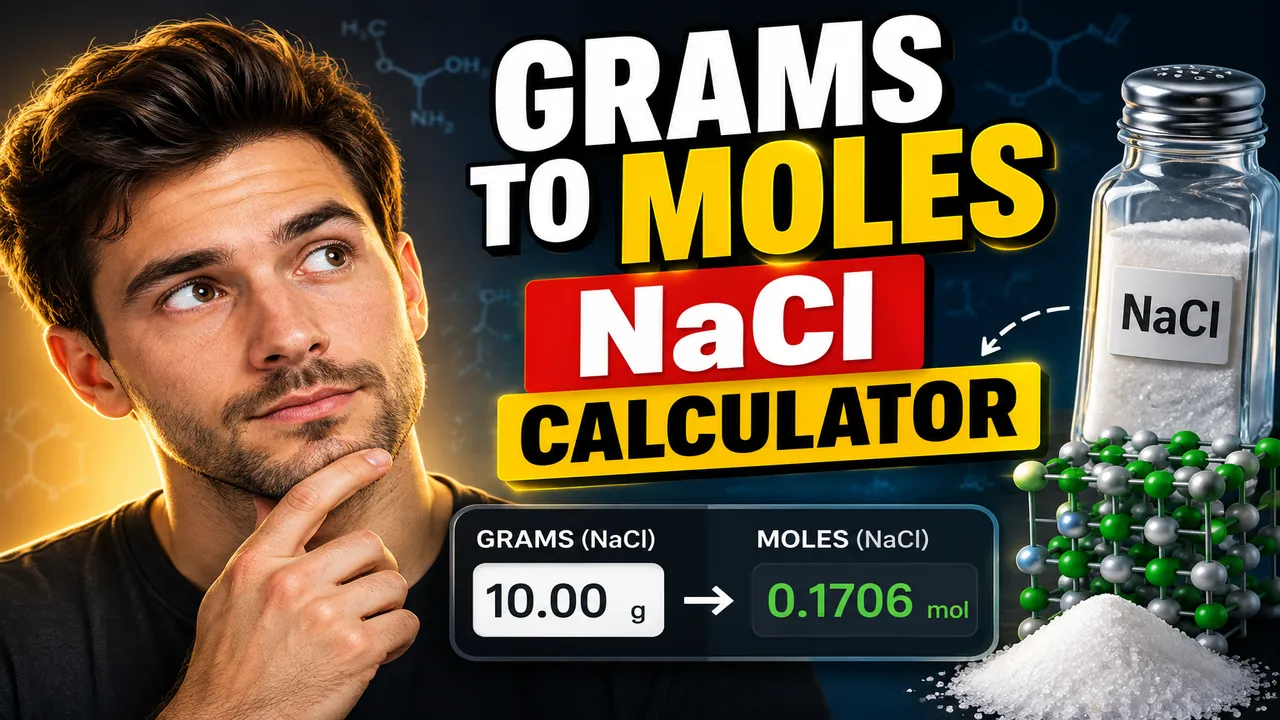
Calculate moles of NaCl from grams using a 58.44 g/mol molar mass. Convert sodium chloride mass to moles for chemistry problems.
Please complete this field to continue.
Results
Grams To Moles Nacl Calculator
TL;DR Summary
The Grams To Moles Nacl Calculator converts a measured mass of sodium chloride (NaCl) in grams into the corresponding amount of substance in moles. It uses the standard grams-to-moles relationship and is intended for quick chemistry calculations; privacy behavior is not specified by the supplied tool information, so avoid entering sensitive information unless the page explains how submitted data is handled.
What Is the Grams To Moles Nacl Calculator?
The Grams To Moles Nacl Calculator is a chemistry conversion tool for finding how many moles of sodium chloride are represented by a given mass in grams. It is useful when a chemistry problem gives you a mass of NaCl but requires the answer in moles.
Sodium chloride, commonly called table salt, has the chemical formula NaCl. In chemistry, grams and moles measure different things. Grams describe mass, while moles describe the amount of a substance. Converting between these units is a basic step in many chemistry calculations, including stoichiometry, solution preparation, reaction calculations, and laboratory work.
The calculator requires one main input: the mass of NaCl in grams. After you enter the mass, the calculator divides it by the molar mass of sodium chloride, which is treated here as 58.44 grams per mole (g/mol). The result is the corresponding amount of NaCl in moles.
Who Can Use This Calculator?
This tool can be useful for students, teachers, laboratory learners, and anyone working through basic chemistry calculations involving sodium chloride. It can also serve as a quick reference when checking a manual calculation.
For students, the calculator can help with homework practice and stoichiometry exercises. For laboratory work, it can provide a quick conversion from a known NaCl mass to an amount in moles. Users should still follow the measurement, rounding, and reporting rules required by their course, laboratory, institution, or experiment.
What Input Do You Need?
The calculator uses one required input:
- Mass of NaCl: Enter the amount of sodium chloride in grams.
The value should represent sodium chloride itself. If your starting material contains impurities, water, or another substance, the simple conversion may not represent the actual amount of pure NaCl.
The calculator does not require you to enter the molar mass. The molar mass is a fixed value used by the calculation. This keeps the input focused on the quantity you want to convert.
What Does the Calculator Produce?
The main result is the amount of NaCl in moles, shown in mol. The calculator also displays the NaCl molar mass used for the conversion so that the calculation is easier to review.
For example, if you enter 58.44 grams of NaCl, the result is 1 mole of NaCl because 58.44 grams represents one molar mass of sodium chloride.
How to Use the Grams To Moles Nacl Calculator
- Step 1: Measure or identify the mass of sodium chloride you want to convert.
- Step 2: Enter that mass in the Mass of NaCl (grams) field.
- Step 3: Run the calculation to convert the mass into moles.
- Step 4: Read the displayed result in moles and check the molar mass shown with the result.
- Step 5: Apply the rounding and significant-figure rules required by your chemistry assignment or laboratory procedure.
Technical Explanation and Formula
The standard calculation for converting grams to moles is:
moles = mass in grams ÷ molar mass in grams per mole
For sodium chloride, the calculator uses:
n = m ÷ 58.44
Where:
- n = amount of NaCl in moles (mol)
- m = mass of NaCl in grams (g)
- 58.44 g/mol = molar mass of NaCl
The units cancel correctly:
g ÷ (g/mol) = mol
This means that dividing a sodium chloride mass in grams by 58.44 grams per mole produces an amount in moles.
Worked Example
Suppose you have 29.22 g of NaCl.
Using the standard formula:
moles = 29.22 g ÷ 58.44 g/mol
moles = 0.500000 mol
So, 29.22 grams of NaCl corresponds to 0.5 mol of NaCl using the molar mass applied by this calculator.
| NaCl Mass | Calculation | Amount of NaCl |
|---|---|---|
| 58.44 g | 58.44 ÷ 58.44 | 1 mol |
| 29.22 g | 29.22 ÷ 58.44 | 0.5 mol |
| 116.88 g | 116.88 ÷ 58.44 | 2 mol |
Understanding Molar Mass
Molar mass is the mass of one mole of a substance. For NaCl, it comes from the atomic masses of sodium and chlorine. The calculator uses 58.44 g/mol as the molar mass for sodium chloride.
Understanding molar mass is important because it provides the link between the laboratory unit of mass and the chemistry unit of amount of substance. Once the mass and molar mass are known, the conversion requires only division.
Rounding and Significant Figures
The calculator displays the calculated mole value to six decimal places. That display precision is not necessarily the same as the correct number of significant figures for every chemistry problem.
If your measured mass has a limited number of significant figures, your final reported answer may need to be rounded accordingly. For example, a laboratory assignment may require the answer to match the precision of the measured mass. Always follow the reporting instructions for the specific problem.
Important Assumptions
- The entered mass represents sodium chloride.
- The mass is entered in grams.
- The conversion uses a NaCl molar mass of 58.44 g/mol.
- The calculation is a direct mass-to-amount conversion and does not perform a broader chemical reaction or stoichiometric analysis.
- The displayed decimal result may need additional rounding based on significant figures.
What This Calculator Does Not Determine
The Grams To Moles Nacl Calculator does not determine solution concentration, reaction yield, limiting reactant, molarity, or the mass of another chemical. Those calculations require additional information.
For example, if you need molarity, you also need the volume of the solution. The formula for molarity is different from the direct grams-to-moles conversion. Likewise, if you are calculating the amount of another substance in a chemical reaction, you need the balanced chemical equation and the relevant mole ratio.
Why Use This Grams To Moles Nacl Calculator & How Our Calculator Compares
| Method | Ease of Use | Calculation Process | Best For | Limitations |
|---|---|---|---|---|
| Toolhox Calculator | Enter one mass value | Uses grams ÷ 58.44 g/mol | Quick NaCl mass-to-mole conversions | Limited to the stated NaCl conversion |
| Manual Calculation | Requires a formula and calculator | User performs the division | Learning the conversion method | More opportunity for input or arithmetic errors |
| Spreadsheet Calculation | Requires a spreadsheet setup | Formula must be entered into a cell | Repeated calculations or custom worksheets | Requires setup and formula management |
| Professional Chemistry Software | Varies by software | May support broader chemical calculations | Complex chemistry workflows | May provide more features than needed for a simple conversion |
The practical advantage of a dedicated calculator is that the conversion formula and NaCl molar mass are already defined for the stated task. A manual calculation gives you more direct practice with the formula, while a spreadsheet can be useful when the same conversion must be repeated for many entries. More advanced chemistry software may be appropriate when a calculation involves reactions, concentrations, equilibrium, or other variables outside a simple mass-to-moles conversion.
Assumptions and Limitations
This tool should be treated as a calculation aid rather than a complete chemistry analysis system. The result depends on the mass you enter and the molar mass used by the calculator. It does not determine whether a sample is pure NaCl or whether a measurement was made correctly.
If your sample is not pure sodium chloride, dividing its total sample mass by the molar mass of NaCl may not give the true amount of NaCl present. A purity value or composition analysis would be needed for that situation.
The calculator also does not replace a balanced chemical equation when you are solving a stoichiometry problem. A grams-to-moles conversion is often one step in a larger calculation. You may need additional conversions between moles, molecules, atoms, solution volume, or other reactants and products.
For laboratory work, use the measured mass, appropriate significant figures, and the procedures required by your laboratory or institution. For high-stakes experimental work, verify the calculation independently before using the result.
Quick Reference
- Input: NaCl mass in grams
- Molar mass used: 58.44 g/mol
- Formula: moles = grams ÷ 58.44
- Output: Amount of NaCl in moles
- Example: 58.44 g NaCl = 1 mol NaCl
In short, the Grams To Moles Nacl Calculator handles a focused chemistry conversion: it takes a sodium chloride mass in grams and converts that value to moles using the standard mass-to-moles relationship. It is useful when you need a direct conversion, while more involved chemistry problems may require additional formulas and information.